 Add to Chrome
 Add to Firefox
 Add to Edge
Interpreting Neural Combinatorial Optimization via Evolving Programmatic Bottlenecks
Jun 18, 2026
Neural Combinatorial Optimization (NCO) achieves strong performance, yet its black-box nature remains a key roadblock to deployment and scientific diagnosis. Standard interpretability tools, such as Concept Bottleneck Models (CBMs), are ill-equipped for NCO, whose decisions are dynamic, state-dependent, and lack proper concept vocabulary definition. To close this gap, we introduce Evolving Programmatic Bottlenecks (EPB), to our knowledge, the first framework for interpreting NCO policies by distilling black-box NCO models into human-readable program portfolios. EPB employs an LLM to autonomously evolve a bank of programs, where each program's per-step action distribution serves as the bottleneck. EPB works through an iterative framework: Block I fixes program bank capacity and introduces a hybrid textual-numerical gradient descent scheme that couples numerical gradients for student router updates and textual gradients for LLM-based program revision; Block II dynamically adapts bank capacity via fault-targeted expansion and redundancy pruning. Extensive experiments demonstrate EPB's effectiveness and broad applicability, where the distilled program portfolios largely match original performance. EPB also reveals that NCO behavior shifts across optimization stages and can be approximated as a composition of classic heuristic variants. Our work advances interpretable NCO and establishes EPB as a promising tool for interpreting sequential decision-making models.

Know Unreported Roadway Incidents in Real-time: A Deep Learning Framework for Early Traffic Anomaly Detection
Dec 14, 2024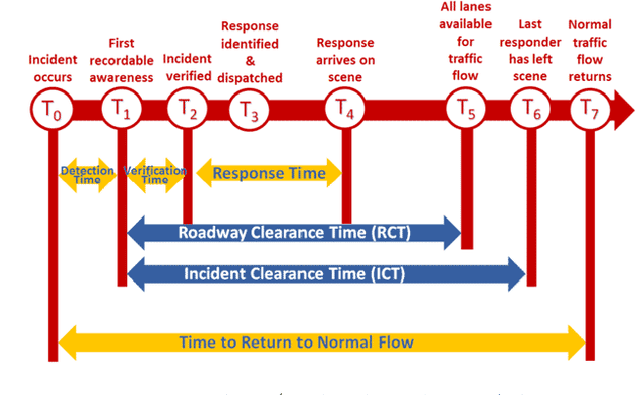

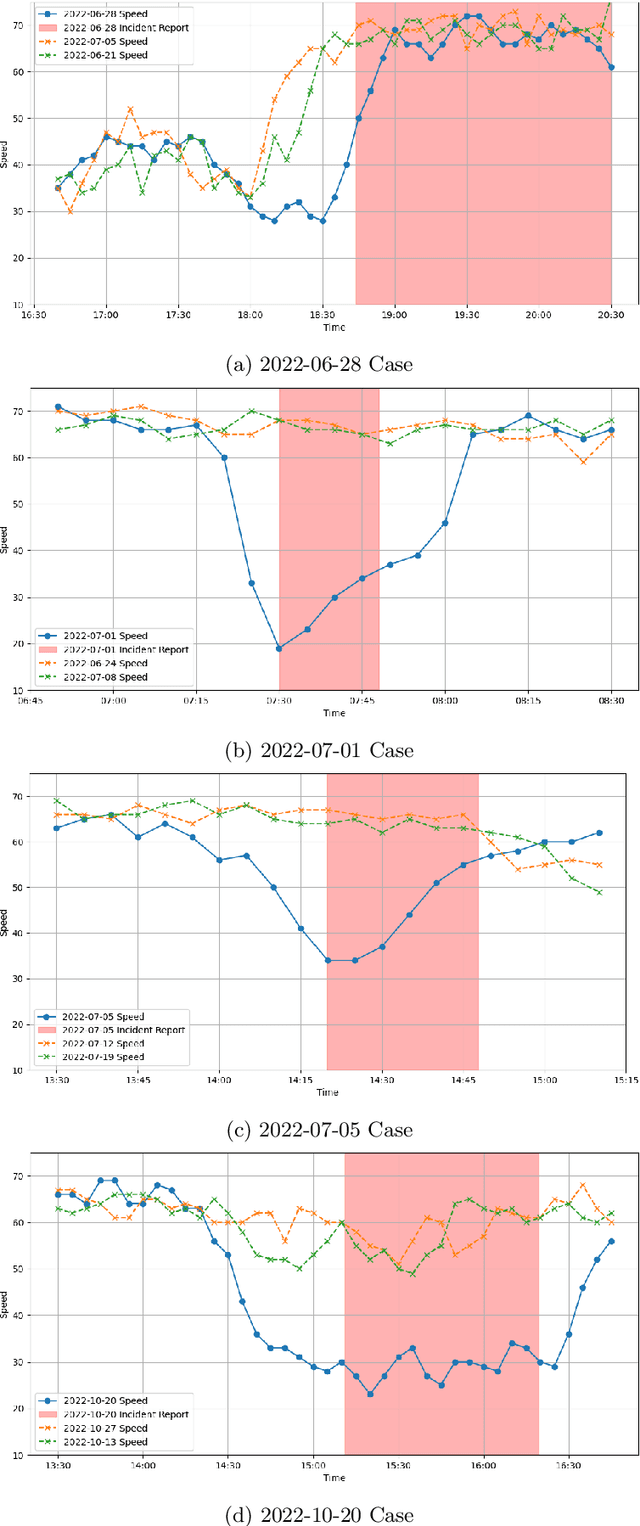

Conventional automatic incident detection (AID) has relied heavily on all incident reports exclusively for training and evaluation. However, these reports suffer from a number of issues, such as delayed reports, inaccurate descriptions, false alarms, missing reports, and incidents that do not necessarily influence traffic. Relying on these reports to train or calibrate AID models hinders their ability to detect traffic anomalies effectively and timely, even leading to convergence issues in the model training process. Moreover, conventional AID models are not inherently designed to capture the early indicators of any generic incidents. It remains unclear how far ahead an AID model can report incidents. The AID applications in the literature are also spatially limited because the data used by most models is often limited to specific test road segments. To solve these problems, we propose a deep learning framework utilizing prior domain knowledge and model-designing strategies. This allows the model to detect a broader range of anomalies, not only incidents that significantly influence traffic flow but also early characteristics of incidents along with historically unreported anomalies. We specially design the model to target the early-stage detection/prediction of an incident. Additionally, unlike most conventional AID studies, we use widely available data, enhancing our method's scalability. The experimental results across numerous road segments on different maps demonstrate that our model leads to more effective and early anomaly detection. Our framework does not focus on stacking or tweaking various deep learning models; instead, it focuses on model design and training strategies to improve early detection performance.
Interpretable mixture of experts for time series prediction under recurrent and non-recurrent conditions
Sep 05, 2024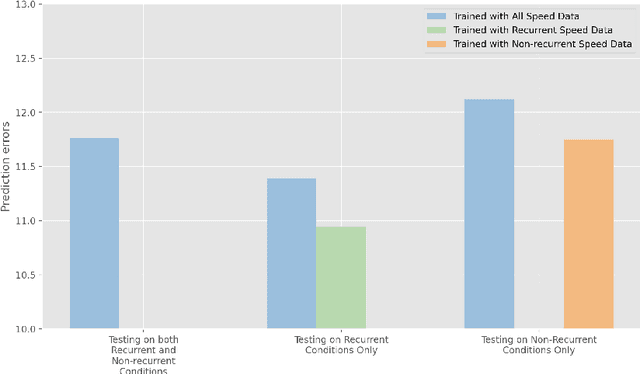
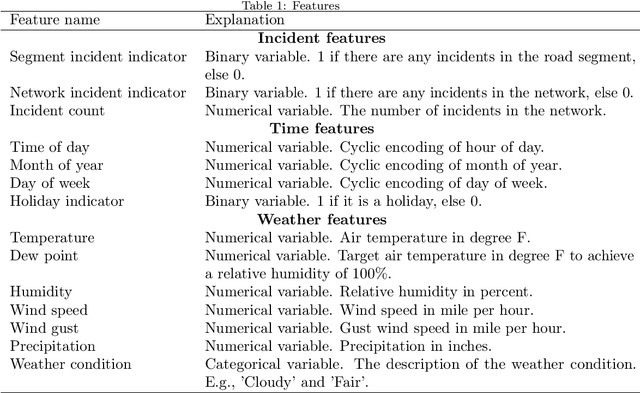
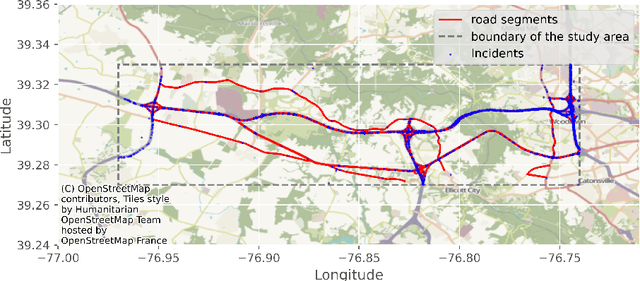
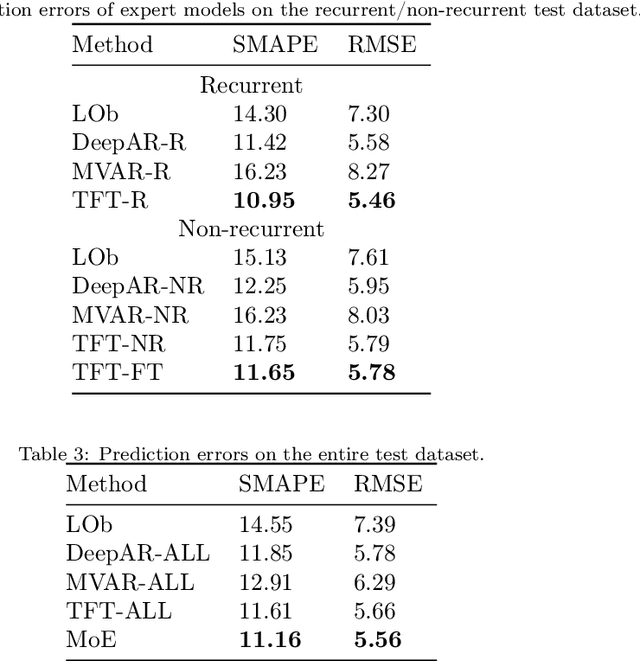
Non-recurrent conditions caused by incidents are different from recurrent conditions that follow periodic patterns. Existing traffic speed prediction studies are incident-agnostic and use one single model to learn all possible patterns from these drastically diverse conditions. This study proposes a novel Mixture of Experts (MoE) model to improve traffic speed prediction under two separate conditions, recurrent and non-recurrent (i.e., with and without incidents). The MoE leverages separate recurrent and non-recurrent expert models (Temporal Fusion Transformers) to capture the distinct patterns of each traffic condition. Additionally, we propose a training pipeline for non-recurrent models to remedy the limited data issues. To train our model, multi-source datasets, including traffic speed, incident reports, and weather data, are integrated and processed to be informative features. Evaluations on a real road network demonstrate that the MoE achieves lower errors compared to other benchmark algorithms. The model predictions are interpreted in terms of temporal dependencies and variable importance in each condition separately to shed light on the differences between recurrent and non-recurrent conditions.