 Add to Chrome
 Add to Firefox
 Add to Edge
Multiplicative Orthogonal Sequential Editing for Language Models
Jan 11, 2026
Knowledge editing aims to efficiently modify the internal knowledge of large language models (LLMs) without compromising their other capabilities. The prevailing editing paradigm, which appends an update matrix to the original parameter matrix, has been shown by some studies to damage key numerical stability indicators (such as condition number and norm), thereby reducing editing performance and general abilities, especially in sequential editing scenario. Although subsequent methods have made some improvements, they remain within the additive framework and have not fundamentally addressed this limitation. To solve this problem, we analyze it from both statistical and mathematical perspectives and conclude that multiplying the original matrix by an orthogonal matrix does not change the numerical stability of the matrix. Inspired by this, different from the previous additive editing paradigm, a multiplicative editing paradigm termed Multiplicative Orthogonal Sequential Editing (MOSE) is proposed. Specifically, we first derive the matrix update in the multiplicative form, the new knowledge is then incorporated into an orthogonal matrix, which is multiplied by the original parameter matrix. In this way, the numerical stability of the edited matrix is unchanged, thereby maintaining editing performance and general abilities. We compared MOSE with several current knowledge editing methods, systematically evaluating their impact on both editing performance and the general abilities across three different LLMs. Experimental results show that MOSE effectively limits deviations in the edited parameter matrix and maintains its numerical stability. Compared to current methods, MOSE achieves a 12.08% improvement in sequential editing performance, while retaining 95.73% of general abilities across downstream tasks. The code is available at https://github.com/famoustourist/MOSE.

Perturbation-Restrained Sequential Model Editing
May 27, 2024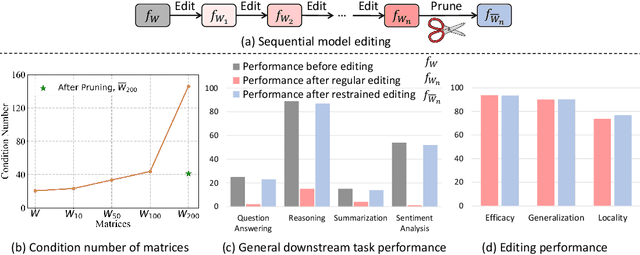
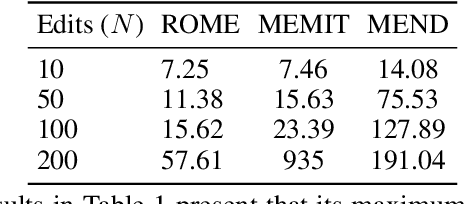
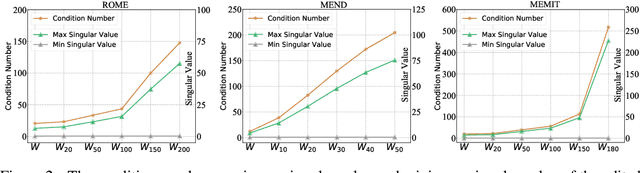

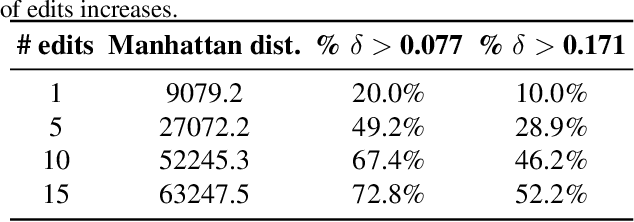
Model editing is an emerging field that focuses on updating the knowledge embedded within large language models (LLMs) without extensive retraining. However, current model editing methods significantly compromise the general abilities of LLMs as the number of edits increases, and this trade-off poses a substantial challenge to the continual learning of LLMs. In this paper, we first theoretically analyze that the factor affecting the general abilities in sequential model editing lies in the condition number of the edited matrix. The condition number of a matrix represents its numerical sensitivity, and therefore can be used to indicate the extent to which the original knowledge associations stored in LLMs are perturbed after editing. Subsequently, statistical findings demonstrate that the value of this factor becomes larger as the number of edits increases, thereby exacerbating the deterioration of general abilities. To this end, a framework termed Perturbation Restraint on Upper bouNd for Editing (PRUNE) is proposed, which applies the condition number restraints in sequential editing. These restraints can lower the upper bound on perturbation to edited models, thus preserving the general abilities. Systematically, we conduct experiments employing three popular editing methods on three LLMs across four representative downstream tasks. Evaluation results show that PRUNE can preserve considerable general abilities while maintaining the editing performance effectively in sequential model editing. The code and data are available at https://github.com/mjy1111/PRUNE.
Model Editing Can Hurt General Abilities of Large Language Models
Jan 09, 2024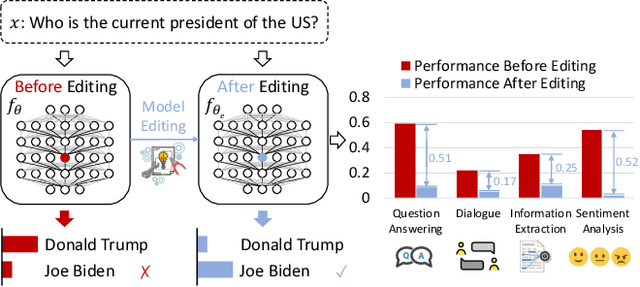
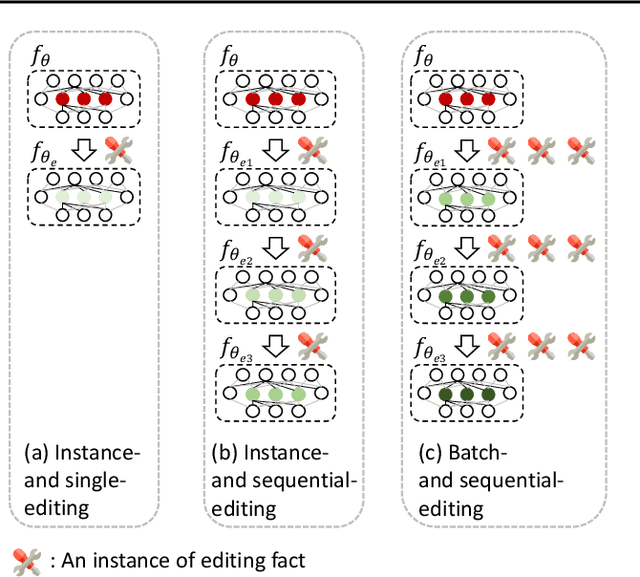
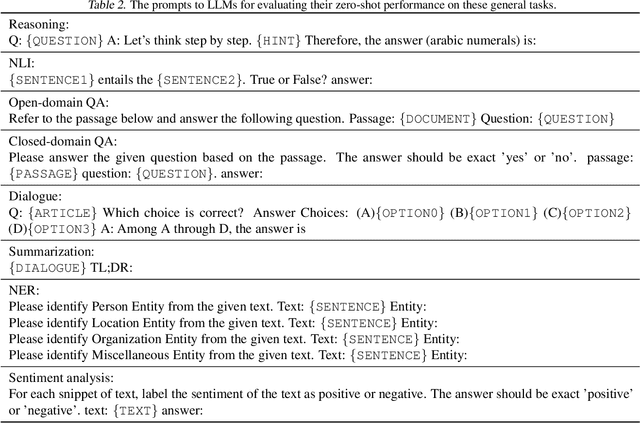
Recent advances in large language models (LLMs) have opened up new paradigms for accessing the knowledge stored in their parameters. One critical challenge that has emerged is the presence of hallucinations in LLM outputs due to false or outdated knowledge. Since retraining LLMs with updated information is resource-intensive, there has been a growing interest in model editing. However, many model editing methods, while effective in various scenarios, tend to overemphasize aspects such as efficacy, generalization, and locality in editing performance, often overlooking potential side effects on the general abilities of LLMs. In this paper, we raise concerns that the improvement of model factuality may come at the cost of a significant degradation of these general abilities, which is not conducive to the sustainable development of LLMs. Systematically, we analyze side effects by evaluating four popular editing methods on two LLMs across eight representative task categories. Extensive empirical research reveals that model editing does improve model factuality but at the expense of substantially impairing general abilities. Therefore, we advocate for more research efforts to minimize the loss of general abilities acquired during LLM pre-training and to ultimately preserve them during model editing.