 Add to Chrome
 Add to Firefox
 Add to Edge
Spatial Covariance Constraints for Gaussian Mixture Models
Jan 12, 2026
Although extensive research exists in spatial modeling, few studies have addressed finite mixture model-based clustering methods for spatial data. Finite mixture models, especially Gaussian mixture models, particularly suffer from high dimensionality due to the number of free covariance parameters. This study introduces a spatial covariance constraint for Gaussian mixture models that requires only four free parameters for each component, independent of dimensionality. Using a coordinate system, the spatially constrained Gaussian mixture model enables clustering of multi-way spatial data and inference of spatial patterns. The parameter estimation is conducted by combining the expectation-maximization (EM) algorithm with the generalized least squares (GLS) estimator. Simulation studies and applications to Raman spectroscopy data are provided to demonstrate the proposed model.

Deep-learning-enabled Brain Hemodynamic Mapping Using Resting-state fMRI
Apr 25, 2022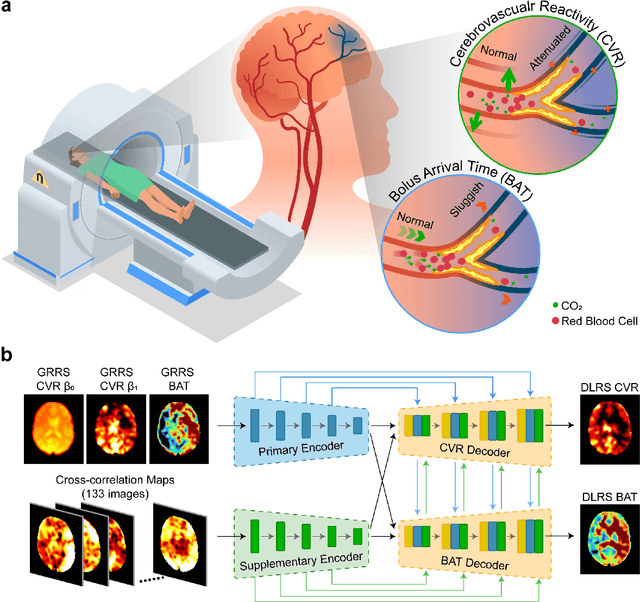
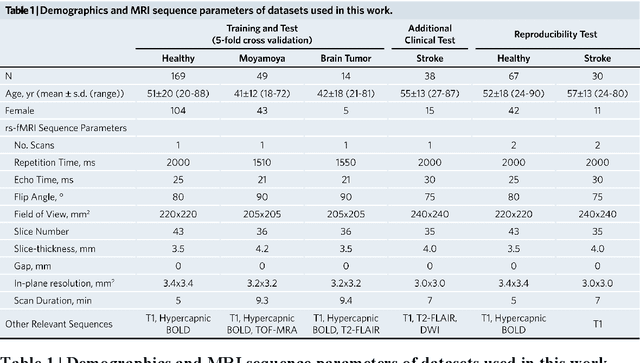
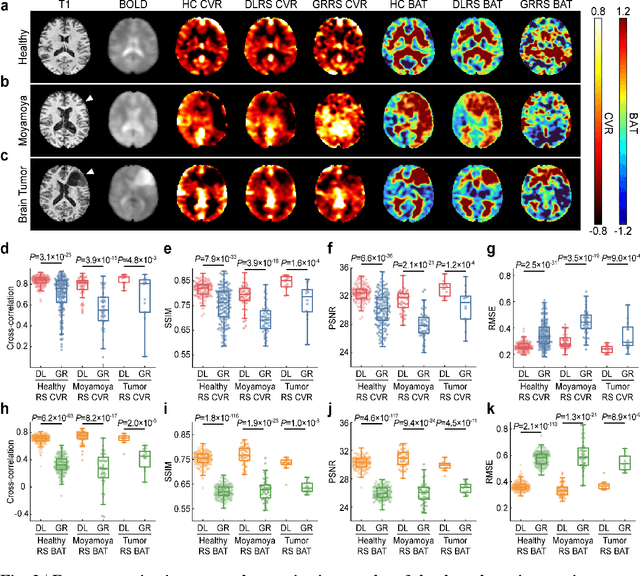
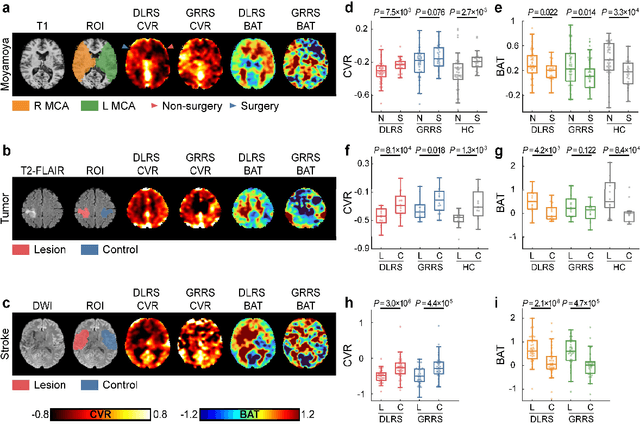
Cerebrovascular disease is a leading cause of death globally. Prevention and early intervention are known to be the most effective forms of its management. Non-invasive imaging methods hold great promises for early stratification, but at present lack the sensitivity for personalized prognosis. Resting-state functional magnetic resonance imaging (rs-fMRI), a powerful tool previously used for mapping neural activity, is available in most hospitals. Here we show that rs-fMRI can be used to map cerebral hemodynamic function and delineate impairment. By exploiting time variations in breathing pattern during rs-fMRI, deep learning enables reproducible mapping of cerebrovascular reactivity (CVR) and bolus arrive time (BAT) of the human brain using resting-state CO2 fluctuations as a natural 'contrast media'. The deep-learning network was trained with CVR and BAT maps obtained with a reference method of CO2-inhalation MRI, which included data from young and older healthy subjects and patients with Moyamoya disease and brain tumors. We demonstrate the performance of deep-learning cerebrovascular mapping in the detection of vascular abnormalities, evaluation of revascularization effects, and vascular alterations in normal aging. In addition, cerebrovascular maps obtained with the proposed method exhibited excellent reproducibility in both healthy volunteers and stroke patients. Deep-learning resting-state vascular imaging has the potential to become a useful tool in clinical cerebrovascular imaging.