 Add to Chrome
 Add to Firefox
 Add to Edge
MultiBind: A Benchmark for Attribute Misbinding in Multi-Subject Generation
Mar 23, 2026
Subject-driven image generation is increasingly expected to support fine-grained control over multiple entities within a single image. In multi-reference workflows, users may provide several subject images, a background reference, and long, entity-indexed prompts to control multiple people within one scene. In this setting, a key failure mode is cross-subject attribute misbinding: attributes are preserved, edited, or transferred to the wrong subject. Existing benchmarks and metrics largely emphasize holistic fidelity or per-subject self-similarity, making such failures hard to diagnose. We introduce MultiBind, a benchmark built from real multi-person photographs. Each instance provides slot-ordered subject crops with masks and bounding boxes, canonicalized subject references, an inpainted background reference, and a dense entity-indexed prompt derived from structured annotations. We also propose a dimension-wise confusion evaluation protocol that matches generated subjects to ground-truth slots and measures slot-to-slot similarity using specialists for face identity, appearance, pose, and expression. By subtracting the corresponding ground-truth similarity matrices, our method separates self-degradation from true cross-subject interference and exposes interpretable failure patterns such as drift, swap, dominance, and blending. Experiments on modern multi-reference generators show that MultiBind reveals binding failures that conventional reconstruction metrics miss.

Clip Your Sequences Fairly: Enforcing Length Fairness for Sequence-Level RL
Sep 11, 2025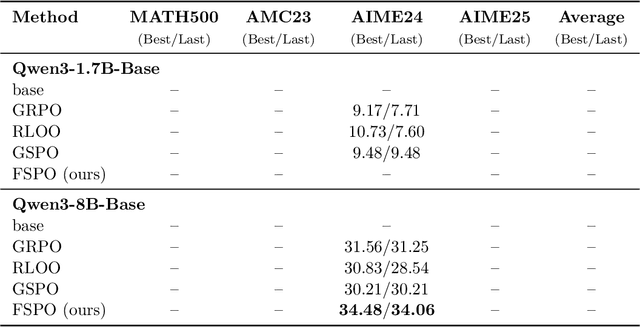
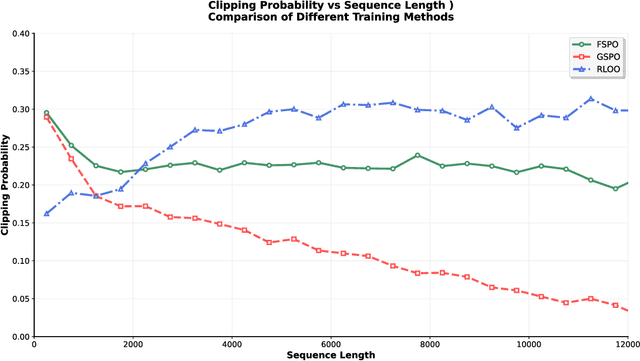
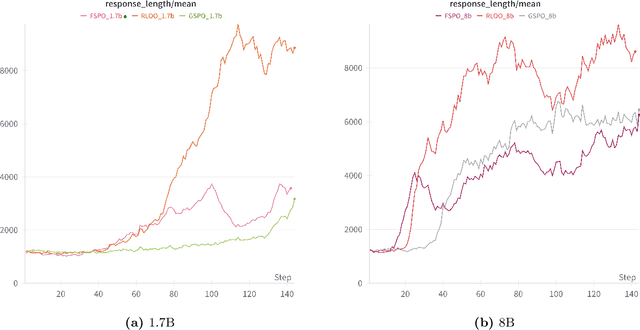
We propose FSPO (Fair Sequence Policy Optimization), a sequence-level reinforcement learning method for LLMs that enforces length-fair clipping directly in the importance-sampling (IS) weight space. We revisit sequence-level RL methods and identify a mismatch when PPO/GRPO-style clipping is transplanted to sequences: a fixed clip range systematically reweights short vs. long responses, distorting the effective objective. Theoretically, we formalize length fairness via a Length Reweighting Error (LRE) and prove that small LRE yields a directional cosine guarantee between the clipped and true updates. FSPO introduces a simple, Gaussian-motivated remedy: we clip the sequence log-IS ratio with a band that applies a KL-corrected drift term and scales as $\sqrt{L}$. Empirically, FSPO flattens clip rates across length bins, stabilizes training, and outperforms all baselines across multiple evaluation datasets.
In2x at WMT25 Translation Task
Aug 20, 2025This paper presents the open-system submission by the In2x research team for the WMT25 General Machine Translation Shared Task. Our submission focuses on Japanese-related translation tasks, aiming to explore a generalizable paradigm for extending large language models (LLMs) to other languages. This paradigm encompasses aspects such as data construction methods and reward model design. The ultimate goal is to enable large language model systems to achieve exceptional performance in low-resource or less commonly spoken languages.