 Add to Chrome
 Add to Firefox
 Add to Edge
Efficient foundation decoders for fault-tolerant quantum computing
Jun 25, 2026
Foundation decoders, a class of high-capacity neural decoders, are leading candidates for fault-tolerant quantum computing, with accurate and efficient decoding at large code distances. However, their construction often faces a steep scaling barrier, as larger code distances rapidly amplify the cost of syndrome generation and neural optimization. To address this bottleneck, here we devise neural transfer unification (NTU), a unified framework for efficient foundation decoders. A central feature of NTU is its ability to align decoding tasks across code distances via algebraic structures shared by scalable code families, which enables knowledge learned on smaller codes to accelerate large-scale decoder training. We instantiate NTU as NTU-Transformer, a transformer-based neural decoder tailored for planar surface codes and bivariate bicycle codes. For planar surface codes under circuit-level noise, NTU-Transformer outperforms correlation-aware matching on the $[\![361,1,19]\!]$ code and further scales to the $[\![625,1,25]\!]$ code, where it exceeds standard matching through transfer adaptation. For the bivariate bicycle code with $[\![72,12,6]\!]$, it surpasses Relay-BP in the low-physical-error regime. These results establish our proposal as a scalable route to amortized cross-distance training of foundation decoders for fault-tolerant quantum processors.

qecGPT: decoding Quantum Error-correcting Codes with Generative Pre-trained Transformers
Jul 18, 2023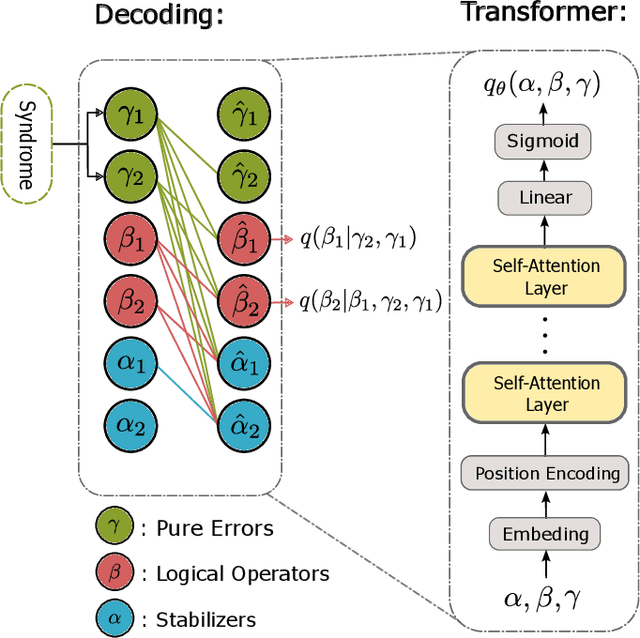

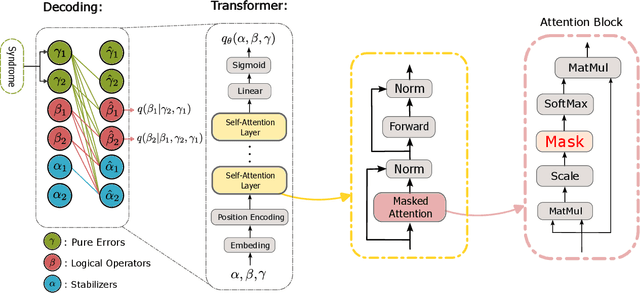
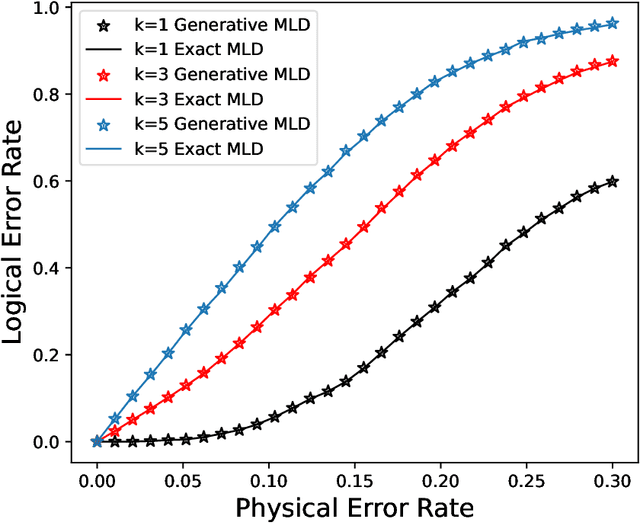
We propose a general framework for decoding quantum error-correcting codes with generative modeling. The model utilizes autoregressive neural networks, specifically Transformers, to learn the joint probability of logical operators and syndromes. This training is in an unsupervised way, without the need for labeled training data, and is thus referred to as pre-training. After the pre-training, the model can efficiently compute the likelihood of logical operators for any given syndrome, using maximum likelihood decoding. It can directly generate the most-likely logical operators with computational complexity $\mathcal O(2k)$ in the number of logical qubits $k$, which is significantly better than the conventional maximum likelihood decoding algorithms that require $\mathcal O(4^k)$ computation. Based on the pre-trained model, we further propose refinement to achieve more accurately the likelihood of logical operators for a given syndrome by directly sampling the stabilizer operators. We perform numerical experiments on stabilizer codes with small code distances, using both depolarizing error models and error models with correlated noise. The results show that our approach provides significantly better decoding accuracy than the minimum weight perfect matching and belief-propagation-based algorithms. Our framework is general and can be applied to any error model and quantum codes with different topologies such as surface codes and quantum LDPC codes. Furthermore, it leverages the parallelization capabilities of GPUs, enabling simultaneous decoding of a large number of syndromes. Our approach sheds light on the efficient and accurate decoding of quantum error-correcting codes using generative artificial intelligence and modern computational power.