 Add to Chrome
 Add to Firefox
 Add to Edge
ScenDi: 3D-to-2D Scene Diffusion Cascades for Urban Generation
Jan 21, 2026
Recent advancements in 3D object generation using diffusion models have achieved remarkable success, but generating realistic 3D urban scenes remains challenging. Existing methods relying solely on 3D diffusion models tend to suffer a degradation in appearance details, while those utilizing only 2D diffusion models typically compromise camera controllability. To overcome this limitation, we propose ScenDi, a method for urban scene generation that integrates both 3D and 2D diffusion models. We first train a 3D latent diffusion model to generate 3D Gaussians, enabling the rendering of images at a relatively low resolution. To enable controllable synthesis, this 3DGS generation process can be optionally conditioned by specifying inputs such as 3d bounding boxes, road maps, or text prompts. Then, we train a 2D video diffusion model to enhance appearance details conditioned on rendered images from the 3D Gaussians. By leveraging the coarse 3D scene as guidance for 2D video diffusion, ScenDi generates desired scenes based on input conditions and successfully adheres to accurate camera trajectories. Experiments on two challenging real-world datasets, Waymo and KITTI-360, demonstrate the effectiveness of our approach.

Learning 3D-Aware GANs from Unposed Images with Template Feature Field
Apr 08, 2024
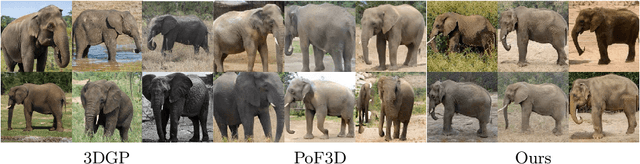

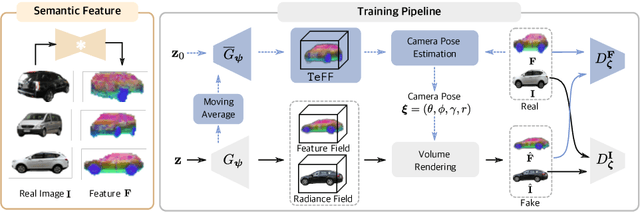
Collecting accurate camera poses of training images has been shown to well serve the learning of 3D-aware generative adversarial networks (GANs) yet can be quite expensive in practice. This work targets learning 3D-aware GANs from unposed images, for which we propose to perform on-the-fly pose estimation of training images with a learned template feature field (TeFF). Concretely, in addition to a generative radiance field as in previous approaches, we ask the generator to also learn a field from 2D semantic features while sharing the density from the radiance field. Such a framework allows us to acquire a canonical 3D feature template leveraging the dataset mean discovered by the generative model, and further efficiently estimate the pose parameters on real data. Experimental results on various challenging datasets demonstrate the superiority of our approach over state-of-the-art alternatives from both the qualitative and the quantitative perspectives.
UrbanGIRAFFE: Representing Urban Scenes as Compositional Generative Neural Feature Fields
Mar 28, 2023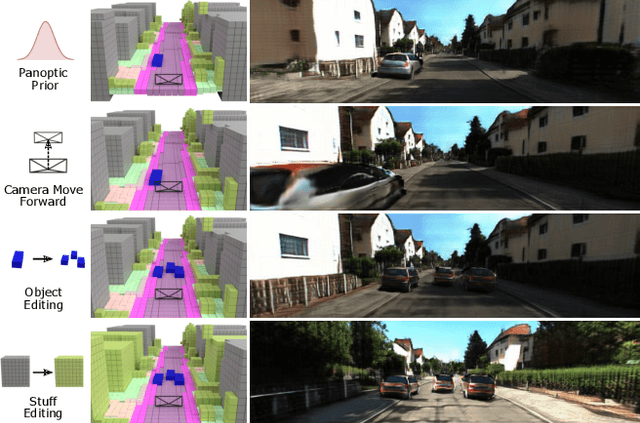
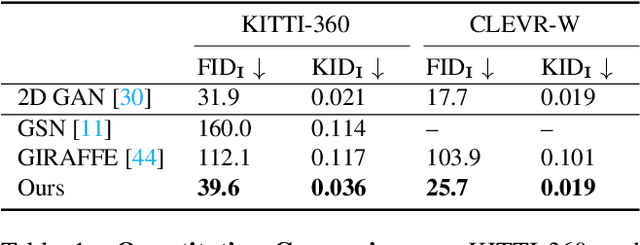
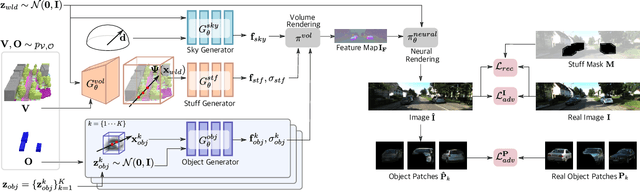
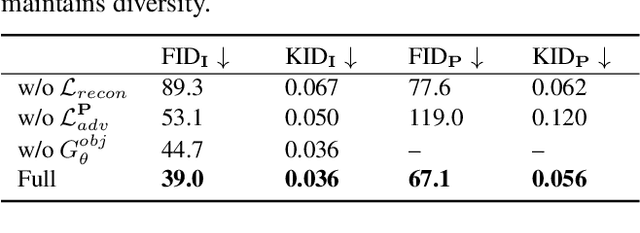
Generating photorealistic images with controllable camera pose and scene contents is essential for many applications including AR/VR and simulation. Despite the fact that rapid progress has been made in 3D-aware generative models, most existing methods focus on object-centric images and are not applicable to generating urban scenes for free camera viewpoint control and scene editing. To address this challenging task, we propose UrbanGIRAFFE, which uses a coarse 3D panoptic prior, including the layout distribution of uncountable stuff and countable objects, to guide a 3D-aware generative model. Our model is compositional and controllable as it breaks down the scene into stuff, objects, and sky. Using stuff prior in the form of semantic voxel grids, we build a conditioned stuff generator that effectively incorporates the coarse semantic and geometry information. The object layout prior further allows us to learn an object generator from cluttered scenes. With proper loss functions, our approach facilitates photorealistic 3D-aware image synthesis with diverse controllability, including large camera movement, stuff editing, and object manipulation. We validate the effectiveness of our model on both synthetic and real-world datasets, including the challenging KITTI-360 dataset.