 Add to Chrome
 Add to Firefox
 Add to Edge
Perturb-and-Restore: Simulation-driven Structural Augmentation Framework for Imbalance Chromosomal Anomaly Detection
Apr 01, 2026
Detecting structural chromosomal abnormalities is crucial for accurate diagnosis and management of genetic disorders. However, collecting sufficient structural abnormality data is extremely challenging and costly in clinical practice, and not all abnormal types can be readily collected. As a result, deep learning approaches face significant performance degradation due to the severe imbalance and scarcity of abnormal chromosome data. To address this challenge, we propose a Perturb-and-Restore (P&R), a simulation-driven structural augmentation framework that effectively alleviates data imbalance in chromosome anomaly detection. The P&R framework comprises two key components: (1) Structure Perturbation and Restoration Simulation, which generates synthetic abnormal chromosomes by perturbing chromosomal banding patterns of normal chromosomes followed by a restoration diffusion network that reconstructs continuous chromosome content and edges, thus eliminating reliance on rare abnormal samples; and (2) Energy-guided Adaptive Sampling, an energy score-based online selection strategy that dynamically prioritizes high-quality synthetic samples by referencing the energy distribution of real samples. To evaluate our method, we construct a comprehensive structural anomaly dataset consisting of over 260,000 chromosome images, including 4,242 abnormal samples spanning 24 categories. Experimental results demonstrate that the P&R framework achieves state-of-the-art (SOTA) performance, surpassing existing methods with an average improvement of 8.92% in sensitivity, 8.89% in precision, and 13.79% in F1-score across all categories.

Data Sensing and Offloading in Edge Computing Networks: TDMA or NOMA?
Nov 22, 2021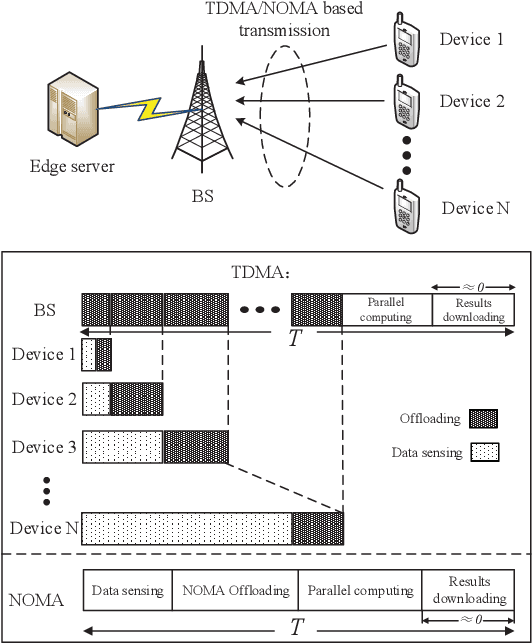
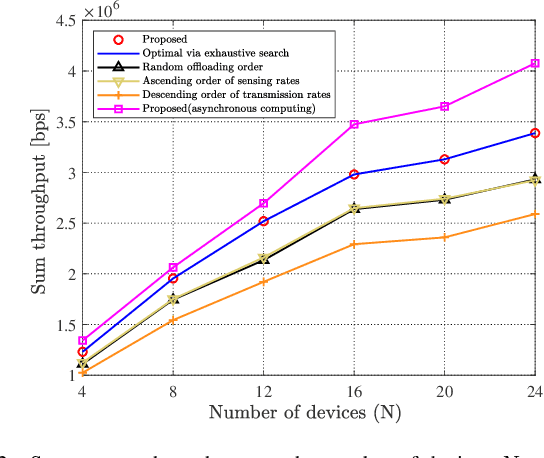
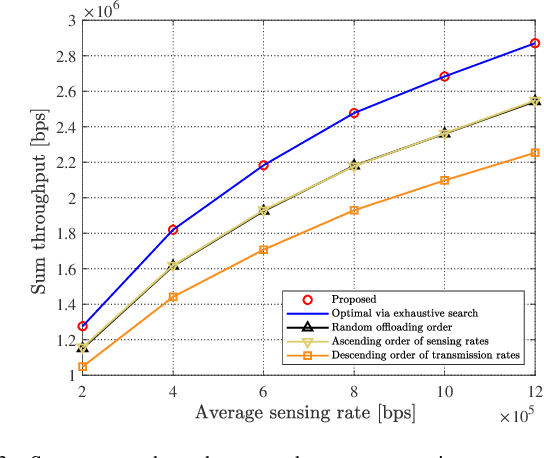
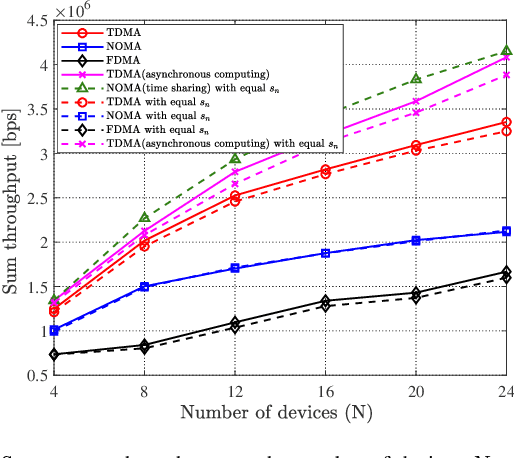
With the development of Internet-of-Things (IoT), we witness the explosive growth in the number of devices with sensing, computing, and communication capabilities, along with a large amount of raw data generated at the network edge. Mobile (multi-access) edge computing (MEC), acquiring and processing data at network edge (like base station (BS)) via wireless links, has emerged as a promising technique for real-time applications. In this paper, we consider the scenario that multiple devices sense then offload data to an edge server/BS, and the offloading throughput maximization problems are studied by joint radio-and-computation resource allocation, based on time-division multiple access (TDMA) and non-orthogonal multiple access (NOMA) multiuser computation offloading. Particularly, we take the sequence of TDMA-based multiuser transmission/offloading into account. The studied problems are NP-hard and non-convex. A set of low-complexity algorithms are designed based on decomposition approach and exploration of valuable insights of problems. They are either optimal or can achieve close-to-optimal performance as shown by simulation. The comprehensive simulation results show that the sequence optimized TDMA scheme achieves better throughput performance than the NOMA scheme, while the NOMA scheme is better under the assumptions of time-sharing strategy and the identical sensing capability of the devices.