 Add to Chrome
 Add to Firefox
 Add to Edge
Probabilistic Forecasting of Localized Wildfire Spread Based on Conditional Flow Matching
Mar 27, 2026
This study presents a probabilistic surrogate model for localized wildfire spread based on a conditional flow matching algorithm. The approach models fire progression as a stochastic process by learning the conditional distribution of fire arrival times given the current fire state along with environmental and atmospheric inputs. Model inputs include current burned area, near-surface wind components, temperature, relative humidity, terrain height, and fuel category information, all defined on a high-resolution spatial grid. The outputs are samples of arrival time within a three-hour time window, conditioned on the input variables. Training data are generated from coupled atmosphere-wildfire spread simulations using WRF-SFIRE, paired with weather fields from the North American Mesoscale model. The proposed framework enables efficient generation of ensembles of arrival times and explicitly represents uncertainty arising from incomplete knowledge of the fire-atmosphere system and unresolved variables. The model supports localized prediction over subdomains, reducing computational cost relative to physics-based simulators while retaining sensitivity to key drivers of fire spread. Model performance is evaluated against WRF-SFIRE simulations for both single-step (3-hour) and recursive multi-step (24-hour) forecasts. Results demonstrate that the method captures variability in fire evolution and produces accurate ensemble predictions. The framework provides a scalable approach for probabilistic wildfire forecasting and offers a pathway for integrating machine learning models with operational fire prediction systems and data assimilation.

Generative Algorithms for Wildfire Progression Reconstruction from Multi-Modal Satellite Active Fire Measurements and Terrain Height
Jun 12, 2025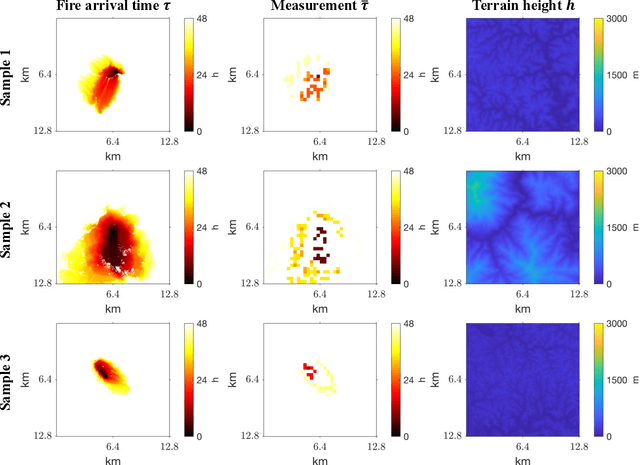
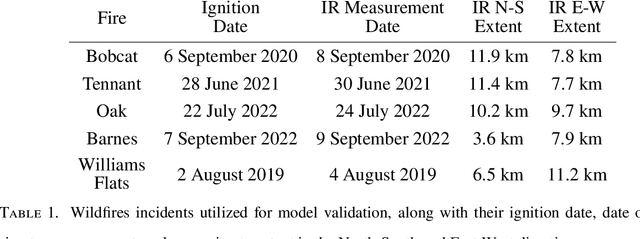
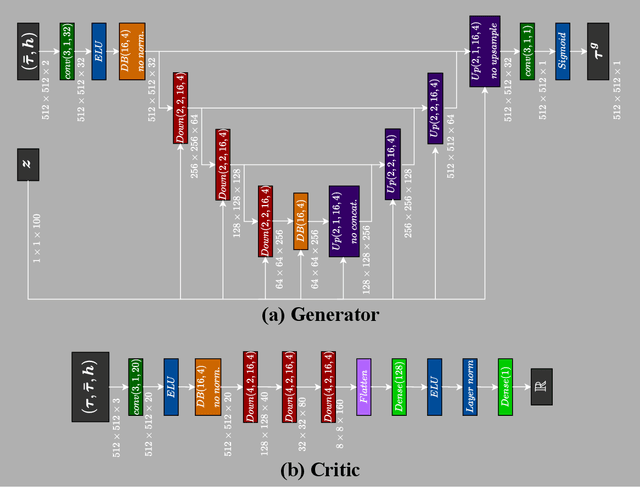

Increasing wildfire occurrence has spurred growing interest in wildfire spread prediction. However, even the most complex wildfire models diverge from observed progression during multi-day simulations, motivating need for data assimilation. A useful approach to assimilating measurement data into complex coupled atmosphere-wildfire models is to estimate wildfire progression from measurements and use this progression to develop a matching atmospheric state. In this study, an approach is developed for estimating fire progression from VIIRS active fire measurements, GOES-derived ignition times, and terrain height data. A conditional Generative Adversarial Network is trained with simulations of historic wildfires from the atmosphere-wildfire model WRF-SFIRE, thus allowing incorporation of WRF-SFIRE physics into estimates. Fire progression is succinctly represented by fire arrival time, and measurements for training are obtained by applying an approximate observation operator to WRF-SFIRE solutions, eliminating need for satellite data during training. The model is trained on tuples of fire arrival times, measurements, and terrain, and once trained leverages measurements of real fires and corresponding terrain data to generate samples of fire arrival times. The approach is validated on five Pacific US wildfires, with results compared against high-resolution perimeters measured via aircraft, finding an average Sorensen-Dice coefficient of 0.81. The influence of terrain height on the arrival time inference is also evaluated and it is observed that terrain has minimal influence when the inference is conditioned on satellite measurements.