 Add to Chrome
 Add to Firefox
 Add to Edge
RAG-Stack: Co-Optimizing RAG Serving Performance and Quality
Aug 04, 2026
Retrieval-augmented generation (RAG), which augments large language model (LLM) generation with information retrieved from databases, has become a widely used approach for knowledge-intensive applications. Modern RAG systems, however, expose many configuration choices, such as retrieval indexes, model selections, and how models invoke retrieval. Each configuration yields a different trade-off between answer quality and serving performance, making it challenging to choose the optimal setting for a specific application deployment. We present RAG-Stack, a framework for efficiently discovering quality-performance Pareto frontiers across diverse RAG applications and serving systems. RAG-Stack consists of RAG-PE, an iterative design-space exploration algorithm that selects the next RAG configuration to evaluate; RAG-IR, a workload abstraction for diverse RAG algorithms; and RAG-CM, a performance model that predicts the optimal deployment and serving performance on the given hardware. Together, these components allow RAG-Stack to search the joint algorithm-system configuration space without deploying every candidate and to transfer an existing Pareto frontier to a new serving system. Given the same number of optimization iterations across diverse datasets, the Pareto frontiers found by RAG-Stack cover 52.5% to 153.2% more of the normalized quality-performance space than those found by state-of-the-art configuration-search methods evaluated over the same RAG design space.

Multi-to-Single Knowledge Distillation for Point Cloud Semantic Segmentation
Apr 28, 2023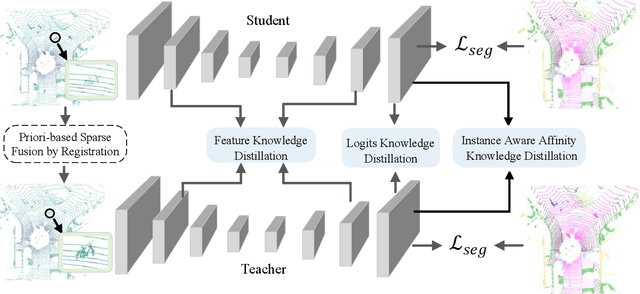


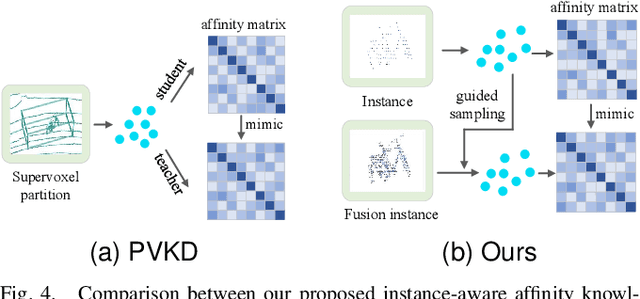
3D point cloud semantic segmentation is one of the fundamental tasks for environmental understanding. Although significant progress has been made in recent years, the performance of classes with few examples or few points is still far from satisfactory. In this paper, we propose a novel multi-to-single knowledge distillation framework for the 3D point cloud semantic segmentation task to boost the performance of those hard classes. Instead of fusing all the points of multi-scans directly, only the instances that belong to the previously defined hard classes are fused. To effectively and sufficiently distill valuable knowledge from multi-scans, we leverage a multilevel distillation framework, i.e., feature representation distillation, logit distillation, and affinity distillation. We further develop a novel instance-aware affinity distillation algorithm for capturing high-level structural knowledge to enhance the distillation efficacy for hard classes. Finally, we conduct experiments on the SemanticKITTI dataset, and the results on both the validation and test sets demonstrate that our method yields substantial improvements compared with the baseline method. The code is available at \Url{https://github.com/skyshoumeng/M2SKD}.
Knowledge Distillation from 3D to Bird's-Eye-View for LiDAR Semantic Segmentation
Apr 22, 2023


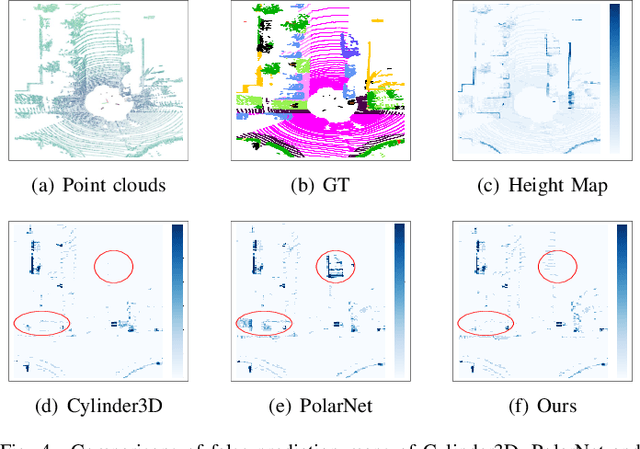
LiDAR point cloud segmentation is one of the most fundamental tasks for autonomous driving scene understanding. However, it is difficult for existing models to achieve both high inference speed and accuracy simultaneously. For example, voxel-based methods perform well in accuracy, while Bird's-Eye-View (BEV)-based methods can achieve real-time inference. To overcome this issue, we develop an effective 3D-to-BEV knowledge distillation method that transfers rich knowledge from 3D voxel-based models to BEV-based models. Our framework mainly consists of two modules: the voxel-to-pillar distillation module and the label-weight distillation module. Voxel-to-pillar distillation distills sparse 3D features to BEV features for middle layers to make the BEV-based model aware of more structural and geometric information. Label-weight distillation helps the model pay more attention to regions with more height information. Finally, we conduct experiments on the SemanticKITTI dataset and Paris-Lille-3D. The results on SemanticKITTI show more than 5% improvement on the test set, especially for classes such as motorcycle and person, with more than 15% improvement. The code can be accessed at https://github.com/fengjiang5/Knowledge-Distillation-from-Cylinder3D-to-PolarNet.