 Add to Chrome
 Add to Firefox
 Add to Edge
Quantum-Structured World Models (QSWMs) for Predictive Latent Dynamics
Aug 05, 2026
World models learn latent states that summarize interaction histories, evolve over time, and support prediction, simulation, or planning. Most existing world models represent these states using classical vectors, probability distributions, recurrent hidden states, or transformer activations. In this paper, we introduce Quantum-Structured World Models (QSWMs), a quantum-inspired framework for predictive world modeling with structured latent states, latent transition operators, and measurement-inspired decoding maps. We study whether mathematical structures inspired by quantum theory, such as complex-valued representations and density-matrix-like latents, provide useful inductive biases for world modeling. We establish three foundational properties: classical inclusion, predictive sufficiency, and structured compactness. We then instantiate complex-valued and density-matrix-like QSWM variants and evaluate them on elementary cellular automata against strong classical baselines. Results show promising local predictive potential for complex-valued QSWMs, while also revealing limitations in long-horizon rollout, density-matrix variants

Can Large Language Models Recover Semantic Optimization Opportunities That Compilers Miss?
Aug 04, 2026Optimizing compilers miss profitable transformations when their enabling semantics are absent from the analyzed program representation. We ask whether large language models (LLMs) can recover such semantics from heterogeneous C/C++ context and realize them as validated, contract-preserving artifacts. We introduce SeGaBench, an executable benchmark containing 100 synthetic and 20 source-backed cases spanning low-level assumptions, data-structure invariants, and high-level semantic lifting. Each case includes hidden enabling semantics, an oracle artifact, correctness and semantic validators, and a reproducible performance protocol. We evaluate five LLMs using five independent responses per case. The strongest model produces correct artifacts in 94.8% of responses, achieves at least 1.05x speedup in 83.3%, and obtains a performance success on 93.3% of cases. Nevertheless, correct artifacts often close only part of the oracle gap. These results show that LLMs can complement compiler analysis as speculative semantic proposers, provided that their artifacts are validated and evaluated.
CarbonEdge: Carbon-Aware Deep Learning Inference Framework for Sustainable Edge Computing
Apr 01, 2026Deep learning applications at the network edge lead to a significant growth in AI-related carbon emissions, presenting a critical sustainability challenge. The existing edge computing frameworks optimize for latency and throughput, but they largely ignore the environmental impact of inference workloads. This paper introduces CarbonEdge, a carbon-aware deep learning inference framework that extends adaptive model partitioning with carbon footprint estimation and green scheduling apabilities. We propose a carbon-aware scheduling algorithm that extends traditional weighted scoring with a carbon efficiency metric, supporting a tunable performance--carbon trade-off (demonstrated via weight sweep). Experimental evaluations on Docker-simulated heterogeneous edge environments show that CarbonEdge-Green mode achieves a 22.9% reduction in carbon emissions compared to monolithic execution. The framework achieves 1.3x improvement in carbon efficiency (245.8 vs 189.5 inferences per gram CO2) with negligible scheduling overhead (0.03ms per task). These results highlight the framework's potential for sustainable edge AI deployment, providing researchers and practitioners a tool to quantify and minimize the environmental footprint of distributed deep learning inference.
Can Large Language Models Understand Intermediate Representations?
Feb 07, 2025Intermediate Representations (IRs) are essential in compiler design and program analysis, yet their comprehension by Large Language Models (LLMs) remains underexplored. This paper presents a pioneering empirical study to investigate the capabilities of LLMs, including GPT-4, GPT-3, Gemma 2, LLaMA 3.1, and Code Llama, in understanding IRs. We analyze their performance across four tasks: Control Flow Graph (CFG) reconstruction, decompilation, code summarization, and execution reasoning. Our results indicate that while LLMs demonstrate competence in parsing IR syntax and recognizing high-level structures, they struggle with control flow reasoning, execution semantics, and loop handling. Specifically, they often misinterpret branching instructions, omit critical IR operations, and rely on heuristic-based reasoning, leading to errors in CFG reconstruction, IR decompilation, and execution reasoning. The study underscores the necessity for IR-specific enhancements in LLMs, recommending fine-tuning on structured IR datasets and integration of explicit control flow models to augment their comprehension and handling of IR-related tasks.
Leveraging Large Language Models to Analyze Emotional and Contextual Drivers of Teen Substance Use in Online Discussions
Jan 23, 2025

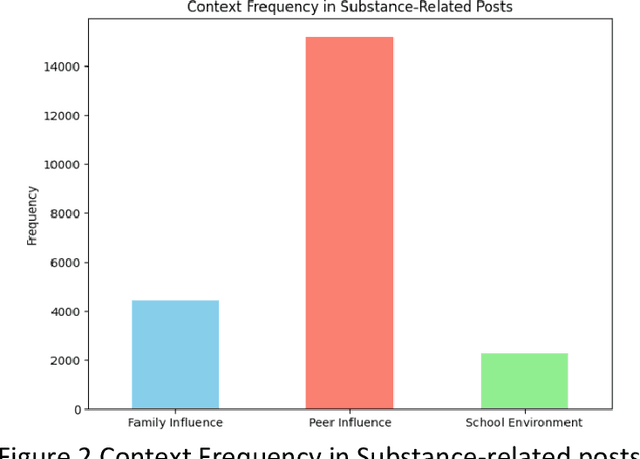

Adolescence is a critical stage often linked to risky behaviors, including substance use, with significant developmental and public health implications. Social media provides a lens into adolescent self-expression, but interpreting emotional and contextual signals remains complex. This study applies Large Language Models (LLMs) to analyze adolescents' social media posts, uncovering emotional patterns (e.g., sadness, guilt, fear, joy) and contextual factors (e.g., family, peers, school) related to substance use. Heatmap and machine learning analyses identified key predictors of substance use-related posts. Negative emotions like sadness and guilt were significantly more frequent in substance use contexts, with guilt acting as a protective factor, while shame and peer influence heightened substance use risk. Joy was more common in non-substance use discussions. Peer influence correlated strongly with sadness, fear, and disgust, while family and school environments aligned with non-substance use. Findings underscore the importance of addressing emotional vulnerabilities and contextual influences, suggesting that collaborative interventions involving families, schools, and communities can reduce risk factors and foster healthier adolescent development.