 Add to Chrome
 Add to Firefox
 Add to Edge
Learning Manifolds in High-D Point Embedding for Anisotropic Surface Approximation from Unstructured Point Clouds
Jul 30, 2026
Dense 3D sensors in various real-world fields produce point clouds that are geometrically redundant for real-time processing. In this paper, we propose an efficient and scalable learning-based anisotropic surface approximation framework, HD-PEA, that operates directly on unstructured point clouds, integrating anisotropic optimization into reconstruction to produce compact, geometry-aligned surface representations with higher fidelity, fewer elements, and improved numerical stability compared to isotropic and adaptive meshes. Firstly, we develop a novel learning-based high-dimensional (high-d) Euclidean point embedding method to map the input point clouds into a high-d manifold embedding space. For handling large-scale point clouds without retraining and fine-tuning, a patch-based meta-embedding scheme is designed during the inference stage. Then, we develop a new tangent subspace estimation for the high-d embedding manifold approximation and anisotropic manifold reconstruction in high-d space. The main contribution of this work is to propose a scalable deep learning framework and a variety of datasets for constructing a high-d Euclidean point embedding space aimed to 3D anisotropic surface mesh approximation and Riemannian curvature tensor estimation from point clouds. We extensively evaluate our method against state-of-the-art surface reconstruction approaches using several datasets, such as Thingi10K dataset, AIM@SHAPE and Stanford 3D Scanning Repository, ScanNet dataset, and further demonstrate its generalization and usability on diverse unseen shapes and applications from these datasets.

NASM: Neural Anisotropic Surface Meshing
Oct 30, 2024This paper introduces a new learning-based method, NASM, for anisotropic surface meshing. Our key idea is to propose a graph neural network to embed an input mesh into a high-dimensional (high-d) Euclidean embedding space to preserve curvature-based anisotropic metric by using a dot product loss between high-d edge vectors. This can dramatically reduce the computational time and increase the scalability. Then, we propose a novel feature-sensitive remeshing on the generated high-d embedding to automatically capture sharp geometric features. We define a high-d normal metric, and then derive an automatic differentiation on a high-d centroidal Voronoi tessellation (CVT) optimization with the normal metric to simultaneously preserve geometric features and curvature anisotropy that exhibit in the original 3D shapes. To our knowledge, this is the first time that a deep learning framework and a large dataset are proposed to construct a high-d Euclidean embedding space for 3D anisotropic surface meshing. Experimental results are evaluated and compared with the state-of-the-art in anisotropic surface meshing on a large number of surface models from Thingi10K dataset as well as tested on extensive unseen 3D shapes from Multi-Garment Network dataset and FAUST human dataset.
VC-Net: Deep Volume-Composition Networks for Segmentation and Visualization of Highly Sparse and Noisy Image Data
Sep 14, 2020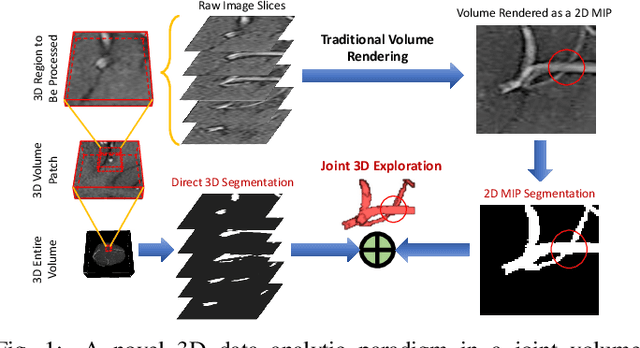
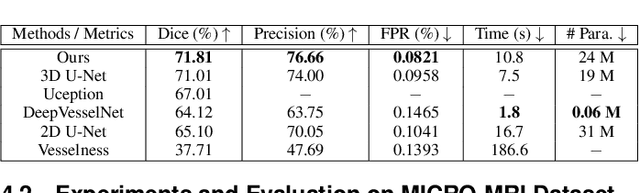

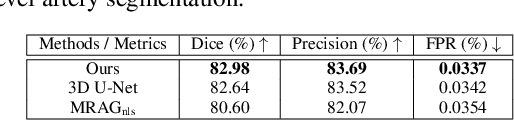
The motivation of our work is to present a new visualization-guided computing paradigm to combine direct 3D volume processing and volume rendered clues for effective 3D exploration such as extracting and visualizing microstructures in-vivo. However, it is still challenging to extract and visualize high fidelity 3D vessel structure due to its high sparseness, noisiness, and complex topology variations. In this paper, we present an end-to-end deep learning method, VC-Net, for robust extraction of 3D microvasculature through embedding the image composition, generated by maximum intensity projection (MIP), into 3D volume image learning to enhance the performance. The core novelty is to automatically leverage the volume visualization technique (MIP) to enhance the 3D data exploration at deep learning level. The MIP embedding features can enhance the local vessel signal and are adaptive to the geometric variability and scalability of vessels, which is crucial in microvascular tracking. A multi-stream convolutional neural network is proposed to learn the 3D volume and 2D MIP features respectively and then explore their inter-dependencies in a joint volume-composition embedding space by unprojecting the MIP features into 3D volume embedding space. The proposed framework can better capture small / micro vessels and improve vessel connectivity. To our knowledge, this is the first deep learning framework to construct a joint convolutional embedding space, where the computed vessel probabilities from volume rendering based 2D projection and 3D volume can be explored and integrated synergistically. Experimental results are compared with the traditional 3D vessel segmentation methods and the deep learning state-of-the-art on public and real patient (micro-)cerebrovascular image datasets. Our method demonstrates the potential in a powerful MR arteriogram and venogram diagnosis of vascular diseases.