 Add to Chrome
 Add to Firefox
 Add to Edge
The 6th International Verification of Neural Networks Competition (VNN-COMP 2025): Summary and Results
Dec 22, 2025
This report summarizes the 6th International Verification of Neural Networks Competition (VNN-COMP 2025), held as a part of the 8th International Symposium on AI Verification (SAIV), that was collocated with the 37th International Conference on Computer-Aided Verification (CAV). VNN-COMP is held annually to facilitate the fair and objective comparison of state-of-the-art neural network verification tools, encourage the standardization of tool interfaces, and bring together the neural network verification community. To this end, standardized formats for networks (ONNX) and specification (VNN-LIB) were defined, tools were evaluated on equal-cost hardware (using an automatic evaluation pipeline based on AWS instances), and tool parameters were chosen by the participants before the final test sets were made public. In the 2025 iteration, 8 teams participated on a diverse set of 16 regular and 9 extended benchmarks. This report summarizes the rules, benchmarks, participating tools, results, and lessons learned from this iteration of this competition.

Harnessing Neuron Stability to Improve DNN Verification
Jan 19, 2024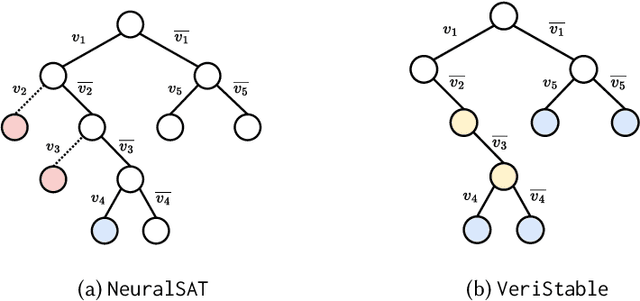
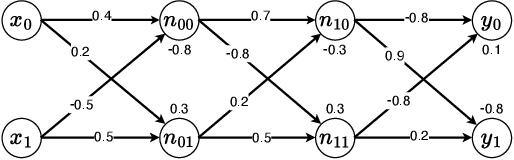
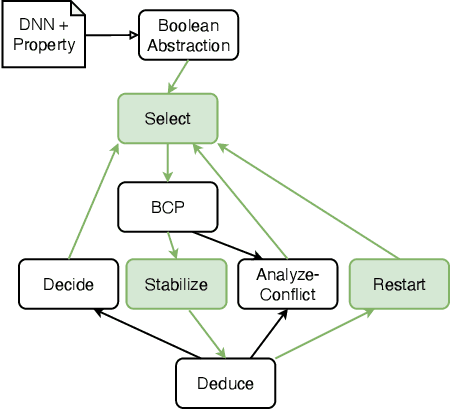
Deep Neural Networks (DNN) have emerged as an effective approach to tackling real-world problems. However, like human-written software, DNNs are susceptible to bugs and attacks. This has generated significant interests in developing effective and scalable DNN verification techniques and tools. In this paper, we present VeriStable, a novel extension of recently proposed DPLL-based constraint DNN verification approach. VeriStable leverages the insight that while neuron behavior may be non-linear across the entire DNN input space, at intermediate states computed during verification many neurons may be constrained to have linear behavior - these neurons are stable. Efficiently detecting stable neurons reduces combinatorial complexity without compromising the precision of abstractions. Moreover, the structure of clauses arising in DNN verification problems shares important characteristics with industrial SAT benchmarks. We adapt and incorporate multi-threading and restart optimizations targeting those characteristics to further optimize DPLL-based DNN verification. We evaluate the effectiveness of VeriStable across a range of challenging benchmarks including fully-connected feedforward networks (FNNs), convolutional neural networks (CNNs) and residual networks (ResNets) applied to the standard MNIST and CIFAR datasets. Preliminary results show that VeriStable is competitive and outperforms state-of-the-art DNN verification tools, including $\alpha$-$\beta$-CROWN and MN-BaB, the first and second performers of the VNN-COMP, respectively.
A DPLL Framework for Verifying Deep Neural Networks
Jul 17, 2023
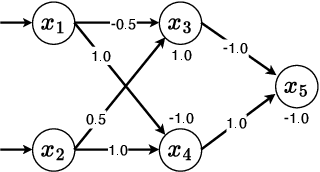
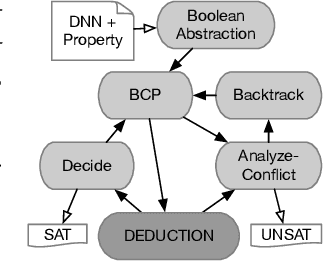
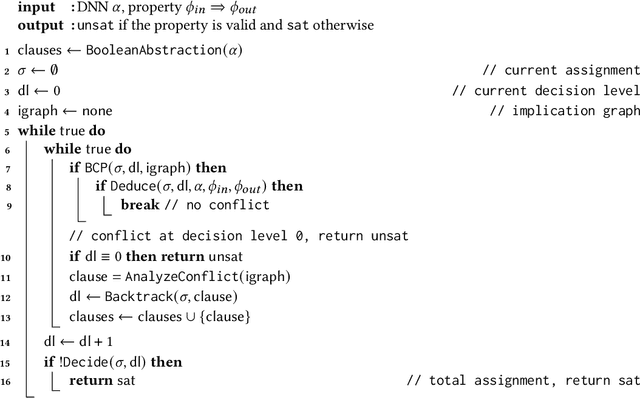
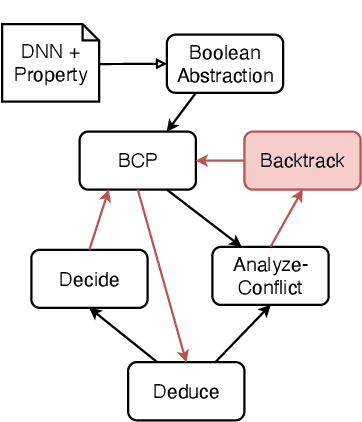
Deep Neural Networks (DNNs) have emerged as an effective approach to tackling real-world problems. However, like human-written software, automatically-generated DNNs can have bugs and be attacked. This thus attracts many recent interests in developing effective and scalable DNN verification techniques and tools. In this work, we introduce a NeuralSAT, a new constraint solving approach to DNN verification. The design of NeuralSAT follows the DPLL(T) algorithm used modern SMT solving, which includes (conflict) clause learning, abstraction, and theory solving, and thus NeuralSAT can be considered as an SMT framework for DNNs. Preliminary results show that the NeuralSAT prototype is competitive to the state-of-the-art. We hope, with proper optimization and engineering, NeuralSAT will carry the power and success of modern SAT/SMT solvers to DNN verification. NeuralSAT is avaliable from: https://github.com/dynaroars/neuralsat-solver