 Add to Chrome
 Add to Firefox
 Add to Edge
VLM-Aware Meta-Optic Front-End Design for Frozen Vision-Language Models
Jun 26, 2026
Conventional machine-vision pipelines typically rely on high-quality optics that produce clean, human-interpretable images, and optical design has therefore been driven by image-level criteria such as resolution, aberration correction, and pixel fidelity. However, such optics are often impractical for size-, cost-, or form-factor-constrained applications, where compact meta-optics offer an attractive alternative but operate under strict physical efficiency limits. We propose CODA, a co-design framework that optimizes a continuous-density meta-optic front-end for frozen-model recognition using differentiable image formation and adjoint-gradient updates of Maxwell-based simulations. CODA directly optimizes the cross-entropy loss of a fixed zero-shot CLIP classifier without learned reconstruction, image signal processing, or image-fidelity auxiliary objectives. In a two-dimensional simulated imaging benchmark on ImageNet-100, CODA improves CLIP ViT-L/14 zero-shot accuracy from 53.75 $\pm$ 3.57$\%$ with a focal-concentration baseline to 65.41 $\pm$ 3.99$\%$. The optimized optics further transfer without re-optimization across CLIP, SigLIP, and DINOv2 on ImageNet-100, CIFAR-100, and Food-101. These results demonstrate that, under constrained meta-optic imaging, downstream recognition can be improved by aligning optical design with frozen vision-model objectives rather than conventional image-formation criteria.

When, Where, and How: Adaptive Binning for Tabular Self-Supervised Learning
Jun 18, 2026Medical tabular data are ubiquitous in clinical research, but deep learning for tables remains underexplored because reliable labels often require costly expert adjudication, even though structured clinical variables are routinely available in tabular form. Self-supervised learning can leverage these unlabeled tables, and recent binning-based pretexts offer a promising inductive bias, but existing objectives fix a single global quantile discretization and apply feature-agnostic supervision. We propose Adaptive Binning, a training-adaptive discretization pretext for tabular SSL that couples discretization to learning through a feature-wise coarse-to-fine curriculum. Motivated by the spectral bias of neural networks and the principles of curriculum learning, our method progressively refines discretization per feature upon plateau detection and selects representation-aware splits to jointly improve value-space concentration and representation-space coherence. A heterogeneity-aware objective unifies categorical reconstruction with ordinal supervision for numerical features, and experiments on public medical tabular datasets under unified evaluation protocols show consistent gains for linear probing and fine-tuning without dataset-specific discretization tuning. We further introduce a medical tabular SSL benchmark with standardized protocols to support reproducible progress in this underexplored domain. Our code is available at https://github.com/labhai/Adaptive-Binning.
CSWinUNETR: Segmentation of Thin Anatomical Structures in Medical Images
Jun 18, 2026Accurate segmentation of thin, tortuous anatomical structures, such as retinal vessels, cerebral vasculature, and facial wrinkles, remains challenging due to low contrast, frequent discontinuities, and severe class imbalance. Although recent convolutional and Transformer-based models have improved performance, they often yield fragmented predictions and fail to recover fine branches. We propose CSWinUNETR, a general-purpose backbone for 2D and 3D thin-structure segmentation. It employs cross-shaped stripe self-attention to model long-range principal-axis context and incorporates cyclic shifts to enhance information exchange across stripes. To better preserve fine-grained details, we further introduce a detail-enhanced multi-scale self-attention module that aggregates contextual features from multi-resolution representations. In addition, we propose sparse-control dynamic snake convolution, which reconstructs reliable dense curvilinear kernels from sparsely predicted control points to better follow tortuous geometry. Extensive experiments on four benchmarks across ophthalmology, neurovascular imaging, and dermatology demonstrate that CSWinUNETR consistently outperforms state-of-the-art methods without task-specific post-processing or topology-aware losses. The code is available at https://github.com/labhai/CSWinUNETR.
OTCHA: Optimal Transport-driven Confidence-aware Latent Hub Alignment for Multi-View Medical Image Classification
Jun 18, 2026Multi-view imaging, such as mammography and chest radiography, is a standard component of clinical practice. However, medical images are often unregistered and contain view-specific artifacts or irrelevant background cues that can obscure diagnostically relevant findings. Many existing methods directly fuse per-view representations, allowing such irrelevant content to contaminate the fused embedding and reducing robustness under varying view configurations. We propose OTCHA, a confidence-aware latent hub token alignment module based on optimal transport (OT) that refines patch tokens before fusion for multi-view classification. OTCHA introduces a set of learnable latent hub tokens shared across views. For each view, we compute an OT plan between patch tokens and hub tokens that jointly considers feature similarity and geometry, and augment the OT formulation with token-conditional dustbins to enable partial matching and discard irrelevant tokens. The resulting transport plan provides token-wise matching confidence, which gates hub-mediated message passing and weights a novel optimal-transport-based representation alignment loss to stabilize refinement. Experiments on three multi-view medical image datasets demonstrate consistent improvements over competing baselines across diverse anatomies and view configurations. Our code is available at https://github.com/labhai/OTCHA.
Surprise-Guided MergeSort: Budget-Efficient Human-in-the-Loop Ranking via Adaptive Comparison Scheduling
Jun 14, 2026Pairwise comparison is the gold standard for subjective ranking tasks; however, exhaustive annotation requires a massive number of human comparisons ($O(n^2)$). While sorting-based methods have reduced this burden to $O(n\log n)$, they still require expensive human judgment for every single comparison. To further improve annotation efficiency, we propose leveraging a Vision-Language Model (VLM) not as an annotator replacement, but as a \emph{question prioritizer} to identify which comparisons genuinely require human judgment. The proposed \textbf{Surprise-Guided MergeSort (SGS)} framework achieves this through three integrated components: (1) a bottom-up MergeSort scheduler that structures comparisons and exploits transitivity, (2) a composite Surprise Scorer -- combining position-bias-cancelled VLM confidence, Elo gap, and vote entropy -- to quantify comparison ambiguity, and (3) an adaptive budget allocator that routes high-surprise pairs to humans while automating low-surprise pairs via transitivity inference. Validation was conducted on six diverse benchmarks spanning text similarity (STS-B, BIOSSES, SICKR-STS) and image quality assessment (KonIQ-10k, TID2013, LIVE Challenge). SGS effectively identified and skipped up to 535 non-informative comparisons per session. Consequently, it achieved Kendall's $τ{\times}100$ improvements of $+6$ to $+12$ over Active Elo under the same total budget. These results demonstrate that combining VLM-guided surprise metrics with algorithmic sorting provides a generally consistent accuracy-efficiency trade-off across diverse domains.
MetaRanker: Human-in-the-loop Active Ranking for Metalens Image Quality
May 28, 2026Image quality in modern imaging systems emerges from the coupled effects of the sensor, optics, and computational reconstruction. Ultra-thin metalenses offer a path toward substantial miniaturization of optical modules, but practical designs often exhibit pronounced chromatic and field-dependent aberrations that necessitate computational reconstruction. In current metalens pipelines, reconstruction models are commonly trained and selected using distortion-based fidelity objectives, such as PSNR, yet these proxies can be weakly correlated with human preference and downstream utility, reflecting the well-known perception--distortion trade-off. We introduce MetaRanker, a human-in-the-loop active ranking framework that formalizes metalens image quality in terms of semantic interpretability, defined as the degree to which humans can reliably recognize objects and structures in the presence of optical artifacts. MetaRanker combines a probabilistic preference model with uncertainty-aware query selection, and leverages vision--language models to provide lightweight semantic priors. Importantly, these priors are used only to guide the sampling of informative comparisons; human judgments remain the primary supervision signal throughout. Across real-world and synthetic metalens datasets with distinct degradation profiles, MetaRanker produces rankings that align most closely with human assessments, while reducing the number of pairwise annotations required by approximately 80% relative to exhaustive pairwise evaluation. Finally, we show that standard image quality assessment metrics exhibit limited alignment with human interpretability in the metalens domain, positioning MetaRanker as a practical step toward perceptually grounded metalens evaluation and co-design.
Neural Adjoint Method for Meta-optics: Accelerating Volumetric Inverse Design via Fourier Neural Operators
Apr 19, 2026Meta-optics promises compact, high-performance imaging and color routing. However, designing high-performance structures is a high-dimensional optimization problem: mapping a desired optical output back to a physical 3D structure requires solving computationally expensive Maxwell's equations iteratively. Even with adjoint optimization, broadband design can require thousands of Maxwell solves, making industrial-scale optimization slow and costly. To overcome this challenge, we propose the Neural Adjoint Method, a solver-supervised surrogate that predicts 3D adjoint gradient fields from a voxelized permittivity volume using a Fourier Neural Operator (FNO). By learning the dense, per-voxel sensitivity field that drives gradient-based updates, our method can replace per-iteration adjoint solves with fast predictions, greatly reducing the computational cost of full-wave simulations required during iterative refinement. To better preserve sensitivity peaks, we introduce a stage-wise FNO that progressively refines residual errors with increasing emphasis on higher-frequency components. We curate a meta-optics dataset from paired forward/adjoint FDTD simulations and evaluate it across three tasks: spectral sorting (color routers), achromatic focusing (metalenses), and waveguide mode conversion. Our method reduces design time from hours to seconds. These results suggest a practical route toward fast, large-scale volumetric meta-optical design enabled by AI-accelerated scientific computing.
Dodgersort: Uncertainty-Aware VLM-Guided Human-in-the-Loop Pairwise Ranking
Mar 21, 2026Pairwise comparison labeling is emerging as it yields higher inter-rater reliability than conventional classification labeling, but exhaustive comparisons require quadratic cost. We propose Dodgersort, which leverages CLIP-based hierarchical pre-ordering, a neural ranking head and probabilistic ensemble (Elo, BTL, GP), epistemic--aleatoric uncertainty decomposition, and information-theoretic pair selection. It reduces human comparisons while improving the reliability of the rankings. In visual ranking tasks in medical imaging, historical dating, and aesthetics, Dodgersort achieves a 11--16\% annotation reduction while improving inter-rater reliability. Cross-domain ablations across four datasets show that neural adaptation and ensemble uncertainty are key to this gain. In FG-NET with ground-truth ages, the framework extracts 5--20$\times$ more ranking information per comparison than baselines, yielding Pareto-optimal accuracy--efficiency trade-offs.
EZ-Sort: Efficient Pairwise Comparison via Zero-Shot CLIP-Based Pre-Ordering and Human-in-the-Loop Sorting
Aug 29, 2025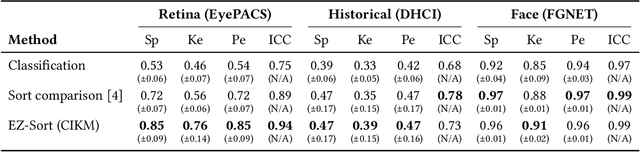
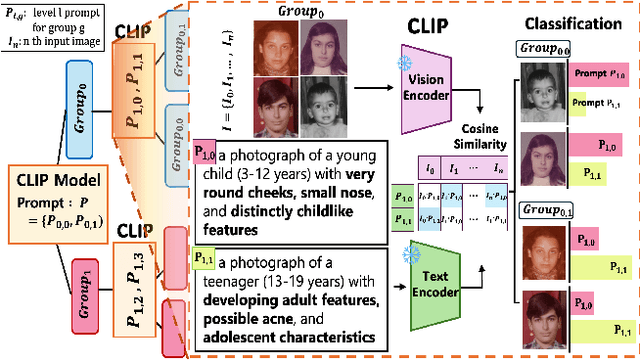
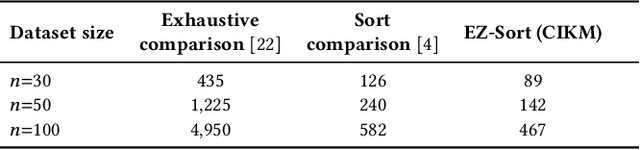
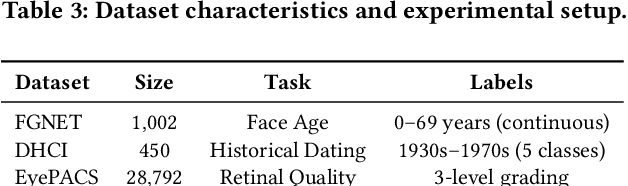
Pairwise comparison is often favored over absolute rating or ordinal classification in subjective or difficult annotation tasks due to its improved reliability. However, exhaustive comparisons require a massive number of annotations (O(n^2)). Recent work has greatly reduced the annotation burden (O(n log n)) by actively sampling pairwise comparisons using a sorting algorithm. We further improve annotation efficiency by (1) roughly pre-ordering items using the Contrastive Language-Image Pre-training (CLIP) model hierarchically without training, and (2) replacing easy, obvious human comparisons with automated comparisons. The proposed EZ-Sort first produces a CLIP-based zero-shot pre-ordering, then initializes bucket-aware Elo scores, and finally runs an uncertainty-guided human-in-the-loop MergeSort. Validation was conducted using various datasets: face-age estimation (FGNET), historical image chronology (DHCI), and retinal image quality assessment (EyePACS). It showed that EZ-Sort reduced human annotation cost by 90.5% compared to exhaustive pairwise comparisons and by 19.8% compared to prior work (when n = 100), while improving or maintaining inter-rater reliability. These results demonstrate that combining CLIP-based priors with uncertainty-aware sampling yields an efficient and scalable solution for pairwise ranking.
Physics-guided and fabrication-aware inverse design of photonic devices using diffusion models
Apr 23, 2025Designing free-form photonic devices is fundamentally challenging due to the vast number of possible geometries and the complex requirements of fabrication constraints. Traditional inverse-design approaches--whether driven by human intuition, global optimization, or adjoint-based gradient methods--often involve intricate binarization and filtering steps, while recent deep learning strategies demand prohibitively large numbers of simulations (10^5 to 10^6). To overcome these limitations, we present AdjointDiffusion, a physics-guided framework that integrates adjoint sensitivity gradients into the sampling process of diffusion models. AdjointDiffusion begins by training a diffusion network on a synthetic, fabrication-aware dataset of binary masks. During inference, we compute the adjoint gradient of a candidate structure and inject this physics-based guidance at each denoising step, steering the generative process toward high figure-of-merit (FoM) solutions without additional post-processing. We demonstrate our method on two canonical photonic design problems--a bent waveguide and a CMOS image sensor color router--and show that our method consistently outperforms state-of-the-art nonlinear optimizers (such as MMA and SLSQP) in both efficiency and manufacturability, while using orders of magnitude fewer simulations (approximately 2 x 10^2) than pure deep learning approaches (approximately 10^5 to 10^6). By eliminating complex binarization schedules and minimizing simulation overhead, AdjointDiffusion offers a streamlined, simulation-efficient, and fabrication-aware pipeline for next-generation photonic device design. Our open-source implementation is available at https://github.com/dongjin-seo2020/AdjointDiffusion.