 Add to Chrome
 Add to Firefox
 Add to Edge
OTCHA: Optimal Transport-driven Confidence-aware Latent Hub Alignment for Multi-View Medical Image Classification
Jun 18, 2026
Multi-view imaging, such as mammography and chest radiography, is a standard component of clinical practice. However, medical images are often unregistered and contain view-specific artifacts or irrelevant background cues that can obscure diagnostically relevant findings. Many existing methods directly fuse per-view representations, allowing such irrelevant content to contaminate the fused embedding and reducing robustness under varying view configurations. We propose OTCHA, a confidence-aware latent hub token alignment module based on optimal transport (OT) that refines patch tokens before fusion for multi-view classification. OTCHA introduces a set of learnable latent hub tokens shared across views. For each view, we compute an OT plan between patch tokens and hub tokens that jointly considers feature similarity and geometry, and augment the OT formulation with token-conditional dustbins to enable partial matching and discard irrelevant tokens. The resulting transport plan provides token-wise matching confidence, which gates hub-mediated message passing and weights a novel optimal-transport-based representation alignment loss to stabilize refinement. Experiments on three multi-view medical image datasets demonstrate consistent improvements over competing baselines across diverse anatomies and view configurations. Our code is available at https://github.com/labhai/OTCHA.

Uncertainty-Weighted Mutual Distillation for Multi-View Fusion
Nov 15, 2024Multi-view learning often faces challenges in effectively leveraging images captured from different angles and locations. This challenge is particularly pronounced when addressing inconsistencies and uncertainties between views. In this paper, we propose a novel Multi-View Uncertainty-Weighted Mutual Distillation (MV-UWMD) method. Our method enhances prediction consistency by performing hierarchical mutual distillation across all possible view combinations, including single-view, partial multi-view, and full multi-view predictions. This introduces an uncertainty-based weighting mechanism through mutual distillation, allowing effective exploitation of unique information from each view while mitigating the impact of uncertain predictions. We extend a CNN-Transformer hybrid architecture to facilitate robust feature learning and integration across multiple view combinations. We conducted extensive experiments using a large, unstructured dataset captured from diverse, non-fixed viewpoints. The results demonstrate that MV-UWMD improves prediction accuracy and consistency compared to existing multi-view learning approaches.
Preoperative Rotator Cuff Tear Prediction from Shoulder Radiographs using a Convolutional Block Attention Module-Integrated Neural Network
Aug 19, 2024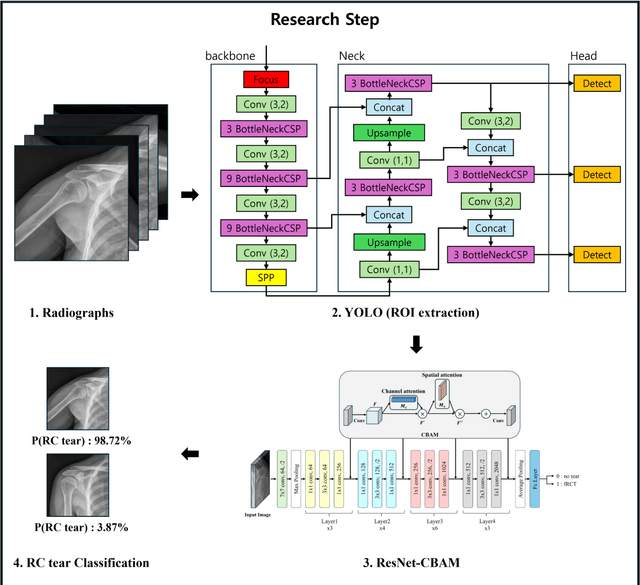
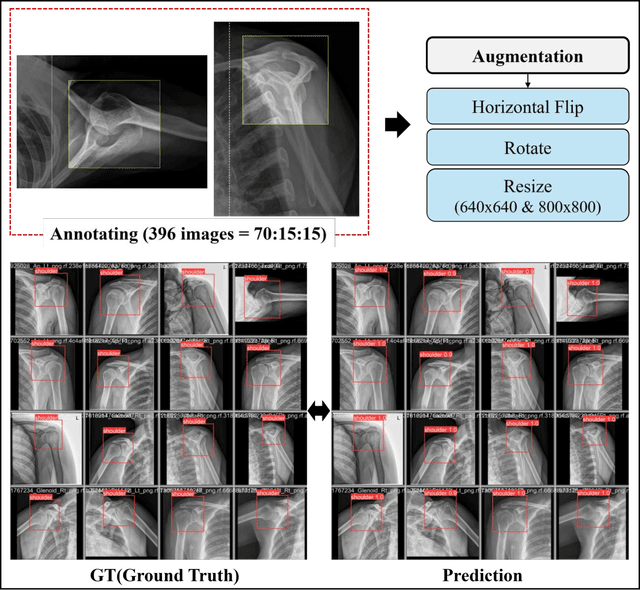
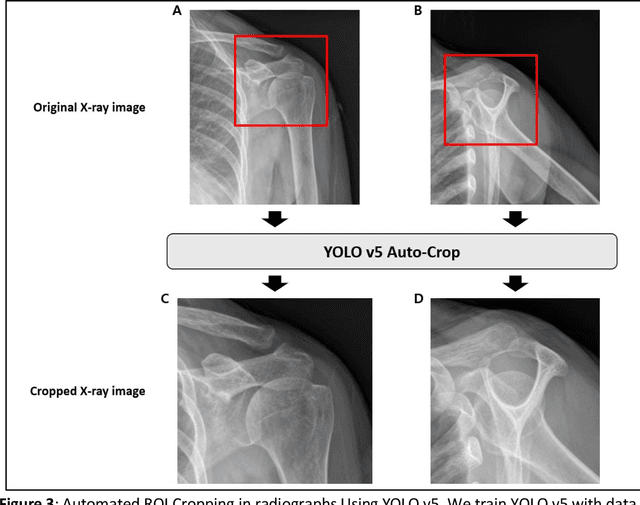
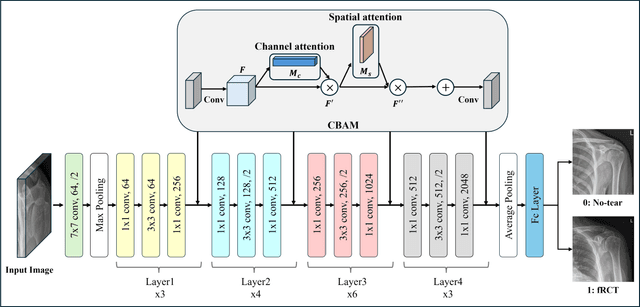
Research question: We test whether a plane shoulder radiograph can be used together with deep learning methods to identify patients with rotator cuff tears as opposed to using an MRI in standard of care. Findings: By integrating convolutional block attention modules into a deep neural network, our model demonstrates high accuracy in detecting patients with rotator cuff tears, achieving an average AUC of 0.889 and an accuracy of 0.831. Meaning: This study validates the efficacy of our deep learning model to accurately detect rotation cuff tears from radiographs, offering a viable pre-assessment or alternative to more expensive imaging techniques such as MRI.