 Add to Chrome
 Add to Firefox
 Add to Edge
Surprise-Guided MergeSort: Budget-Efficient Human-in-the-Loop Ranking via Adaptive Comparison Scheduling
Jun 14, 2026
Pairwise comparison is the gold standard for subjective ranking tasks; however, exhaustive annotation requires a massive number of human comparisons ($O(n^2)$). While sorting-based methods have reduced this burden to $O(n\log n)$, they still require expensive human judgment for every single comparison. To further improve annotation efficiency, we propose leveraging a Vision-Language Model (VLM) not as an annotator replacement, but as a \emph{question prioritizer} to identify which comparisons genuinely require human judgment. The proposed \textbf{Surprise-Guided MergeSort (SGS)} framework achieves this through three integrated components: (1) a bottom-up MergeSort scheduler that structures comparisons and exploits transitivity, (2) a composite Surprise Scorer -- combining position-bias-cancelled VLM confidence, Elo gap, and vote entropy -- to quantify comparison ambiguity, and (3) an adaptive budget allocator that routes high-surprise pairs to humans while automating low-surprise pairs via transitivity inference. Validation was conducted on six diverse benchmarks spanning text similarity (STS-B, BIOSSES, SICKR-STS) and image quality assessment (KonIQ-10k, TID2013, LIVE Challenge). SGS effectively identified and skipped up to 535 non-informative comparisons per session. Consequently, it achieved Kendall's $τ{\times}100$ improvements of $+6$ to $+12$ over Active Elo under the same total budget. These results demonstrate that combining VLM-guided surprise metrics with algorithmic sorting provides a generally consistent accuracy-efficiency trade-off across diverse domains.

MetaRanker: Human-in-the-loop Active Ranking for Metalens Image Quality
May 28, 2026Image quality in modern imaging systems emerges from the coupled effects of the sensor, optics, and computational reconstruction. Ultra-thin metalenses offer a path toward substantial miniaturization of optical modules, but practical designs often exhibit pronounced chromatic and field-dependent aberrations that necessitate computational reconstruction. In current metalens pipelines, reconstruction models are commonly trained and selected using distortion-based fidelity objectives, such as PSNR, yet these proxies can be weakly correlated with human preference and downstream utility, reflecting the well-known perception--distortion trade-off. We introduce MetaRanker, a human-in-the-loop active ranking framework that formalizes metalens image quality in terms of semantic interpretability, defined as the degree to which humans can reliably recognize objects and structures in the presence of optical artifacts. MetaRanker combines a probabilistic preference model with uncertainty-aware query selection, and leverages vision--language models to provide lightweight semantic priors. Importantly, these priors are used only to guide the sampling of informative comparisons; human judgments remain the primary supervision signal throughout. Across real-world and synthetic metalens datasets with distinct degradation profiles, MetaRanker produces rankings that align most closely with human assessments, while reducing the number of pairwise annotations required by approximately 80% relative to exhaustive pairwise evaluation. Finally, we show that standard image quality assessment metrics exhibit limited alignment with human interpretability in the metalens domain, positioning MetaRanker as a practical step toward perceptually grounded metalens evaluation and co-design.
Dodgersort: Uncertainty-Aware VLM-Guided Human-in-the-Loop Pairwise Ranking
Mar 21, 2026Pairwise comparison labeling is emerging as it yields higher inter-rater reliability than conventional classification labeling, but exhaustive comparisons require quadratic cost. We propose Dodgersort, which leverages CLIP-based hierarchical pre-ordering, a neural ranking head and probabilistic ensemble (Elo, BTL, GP), epistemic--aleatoric uncertainty decomposition, and information-theoretic pair selection. It reduces human comparisons while improving the reliability of the rankings. In visual ranking tasks in medical imaging, historical dating, and aesthetics, Dodgersort achieves a 11--16\% annotation reduction while improving inter-rater reliability. Cross-domain ablations across four datasets show that neural adaptation and ensemble uncertainty are key to this gain. In FG-NET with ground-truth ages, the framework extracts 5--20$\times$ more ranking information per comparison than baselines, yielding Pareto-optimal accuracy--efficiency trade-offs.
Rethinking Retrieval-Augmented Generation for Medicine: A Large-Scale, Systematic Expert Evaluation and Practical Insights
Nov 10, 2025Large language models (LLMs) are transforming the landscape of medicine, yet two fundamental challenges persist: keeping up with rapidly evolving medical knowledge and providing verifiable, evidence-grounded reasoning. Retrieval-augmented generation (RAG) has been widely adopted to address these limitations by supplementing model outputs with retrieved evidence. However, whether RAG reliably achieves these goals remains unclear. Here, we present the most comprehensive expert evaluation of RAG in medicine to date. Eighteen medical experts contributed a total of 80,502 annotations, assessing 800 model outputs generated by GPT-4o and Llama-3.1-8B across 200 real-world patient and USMLE-style queries. We systematically decomposed the RAG pipeline into three components: (i) evidence retrieval (relevance of retrieved passages), (ii) evidence selection (accuracy of evidence usage), and (iii) response generation (factuality and completeness of outputs). Contrary to expectation, standard RAG often degraded performance: only 22% of top-16 passages were relevant, evidence selection remained weak (precision 41-43%, recall 27-49%), and factuality and completeness dropped by up to 6% and 5%, respectively, compared with non-RAG variants. Retrieval and evidence selection remain key failure points for the model, contributing to the overall performance drop. We further show that simple yet effective strategies, including evidence filtering and query reformulation, substantially mitigate these issues, improving performance on MedMCQA and MedXpertQA by up to 12% and 8.2%, respectively. These findings call for re-examining RAG's role in medicine and highlight the importance of stage-aware evaluation and deliberate system design for reliable medical LLM applications.
EZ-Sort: Efficient Pairwise Comparison via Zero-Shot CLIP-Based Pre-Ordering and Human-in-the-Loop Sorting
Aug 29, 2025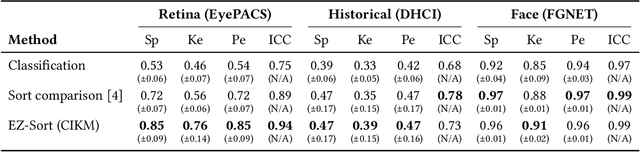
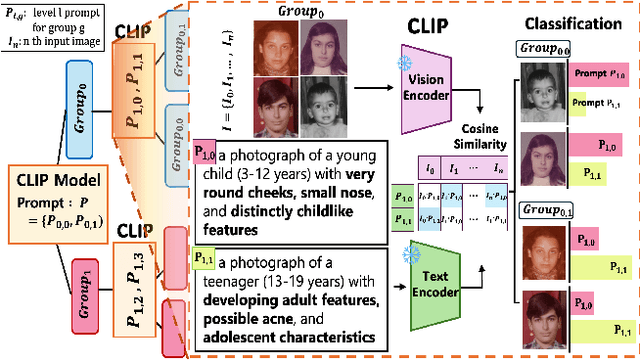
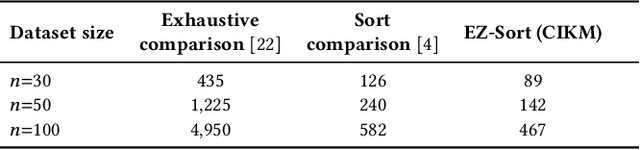
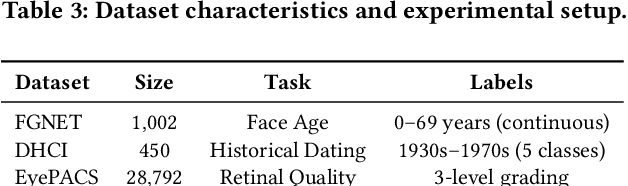
Pairwise comparison is often favored over absolute rating or ordinal classification in subjective or difficult annotation tasks due to its improved reliability. However, exhaustive comparisons require a massive number of annotations (O(n^2)). Recent work has greatly reduced the annotation burden (O(n log n)) by actively sampling pairwise comparisons using a sorting algorithm. We further improve annotation efficiency by (1) roughly pre-ordering items using the Contrastive Language-Image Pre-training (CLIP) model hierarchically without training, and (2) replacing easy, obvious human comparisons with automated comparisons. The proposed EZ-Sort first produces a CLIP-based zero-shot pre-ordering, then initializes bucket-aware Elo scores, and finally runs an uncertainty-guided human-in-the-loop MergeSort. Validation was conducted using various datasets: face-age estimation (FGNET), historical image chronology (DHCI), and retinal image quality assessment (EyePACS). It showed that EZ-Sort reduced human annotation cost by 90.5% compared to exhaustive pairwise comparisons and by 19.8% compared to prior work (when n = 100), while improving or maintaining inter-rater reliability. These results demonstrate that combining CLIP-based priors with uncertainty-aware sampling yields an efficient and scalable solution for pairwise ranking.
On the Energy Distribution of the Galactic Center Excess' Sources
Jul 23, 2025The Galactic Center Excess (GCE) remains one of the defining mysteries uncovered by the Fermi $\gamma$-ray Space Telescope. Although it may yet herald the discovery of annihilating dark matter, weighing against that conclusion are analyses showing the spatial structure of the emission appears more consistent with a population of dim point sources. Technical limitations have restricted prior analyses to studying the point-source hypothesis purely spatially. All spectral information that could help disentangle the GCE from the complex and uncertain astrophysical emission was discarded. We demonstrate that a neural network-aided simulation-based inference approach can overcome such limitations and thereby confront the point source explanation of the GCE with spatial and spectral data. The addition is profound: energy information drives the putative point sources to be significantly dimmer, indicating either the GCE is truly diffuse in nature or made of an exceptionally large number of sources. Quantitatively, for our best fit background model, the excess is essentially consistent with Poisson emission as predicted by dark matter. If the excess is instead due to point sources, our median prediction is ${\cal O}(10^5)$ sources in the Galactic Center, or more than 35,000 sources at 90% confidence, both significantly larger than the hundreds of sources preferred by earlier point-source analyses of the GCE.