 Add to Chrome
 Add to Firefox
 Add to Edge
Reason2Decide: Rationale-Driven Multi-Task Learning
Dec 23, 2025
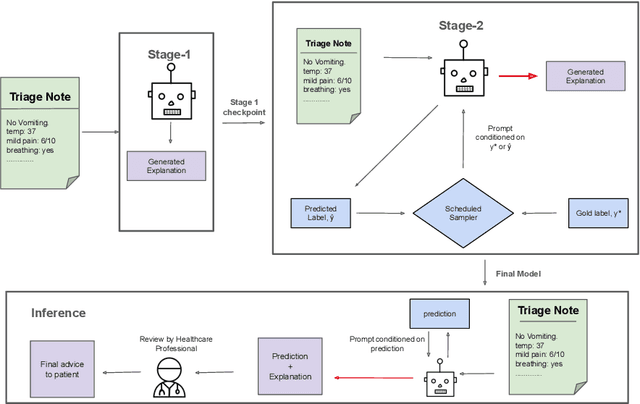
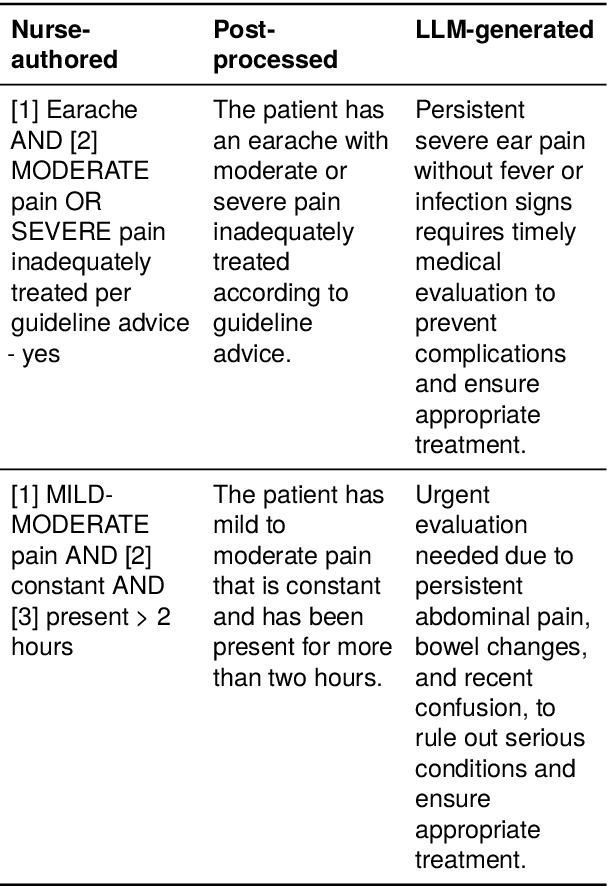
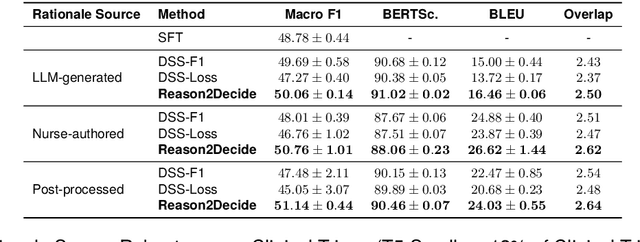
Despite the wide adoption of Large Language Models (LLM)s, clinical decision support systems face a critical challenge: achieving high predictive accuracy while generating explanations aligned with the predictions. Current approaches suffer from exposure bias leading to misaligned explanations. We propose Reason2Decide, a two-stage training framework that addresses key challenges in self-rationalization, including exposure bias and task separation. In Stage-1, our model is trained on rationale generation, while in Stage-2, we jointly train on label prediction and rationale generation, applying scheduled sampling to gradually transition from conditioning on gold labels to model predictions. We evaluate Reason2Decide on three medical datasets, including a proprietary triage dataset and public biomedical QA datasets. Across model sizes, Reason2Decide outperforms other fine-tuning baselines and some zero-shot LLMs in prediction (F1) and rationale fidelity (BERTScore, BLEU, LLM-as-a-Judge). In triage, Reason2Decide is rationale source-robust across LLM-generated, nurse-authored, and nurse-post-processed rationales. In our experiments, while using only LLM-generated rationales in Stage-1, Reason2Decide outperforms other fine-tuning variants. This indicates that LLM-generated rationales are suitable for pretraining models, reducing reliance on human annotations. Remarkably, Reason2Decide achieves these gains with models 40x smaller than contemporary foundation models, making clinical reasoning more accessible for resource-constrained deployments while still providing explainable decision support.

BEnQA: A Question Answering and Reasoning Benchmark for Bengali and English
Mar 16, 2024In this study, we introduce BEnQA, a dataset comprising parallel Bengali and English exam questions for middle and high school levels in Bangladesh. Our dataset consists of approximately 5K questions covering several subjects in science with different types of questions, including factual, application, and reasoning-based questions. We benchmark several Large Language Models (LLMs) with our parallel dataset and observe a notable performance disparity between the models in Bengali and English. We also investigate some prompting methods, and find that Chain-of-Thought prompting is beneficial mostly on reasoning questions, but not so much on factual ones. We also find that appending English translation helps to answer questions in Bengali. Our findings point to promising future research directions for improving the performance of LLMs in Bengali and more generally in low-resource languages.