 Add to Chrome
 Add to Firefox
 Add to Edge
Does Role Specialization Matter for Explanation Faithfulness in Mixture-of-Experts?
Jun 28, 2026
Mixture-of-Experts (MoE) architectures have recently been extended with role-based mechanisms for interpretability. This is typically done by assigning semantic roles to individual expert components, for example roles like synergy, redundancy, and uniqueness in multimodal settings. However, whether such structural role decomposition preserves explanation faithfulness of the overall architecture remains largely underexplored. We hypothesize that inter-expert representation overlap weakens effective role separation and degrades attribution-based faithfulness, even when semantic roles are explicitly defined. To address this limitation, we introduce representation-level decorrelation regularization to explicitly reduce inter-expert similarity in latent space. Using representation decorrelation objectives, we encourage clearer specialization among experts by minimizing representation overlap. Our experiments show that across multiple multimodal benchmarks, this separation consistently improves explanation faithfulness, as measured by comprehensiveness, sufficiency, and their Area Over the Perturbation Curve (AOPC) summaries, while preserving task performance. We further show that these improvements are not limited to role-based architectures such as Interpretable Multimodal Interaction-aware MoE (I2MoE). Similar trends are observed in a standard sparse MoE baseline, suggesting that representation-level separation may provide a more general mechanism for enhancing explanation faithfulness in MoE systems. Overall, our findings suggest that structural role decomposition alone may be insufficient to guarantee faithful explanations and that representation-level separation helps improve explanation faithfulness. To support reproducibility, the source code and supplementary material are publicly available at https://github.com/dut0817/FL-I2MoE_Decor.

Reason2Decide: Rationale-Driven Multi-Task Learning
Dec 23, 2025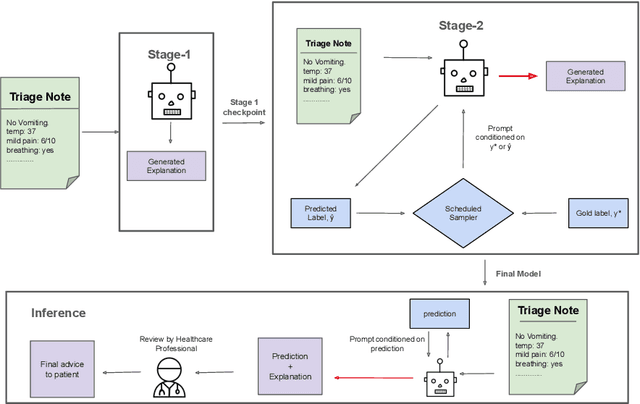
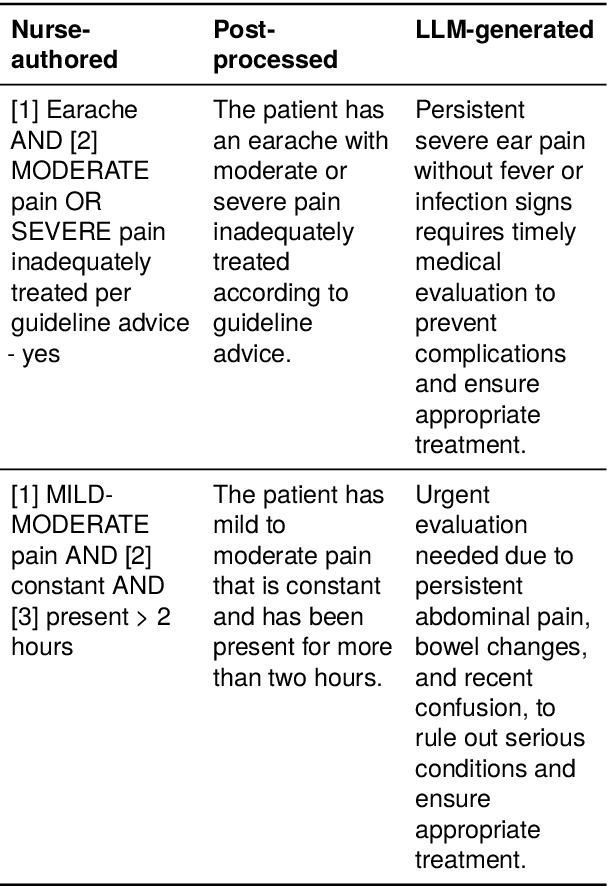
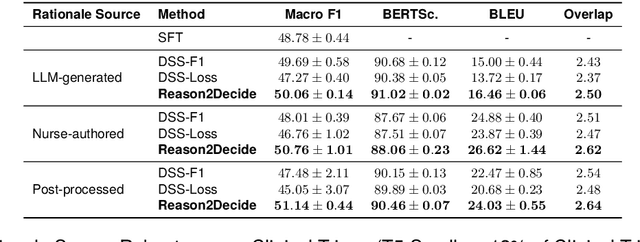
Despite the wide adoption of Large Language Models (LLM)s, clinical decision support systems face a critical challenge: achieving high predictive accuracy while generating explanations aligned with the predictions. Current approaches suffer from exposure bias leading to misaligned explanations. We propose Reason2Decide, a two-stage training framework that addresses key challenges in self-rationalization, including exposure bias and task separation. In Stage-1, our model is trained on rationale generation, while in Stage-2, we jointly train on label prediction and rationale generation, applying scheduled sampling to gradually transition from conditioning on gold labels to model predictions. We evaluate Reason2Decide on three medical datasets, including a proprietary triage dataset and public biomedical QA datasets. Across model sizes, Reason2Decide outperforms other fine-tuning baselines and some zero-shot LLMs in prediction (F1) and rationale fidelity (BERTScore, BLEU, LLM-as-a-Judge). In triage, Reason2Decide is rationale source-robust across LLM-generated, nurse-authored, and nurse-post-processed rationales. In our experiments, while using only LLM-generated rationales in Stage-1, Reason2Decide outperforms other fine-tuning variants. This indicates that LLM-generated rationales are suitable for pretraining models, reducing reliance on human annotations. Remarkably, Reason2Decide achieves these gains with models 40x smaller than contemporary foundation models, making clinical reasoning more accessible for resource-constrained deployments while still providing explainable decision support.
On Generality and Knowledge Transferability in Cross-Domain Duplicate Question Detection for Heterogeneous Community Question Answering
Nov 15, 2018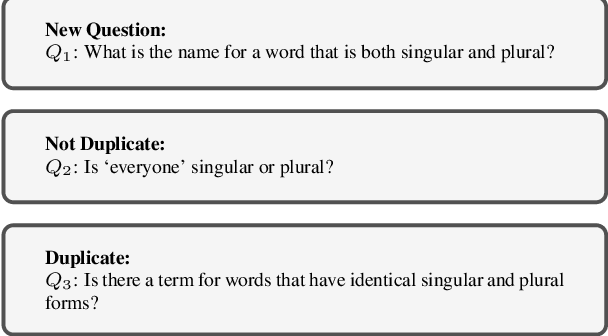
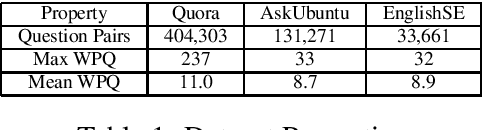
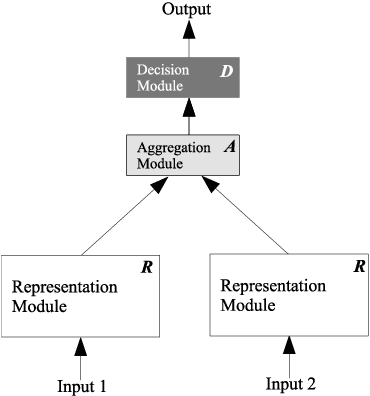
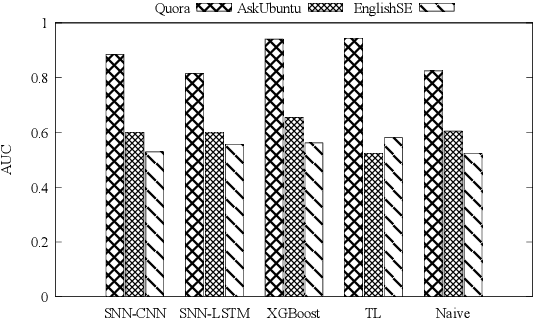
Duplicate question detection is an ongoing challenge in community question answering because semantically equivalent questions can have significantly different words and structures. In addition, the identification of duplicate questions can reduce the resources required for retrieval, when the same questions are not repeated. This study compares the performance of deep neural networks and gradient tree boosting, and explores the possibility of domain adaptation with transfer learning to improve the under-performing target domains for the text-pair duplicates classification task, using three heterogeneous datasets: general-purpose Quora, technical Ask Ubuntu, and academic English Stack Exchange. Ultimately, our study exposes the alternative hypothesis that the meaning of a "duplicate" is not inherently general-purpose, but rather is dependent on the domain of learning, hence reducing the chance of transfer learning through adapting to the domain.