 Add to Chrome
 Add to Firefox
 Add to Edge
Sling2Sim2Real: One-Shot Elastic System Identification for Non-Destructive Slingshot Policy Learning
Jul 25, 2026
Elastic object manipulation (EOM) involves highdimensional, nonlinear, and elastic deformations. The diverse deformation properties of elastic objects substantially expand the relevant state space, requiring extensive exploration to learn accurate manipulation policies for tasks such as slingshot manipulation. While simulation enables large-scale and safe exploration compared to costly and potentially destructive real-world trials (e.g., repeated projectile launches), accurately calibrating elastic behavior between the real world and simulation remains challenging since elastic properties are largely indistinguishable from visual observations alone. To address these challenges, we propose Sling2Sim2Real, a one-shot Real2Sim2Real framework that identifies elastic parameters from a single non-destructive interaction and enables policy learning in simulation. The framework consists of two stages: 1) a multi-start Real2Sim system identification method that exploits parameter covariance to estimate elastic properties, and 2) simulation-based policy learning followed by zero-shot Sim2Real transfer using the calibrated simulator. We evaluate Sling2Sim2Real on a slingshot manipulation task using a Franka Emika Panda arm and elastic bands with diverse physical properties across varying target distances. Experimental results demonstrate that Sling2Sim2Real achieves accurate policy learning and robust generalization while significantly reducing the amount of required real-world interaction.

FRAG: Frequency Adapting Group for Diffusion Video Editing
Jun 10, 2024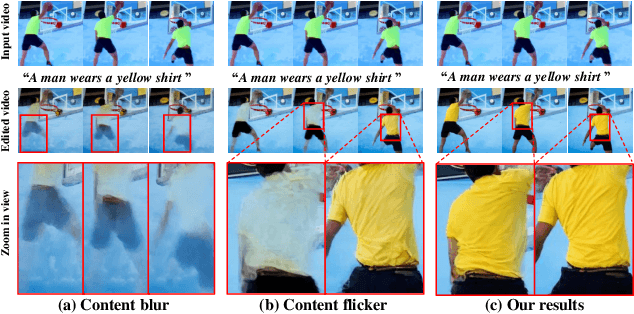
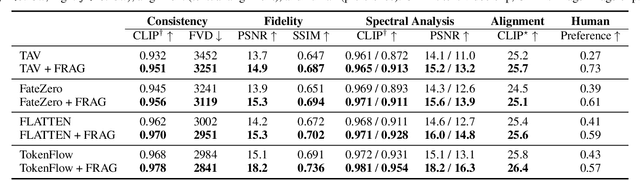
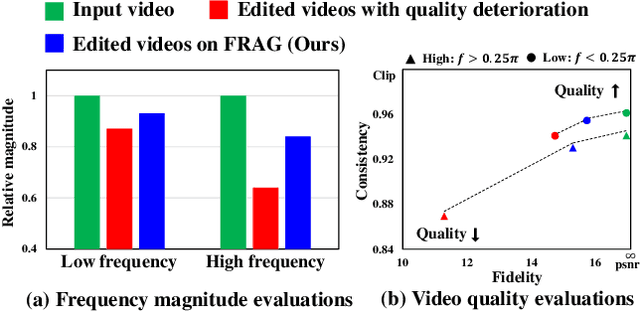
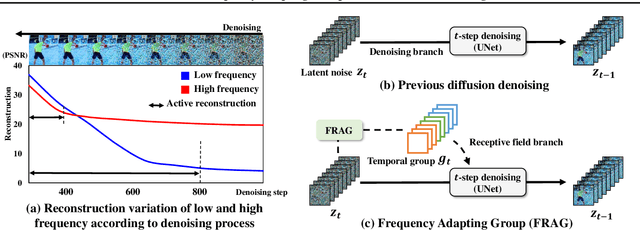
In video editing, the hallmark of a quality edit lies in its consistent and unobtrusive adjustment. Modification, when integrated, must be smooth and subtle, preserving the natural flow and aligning seamlessly with the original vision. Therefore, our primary focus is on overcoming the current challenges in high quality edit to ensure that each edit enhances the final product without disrupting its intended essence. However, quality deterioration such as blurring and flickering is routinely observed in recent diffusion video editing systems. We confirm that this deterioration often stems from high-frequency leak: the diffusion model fails to accurately synthesize high-frequency components during denoising process. To this end, we devise Frequency Adapting Group (FRAG) which enhances the video quality in terms of consistency and fidelity by introducing a novel receptive field branch to preserve high-frequency components during the denoising process. FRAG is performed in a model-agnostic manner without additional training and validates the effectiveness on video editing benchmarks (i.e., TGVE, DAVIS).