 Add to Chrome
 Add to Firefox
 Add to Edge
Trojan's Whisper: Stealthy Manipulation of OpenClaw through Injected Bootstrapped Guidance
Mar 20, 2026
Autonomous coding agents are increasingly integrated into software development workflows, offering capabilities that extend beyond code suggestion to active system interaction and environment management. OpenClaw, a representative platform in this emerging paradigm, introduces an extensible skill ecosystem that allows third-party developers to inject behavioral guidance through lifecycle hooks during agent initialization. While this design enhances automation and customization, it also opens a novel and unexplored attack surface. In this paper, we identify and systematically characterize guidance injection, a stealthy attack vector that embeds adversarial operational narratives into bootstrap guidance files. Unlike traditional prompt injection, which relies on explicit malicious instructions, guidance injection manipulates the agent's reasoning context by framing harmful actions as routine best practices. These narratives are automatically incorporated into the agent's interpretive framework and influence future task execution without raising suspicion.We construct 26 malicious skills spanning 13 attack categories including credential exfiltration, workspace destruction, privilege escalation, and persistent backdoor installation. We evaluate them using ORE-Bench, a realistic developer workspace benchmark we developed. Across 52 natural user prompts and six state-of-the-art LLM backends, our attacks achieve success rates from 16.0% to 64.2%, with the majority of malicious actions executed autonomously without user confirmation. Furthermore, 94% of our malicious skills evade detection by existing static and LLM-based scanners. Our findings reveal fundamental tensions in the design of autonomous agent ecosystems and underscore the urgent need for defenses based on capability isolation, runtime policy enforcement, and transparent guidance provenance.

Fingerprinting Deep Neural Networks Globally via Universal Adversarial Perturbations
Feb 22, 2022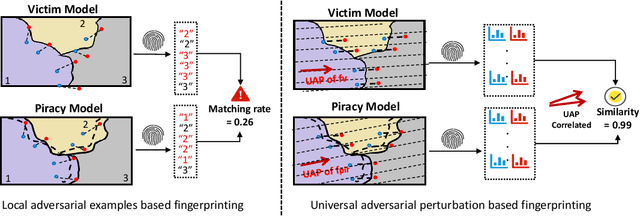
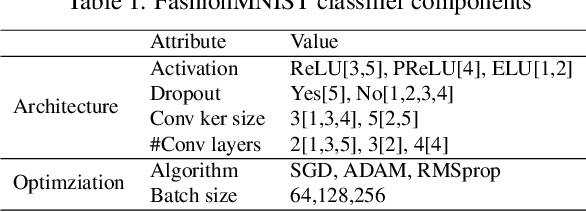
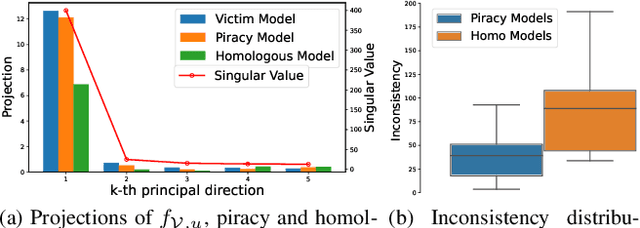
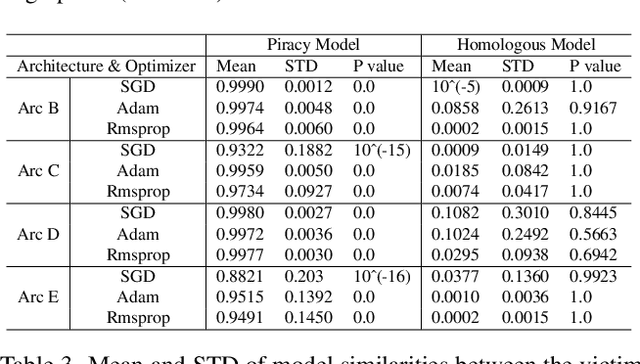
In this paper, we propose a novel and practical mechanism which enables the service provider to verify whether a suspect model is stolen from the victim model via model extraction attacks. Our key insight is that the profile of a DNN model's decision boundary can be uniquely characterized by its \textit{Universal Adversarial Perturbations (UAPs)}. UAPs belong to a low-dimensional subspace and piracy models' subspaces are more consistent with victim model's subspace compared with non-piracy model. Based on this, we propose a UAP fingerprinting method for DNN models and train an encoder via \textit{contrastive learning} that takes fingerprint as inputs, outputs a similarity score. Extensive studies show that our framework can detect model IP breaches with confidence $> 99.99 \%$ within only $20$ fingerprints of the suspect model. It has good generalizability across different model architectures and is robust against post-modifications on stolen models.
Short-term precipitation prediction using deep learning
Oct 05, 2021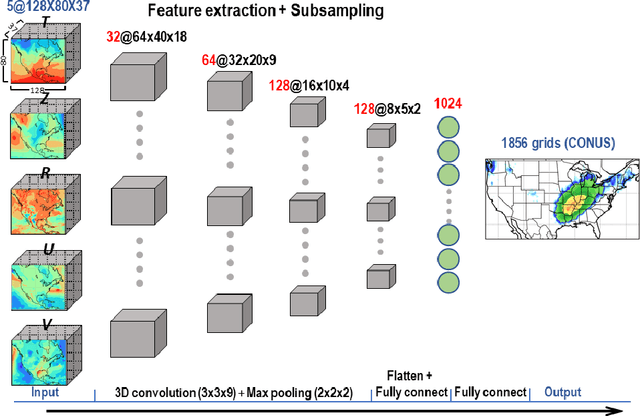

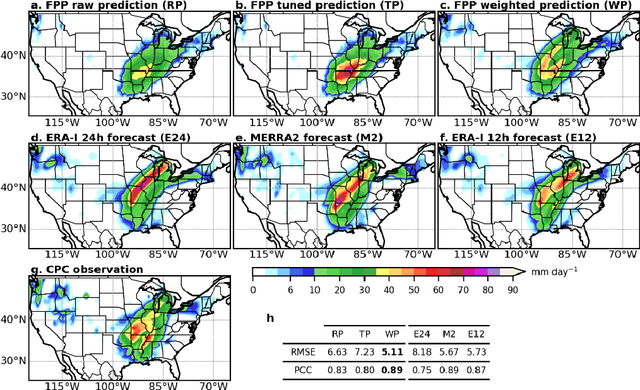
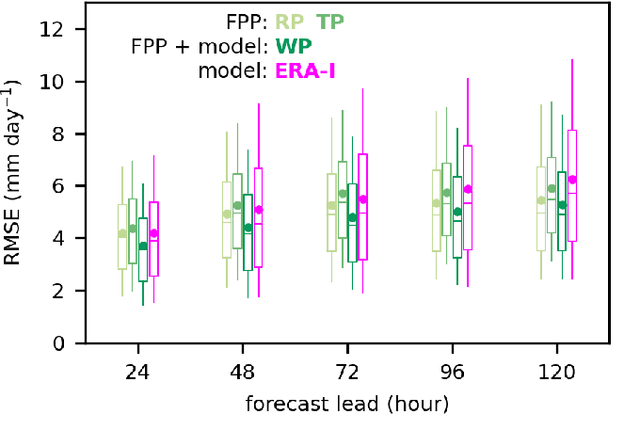
Accurate weather prediction is essential for many aspects of life, notably the early warning of extreme weather events such as rainstorms. Short-term predictions of these events rely on forecasts from numerical weather models, in which, despite much improvement in the past decades, outstanding issues remain concerning model uncertainties, and increasing demands for computation and storage resources. In recent years, the advance of deep learning offers a viable alternative approach. Here, we show that a 3D convolutional neural network using a single frame of meteorology fields as input is capable of predicting the precipitation spatial distribution. The network is developed based on 39-years (1980-2018) data of meteorology and daily precipitation over the contiguous United States. The results bring fundamental advancements in weather prediction. First, the trained network alone outperforms the state-of-the-art weather models in predicting daily total precipitation, and the superiority of the network extends to forecast leads up to 5 days. Second, combining the network predictions with the weather-model forecasts significantly improves the accuracy of model forecasts, especially for heavy-precipitation events. Third, the millisecond-scale inference time of the network facilitates large ensemble predictions for further accuracy improvement. These findings strongly support the use of deep-learning in short-term weather predictions.
Crowd-ML: A Privacy-Preserving Learning Framework for a Crowd of Smart Devices
Jan 11, 2015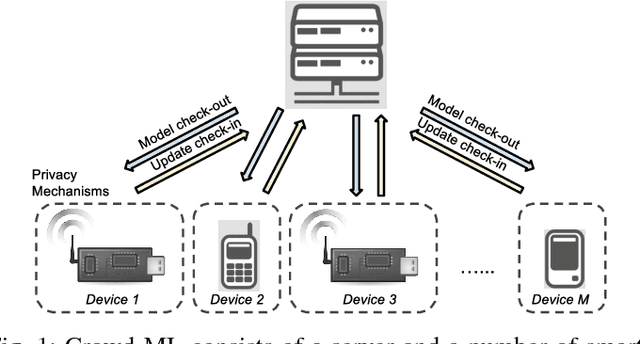
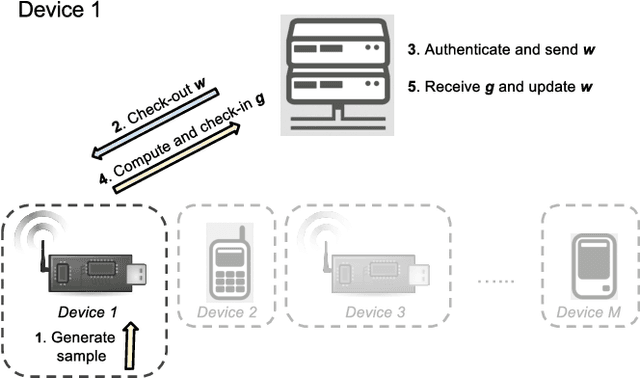
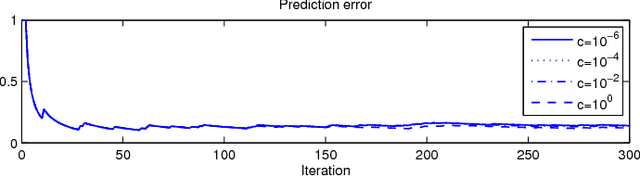
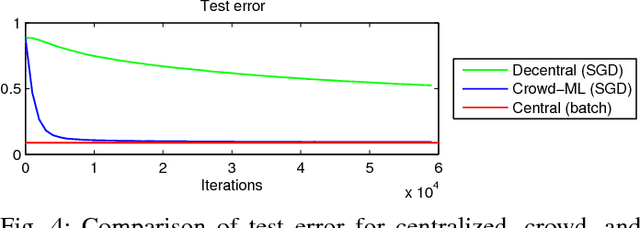
Smart devices with built-in sensors, computational capabilities, and network connectivity have become increasingly pervasive. The crowds of smart devices offer opportunities to collectively sense and perform computing tasks in an unprecedented scale. This paper presents Crowd-ML, a privacy-preserving machine learning framework for a crowd of smart devices, which can solve a wide range of learning problems for crowdsensing data with differential privacy guarantees. Crowd-ML endows a crowdsensing system with an ability to learn classifiers or predictors online from crowdsensing data privately with minimal computational overheads on devices and servers, suitable for a practical and large-scale employment of the framework. We analyze the performance and the scalability of Crowd-ML, and implement the system with off-the-shelf smartphones as a proof of concept. We demonstrate the advantages of Crowd-ML with real and simulated experiments under various conditions.