 Add to Chrome
 Add to Firefox
 Add to Edge
Bridging Reinforcement Learning and Optimal Control via Feasible Action Mapping
Jul 27, 2026
Operating constrained dynamical systems requires controllers to efficiently solve complex tasks while enforcing recursive feasibility and safety constraints. To address these competing requirements, we present Feasible Action for Optimal Control (FAOC), a novel control framework integrating Reinforcement Learning (RL) and Optimal Control (OC). The key contribution is a computationally efficient, optimization-based mapping algorithm that transforms the RL agent's action from a static abstract set into a state-dependent feasible parameter set of the Optimal Control Problem (OCP), guaranteeing strict satisfaction of the dynamical system's constraints. Thus, FAOC effectively combines the predictable safety of OC with the flexibility of RL. In contrast to prior work, the abstract action space of the RL agent does not require expert or heuristic design, and the OCP formulation is not compromised by the inability of RL to guarantee feasibility. We apply our approach to real-time motion planning for robot table tennis, which encapsulates these challenges. Via simulated experiments, we show that FAOC outperforms state-of-the-art baselines in both sample efficiency and closed-loop performance.

Ace! Motion Planning of Professional-Level Table Tennis Serves with a Robot Arm
Jul 08, 2026Table tennis, a dynamic, compact, and popular sport, has received significant attention as a robotics benchmark over the last decades. Most of the research has focused on the rally aspect - returning an incoming ball - requiring high-speed vision, agile motion planning, and tight closed-loop control. However, the other component of table tennis gameplay - the serve - is comparatively a quite unexplored research problem, that in fact requires pushing physics modeling and control to the extremes. Achieving competitive serves with a robot presents domain-specific challenges, such as high-spin generation from a spinless ball, precise aiming, or multi-objective optimization. In this work, we present a novel approach for generating official rule-compliant serves by combining motion primitives, Model Predictive Control, and Bayesian Optimization. Serves generated in this way offer a wide and controllable variation of spins of up to 550 rad/s, and speeds of up to 6.7 m/s, matching and even surpassing those of elite table tennis players.
Hardware Design for Table Tennis Robot Capable of Beating Professional Players
Jun 25, 2026This paper focuses on the hardware specifications required for a table tennis robot to beat professional players. After analyzing the motions of elite players, we defined target specifications for the workspace, payload, external-force resistance, physical performance, serve capability, and end-effector accuracy. Based on these specifications, we developed "Ace", a custom 8-DoF robot. The mechanical structure was improved through topology optimization to minimize mass while preserving stiffness. Motor and gearbox selection was optimized using an inverse-dynamics torque model. Low-order per-joint dynamics models with delay compensation were identified and integrated into simulation to enable the use of an RL control policy. Experiments demonstrated repeated full-stroke swings with a cycle time of 0.8 s and a peak racket-center velocity of 22 m/s. The robot successfully defeated multiple professional players.
Data-Driven MPC for Quadrotors
Mar 03, 2021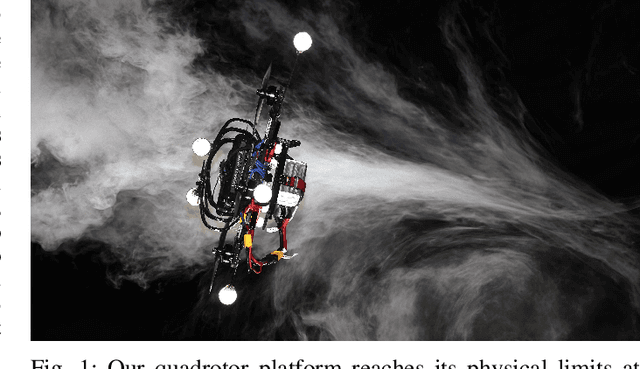
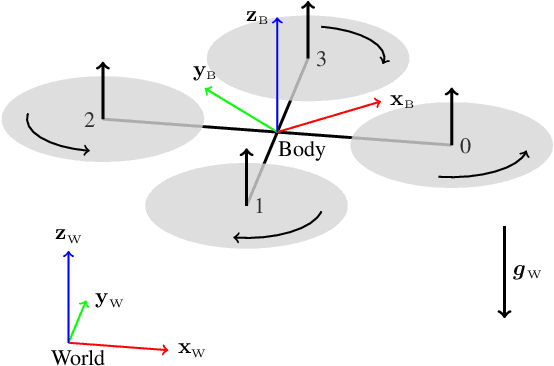
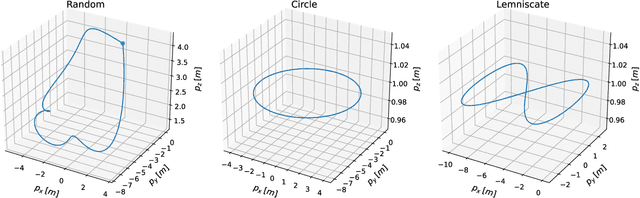
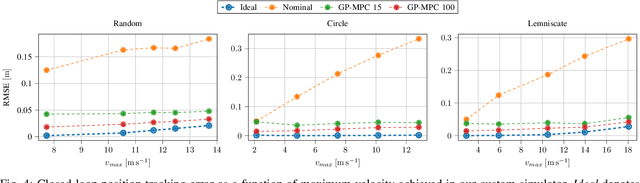
Aerodynamic forces render accurate high-speed trajectory tracking with quadrotors extremely challenging. These complex aerodynamic effects become a significant disturbance at high speeds, introducing large positional tracking errors, and are extremely difficult to model. To fly at high speeds, feedback control must be able to account for these aerodynamic effects in real-time. This necessitates a modelling procedure that is both accurate and efficient to evaluate. Therefore, we present an approach to model aerodynamic effects using Gaussian Processes, which we incorporate into a Model Predictive Controller to achieve efficient and precise real-time feedback control, leading to up to 70% reduction in trajectory tracking error at high speeds. We verify our method by extensive comparison to a state-of-the-art linear drag model in synthetic and real-world experiments at speeds of up to 14m/s and accelerations beyond 4g.
* 8 pages