 Add to Chrome
 Add to Firefox
 Add to Edge
QuietWalk: Physics-Informed Reinforcement Learning for Ground Reaction Force-Aware Humanoid Locomotion Under Diverse Footwear
Apr 26, 2026
Humanoid robots operating in human-centered environments (e.g., homes, hospitals, and offices) must mitigate foot--ground impact transients, as impact-induced vibration and noise degrade user experience and repeated impacts accelerate hardware wear. However, existing low-noise locomotion training often relies on kinematic proxy objectives or fragile force sensors, and footwear-induced changes in contact dynamics introduce distribution shifts that hinder policy generalization.We present QuietWalk, a physics-informed reinforcement learning framework for ground-reaction-force-aware humanoid locomotion under diverse footwear conditions. QuietWalk employs an inverse-dynamics-constrained physics-informed neural network (PINN) to estimate per-foot vertical ground reaction forces (GRFs) from proprioceptive signals, and integrates the frozen predictor into the RL training loop to penalize predicted impact forces without requiring force sensors at deployment.On a held-out real-robot dataset, enforcing inverse-dynamics consistency reduces vertical GRF prediction errors by 82%-86% compared with a purely supervised predictor and improves the coefficient of determination from 0.39/0.67 to 0.99/0.99 for the left/right feet. On hardware at 1.2 m/s (barefoot; averaged over four floor materials), QuietWalk reduces mean A-weighted noise level by 7.17 dB and peak noise level by 4.98 dB under a consistent recording setup. Cross-footwear experiments (barefoot, skate shoes, athletic sneakers, and high heels) across multiple surfaces further demonstrate robust adaptation to footwear-induced contact variations.

Real-time Local Feature with Global Visual Information Enhancement
Nov 20, 2022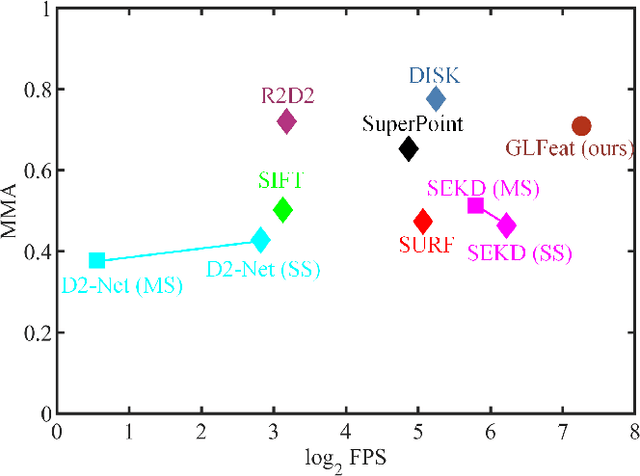
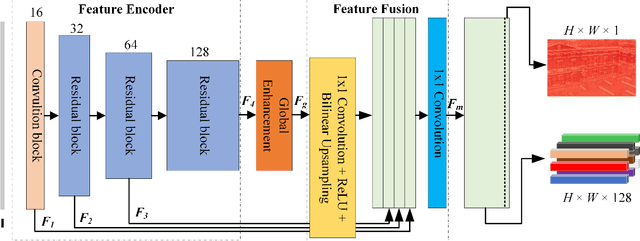
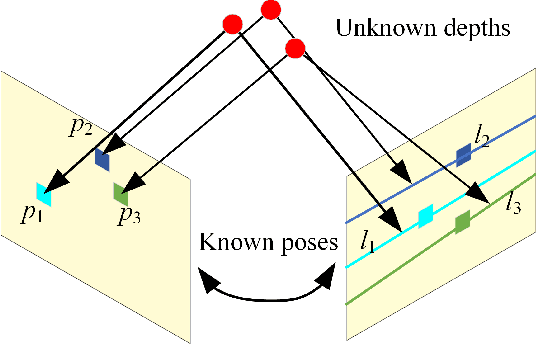
Local feature provides compact and invariant image representation for various visual tasks. Current deep learning-based local feature algorithms always utilize convolution neural network (CNN) architecture with limited receptive field. Besides, even with high-performance GPU devices, the computational efficiency of local features cannot be satisfactory. In this paper, we tackle such problems by proposing a CNN-based local feature algorithm. The proposed method introduces a global enhancement module to fuse global visual clues in a light-weight network, and then optimizes the network by novel deep reinforcement learning scheme from the perspective of local feature matching task. Experiments on the public benchmarks demonstrate that the proposal can achieve considerable robustness against visual interference and meanwhile run in real time.