 Add to Chrome
 Add to Firefox
 Add to Edge
Enroll-on-Wakeup: A First Comparative Study of Target Speech Extraction for Seamless Interaction in Real Noisy Human-Machine Dialogue Scenarios
Feb 17, 2026
Target speech extraction (TSE) typically relies on pre-recorded high-quality enrollment speech, which disrupts user experience and limits feasibility in spontaneous interaction. In this paper, we propose Enroll-on-Wakeup (EoW), a novel framework where the wake-word segment, captured naturally during human-machine interaction, is automatically utilized as the enrollment reference. This eliminates the need for pre-collected speech to enable a seamless experience. We perform the first systematic study of EoW-TSE, evaluating advanced discriminative and generative models under real diverse acoustic conditions. Given the short and noisy nature of wake-word segments, we investigate enrollment augmentation using LLM-based TTS. Results show that while current TSE models face performance degradation in EoW-TSE, TTS-based assistance significantly enhances the listening experience, though gaps remain in speech recognition accuracy.

A Mask Free Neural Network for Monaural Speech Enhancement
Jun 07, 2023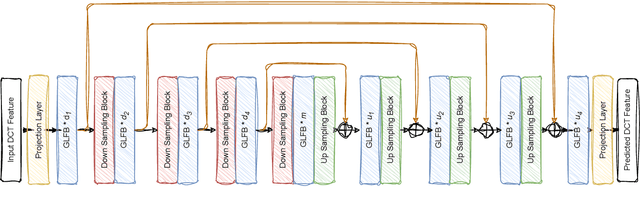
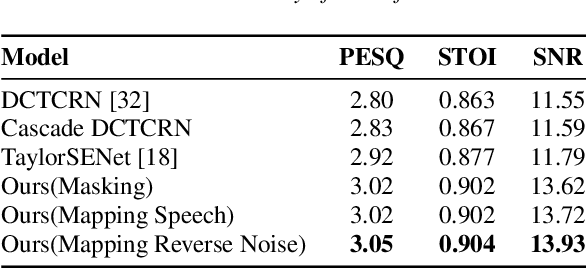
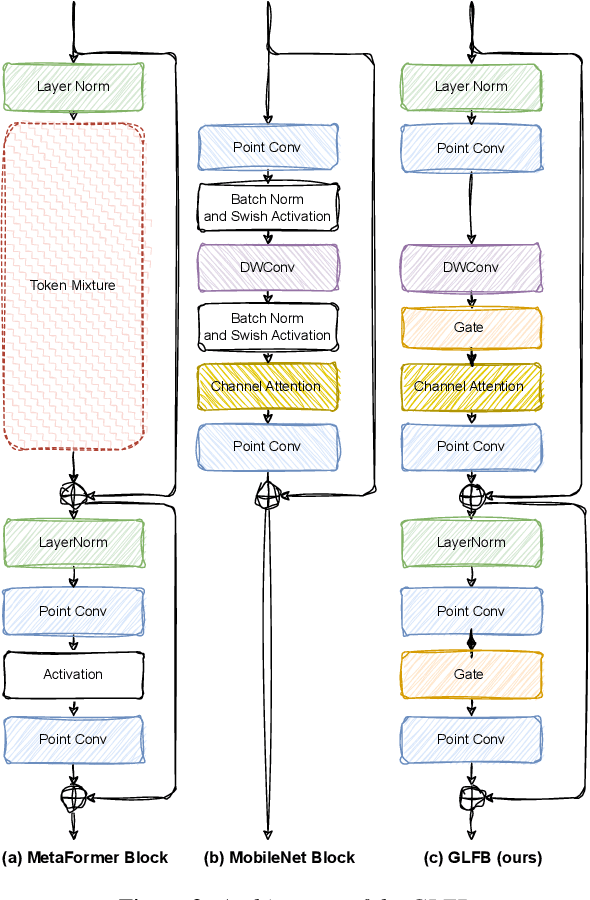
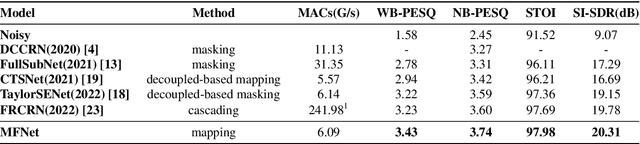
In speech enhancement, the lack of clear structural characteristics in the target speech phase requires the use of conservative and cumbersome network frameworks. It seems difficult to achieve competitive performance using direct methods and simple network architectures. However, we propose the MFNet, a direct and simple network that can not only map speech but also map reverse noise. This network is constructed by stacking global local former blocks (GLFBs), which combine the advantages of Mobileblock for global processing and Metaformer architecture for local interaction. Our experimental results demonstrate that our network using mapping method outperforms masking methods, and direct mapping of reverse noise is the optimal solution in strong noise environments. In a horizontal comparison on the 2020 Deep Noise Suppression (DNS) challenge test set without reverberation, to the best of our knowledge, MFNet is the current state-of-the-art (SOTA) mapping model.