 Add to Chrome
 Add to Firefox
 Add to Edge
TSCA-Net: Temporal-Spatial Clique Attention for Interpretable Multimodal Pedestrian Trajectory Prediction
Jul 11, 2026
Accurate pedestrian trajectory prediction in crowded environments remains challenging due to the multimodal uncertainty of human motion and the variable complexity of motion dynamics across different scene contexts. Existing goal-conditioned models rely on static displacement structures that assign equal weight to all historical time steps, standard graph attention mechanisms, and fixed-capacity motion decoders that cannot adapt to local prediction complexity. To address these limitations, we propose TSCA-Net, a trajectory prediction framework built upon three complementary modules. The Temporal-Spatial Clique Attention (TSCA) module introduces learnable temporal gating into clique-based goal-history interaction, enabling time-aware modulation of historical observations relative to each candidate goal. The Cross-Pedestrian Clique Potential (CPCP) module models asymmetric pairwise agent relationships through a dynamic clique potential framework with a time-varying social graph. The Adaptive KAN Grid Refinement (AKGR) mechanism dynamically adjusts the B-spline grid resolution of a Kolmogorov-Arnold Network-augmented LSTM decoder based on per-agent goal distribution entropy, balancing model expressiveness against overfitting across varying motion complexities. Extensive experiments on the ETH/UCY and Stanford Drone Dataset benchmarks demonstrate that TSCA-Net achieves state-of-the-art performance, with average ADE/FDE of 0.13/0.20 m on ETH/UCY and 6.95/10.43 pixels on SDD. Comprehensive ablation studies confirm the complementary contributions of all three proposed modules.

GenDiff: A Dose and Anatomy Aware Diffusion Model with Structural Prior Refinement for Low-Dose CT Reconstruction and Generalization
Jul 11, 2026Computed tomography (CT) is a critical imaging modality for clinical diagnosis, but reducing radiation dose inevitably introduces severe noise and structured artifacts that degrade image quality. Existing deep learning-based low-dose CT (LDCT) reconstruction methods are typically optimized for fixed dose levels or specific anatomical regions, limiting their robustness and generalization in realistic clinical settings. We propose GenDiff, a generalizable diffusion-based framework for LDCT reconstruction that jointly models continuous radiation dose and anatomical information within a unified reconstruction network. The proposed framework integrates a Dose-Anatomy Encoder to learn acquisition-aware embeddings, a dose- and anatomy-conditioned cold diffusion backbone for iterative refinement, a physics-consistency update to enforce fidelity to the CT forward model, and a Structural Prior Refinement Module (SPRM) that preserves anatomical structures while suppressing dose-dependent artifacts. Extensive experiments on multi-anatomy clinical datasets, including unseen ultra-low-dose conditions as well as out-of-distribution phantom and animal datasets, demonstrate that GenDiff consistently outperforms state-of-the-art convolutional neural network and diffusion-based reconstruction methods. The proposed approach achieves superior reconstruction quality while maintaining strong robustness across different dose levels, anatomical regions, and acquisition domains, making it a promising solution for practical low-dose CT imaging.
MSA-GCN:Multiscale Adaptive Graph Convolution Network for Gait Emotion Recognition
Sep 19, 2022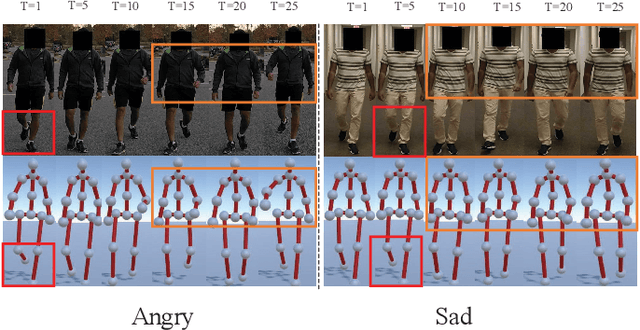
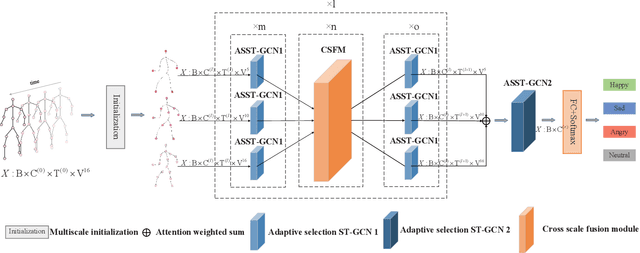
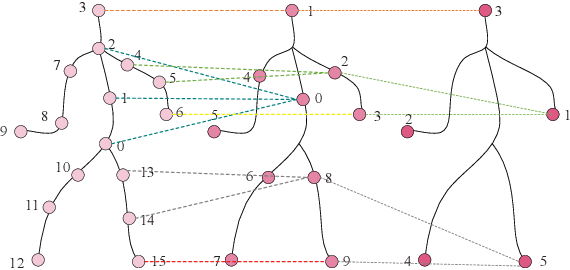
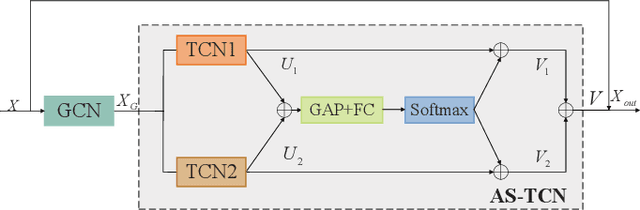
Gait emotion recognition plays a crucial role in the intelligent system. Most of the existing methods recognize emotions by focusing on local actions over time. However, they ignore that the effective distances of different emotions in the time domain are different, and the local actions during walking are quite similar. Thus, emotions should be represented by global states instead of indirect local actions. To address these issues, a novel Multi Scale Adaptive Graph Convolution Network (MSA-GCN) is presented in this work through constructing dynamic temporal receptive fields and designing multiscale information aggregation to recognize emotions. In our model, a adaptive selective spatial-temporal graph convolution is designed to select the convolution kernel dynamically to obtain the soft spatio-temporal features of different emotions. Moreover, a Cross-Scale mapping Fusion Mechanism (CSFM) is designed to construct an adaptive adjacency matrix to enhance information interaction and reduce redundancy. Compared with previous state-of-the-art methods, the proposed method achieves the best performance on two public datasets, improving the mAP by 2\%. We also conduct extensive ablations studies to show the effectiveness of different components in our methods.