 Add to Chrome
 Add to Firefox
 Add to Edge
Adaptive Cross-Modal Fusion with Sparse Attention for Pedestrian Crossing Intention Prediction
Jul 14, 2026
Predicting pedestrian crossing intention is a safety-critical task for autonomous driving, yet existing approaches often rely on single-modal inputs or dense multimodal fusion strategies that inadequately capture complementary visual and kinematic information while introducing redundant inter-modal interactions. We propose ADAPT (Adaptive Domain-Aware Pedestrian Crossing Transformer), a multimodal framework that jointly models local and global visual context together with temporal motion dynamics for accurate pedestrian crossing intention prediction. ADAPT processes four spatially aligned visual modalities, including RGB images, local depth maps, global semantic maps, and global depth maps, together with ego-vehicle speed, pedestrian bounding boxes, and skeleton pose information through five specialized modules: a weight-shared Swin Transformer V2 backbone for visual feature extraction, a Cross-Modality Guided Attention module for hierarchical visual fusion, a Mamba-based Motion Feature Encoding module for efficient temporal modeling, a Sparse Cross-Modal Attention module that selectively preserves the most informative inter-modal interactions, and a Vision Transformer-based Temporal Feature Fusion module for sequence-level prediction. Extensive experiments on the JAAD and PIE benchmark datasets demonstrate that ADAPT consistently outperforms existing state-of-the-art methods while maintaining low computational complexity. On JAAD, the proposed method achieves an AUC of 0.73 on JAADbeh and 0.85 on JAADall, while on PIE it achieves an accuracy of 0.92 and an AUC of 0.90. Furthermore, ADAPT performs inference in only 17.23 ms per sample, offering an effective balance between predictive accuracy and real-time deployment efficiency for intelligent transportation and autonomous driving applications.

TSCA-Net: Temporal-Spatial Clique Attention for Interpretable Multimodal Pedestrian Trajectory Prediction
Jul 11, 2026Accurate pedestrian trajectory prediction in crowded environments remains challenging due to the multimodal uncertainty of human motion and the variable complexity of motion dynamics across different scene contexts. Existing goal-conditioned models rely on static displacement structures that assign equal weight to all historical time steps, standard graph attention mechanisms, and fixed-capacity motion decoders that cannot adapt to local prediction complexity. To address these limitations, we propose TSCA-Net, a trajectory prediction framework built upon three complementary modules. The Temporal-Spatial Clique Attention (TSCA) module introduces learnable temporal gating into clique-based goal-history interaction, enabling time-aware modulation of historical observations relative to each candidate goal. The Cross-Pedestrian Clique Potential (CPCP) module models asymmetric pairwise agent relationships through a dynamic clique potential framework with a time-varying social graph. The Adaptive KAN Grid Refinement (AKGR) mechanism dynamically adjusts the B-spline grid resolution of a Kolmogorov-Arnold Network-augmented LSTM decoder based on per-agent goal distribution entropy, balancing model expressiveness against overfitting across varying motion complexities. Extensive experiments on the ETH/UCY and Stanford Drone Dataset benchmarks demonstrate that TSCA-Net achieves state-of-the-art performance, with average ADE/FDE of 0.13/0.20 m on ETH/UCY and 6.95/10.43 pixels on SDD. Comprehensive ablation studies confirm the complementary contributions of all three proposed modules.
GenDiff: A Dose and Anatomy Aware Diffusion Model with Structural Prior Refinement for Low-Dose CT Reconstruction and Generalization
Jul 11, 2026Computed tomography (CT) is a critical imaging modality for clinical diagnosis, but reducing radiation dose inevitably introduces severe noise and structured artifacts that degrade image quality. Existing deep learning-based low-dose CT (LDCT) reconstruction methods are typically optimized for fixed dose levels or specific anatomical regions, limiting their robustness and generalization in realistic clinical settings. We propose GenDiff, a generalizable diffusion-based framework for LDCT reconstruction that jointly models continuous radiation dose and anatomical information within a unified reconstruction network. The proposed framework integrates a Dose-Anatomy Encoder to learn acquisition-aware embeddings, a dose- and anatomy-conditioned cold diffusion backbone for iterative refinement, a physics-consistency update to enforce fidelity to the CT forward model, and a Structural Prior Refinement Module (SPRM) that preserves anatomical structures while suppressing dose-dependent artifacts. Extensive experiments on multi-anatomy clinical datasets, including unseen ultra-low-dose conditions as well as out-of-distribution phantom and animal datasets, demonstrate that GenDiff consistently outperforms state-of-the-art convolutional neural network and diffusion-based reconstruction methods. The proposed approach achieves superior reconstruction quality while maintaining strong robustness across different dose levels, anatomical regions, and acquisition domains, making it a promising solution for practical low-dose CT imaging.
Geometrically Guided Integrated Gradients
Jun 16, 2022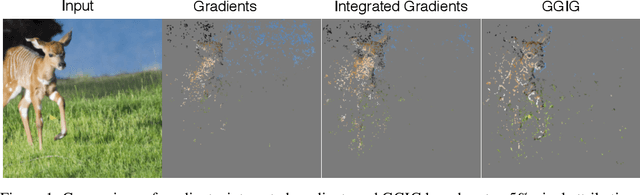
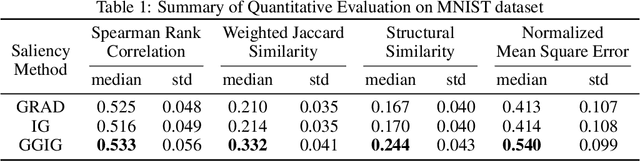
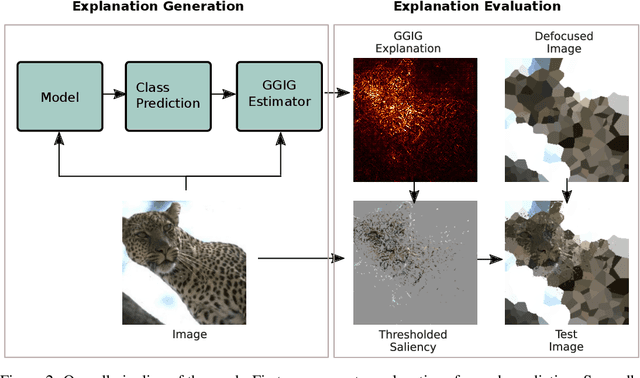
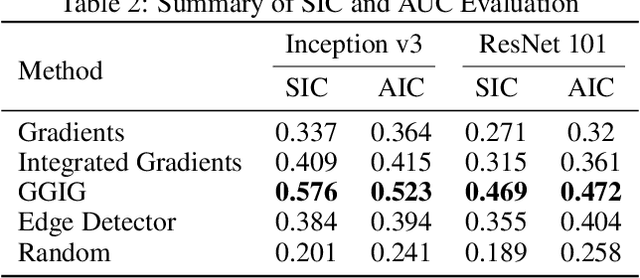
Interpretability methods for deep neural networks mainly focus on the sensitivity of the class score with respect to the original or perturbed input, usually measured using actual or modified gradients. Some methods also use a model-agnostic approach to understanding the rationale behind every prediction. In this paper, we argue and demonstrate that local geometry of the model parameter space relative to the input can also be beneficial for improved post-hoc explanations. To achieve this goal, we introduce an interpretability method called "geometrically-guided integrated gradients" that builds on top of the gradient calculation along a linear path as traditionally used in integrated gradient methods. However, instead of integrating gradient information, our method explores the model's dynamic behavior from multiple scaled versions of the input and captures the best possible attribution for each input. We demonstrate through extensive experiments that the proposed approach outperforms vanilla and integrated gradients in subjective and quantitative assessment. We also propose a "model perturbation" sanity check to complement the traditionally used "model randomization" test.
Whole MILC: generalizing learned dynamics across tasks, datasets, and populations
Jul 29, 2020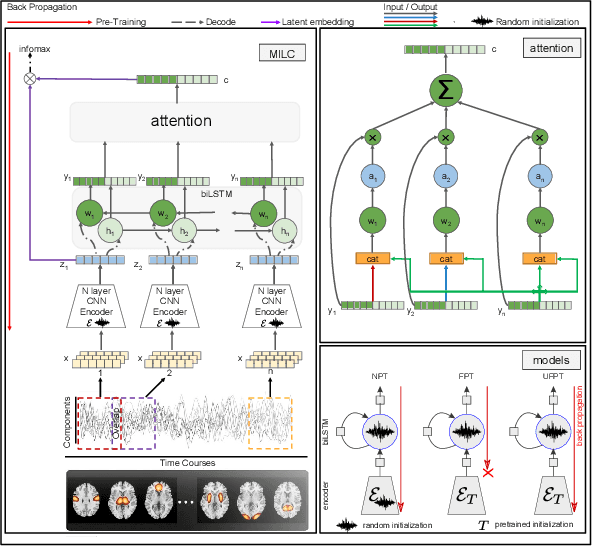
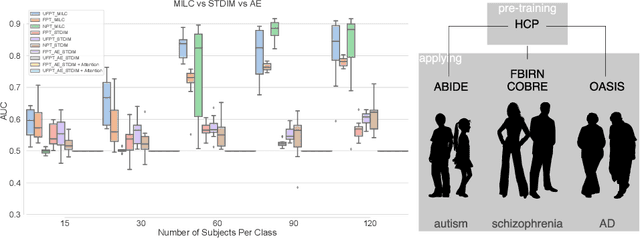
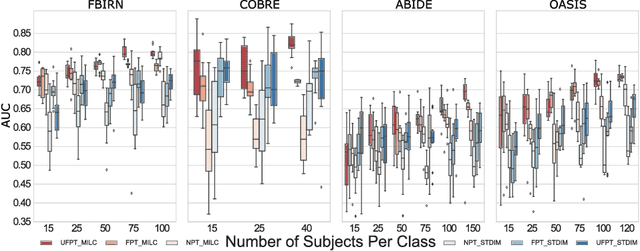
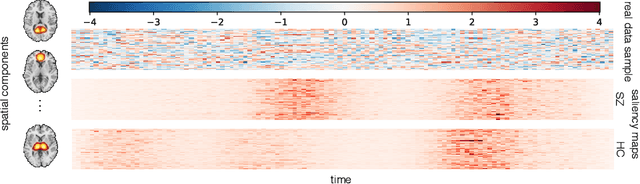
Behavioral changes are the earliest signs of a mental disorder, but arguably, the dynamics of brain function gets affected even earlier. Subsequently, spatio-temporal structure of disorder-specific dynamics is crucial for early diagnosis and understanding the disorder mechanism. A common way of learning discriminatory features relies on training a classifier and evaluating feature importance. Classical classifiers, based on handcrafted features are quite powerful, but suffer the curse of dimensionality when applied to large input dimensions of spatio-temporal data. Deep learning algorithms could handle the problem and a model introspection could highlight discriminatory spatio-temporal regions but need way more samples to train. In this paper we present a novel self supervised training schema which reinforces whole sequence mutual information local to context (whole MILC). We pre-train the whole MILC model on unlabeled and unrelated healthy control data. We test our model on three different disorders (i) Schizophrenia (ii) Autism and (iii) Alzheimers and four different studies. Our algorithm outperforms existing self-supervised pre-training methods and provides competitive classification results to classical machine learning algorithms. Importantly, whole MILC enables attribution of subject diagnosis to specific spatio-temporal regions in the fMRI signal.
Transfer Learning of fMRI Dynamics
Nov 16, 2019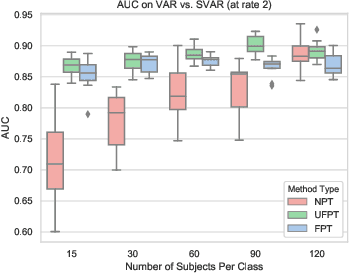
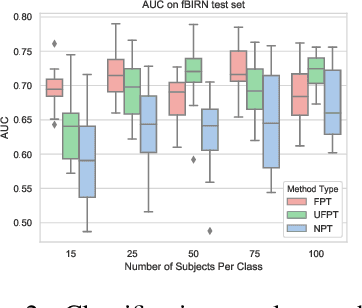
As a mental disorder progresses, it may affect brain structure, but brain function expressed in brain dynamics is affected much earlier. Capturing the moment when brain dynamics express the disorder is crucial for early diagnosis. The traditional approach to this problem via training classifiers either proceeds from handcrafted features or requires large datasets to combat the $m>>n$ problem when a high dimensional fMRI volume only has a single label that carries learning signal. Large datasets may not be available for a study of each disorder, or rare disorder types or sub-populations may not warrant for them. In this paper, we demonstrate a self-supervised pre-training method that enables us to pre-train directly on fMRI dynamics of healthy control subjects and transfer the learning to much smaller datasets of schizophrenia. Not only we enable classification of disorder directly based on fMRI dynamics in small data but also significantly speed up the learning when possible. This is encouraging evidence of informative transfer learning across datasets and diagnostic categories.
GLIMPS: A Greedy Mixed Integer Approach for Super Robust Matched Subspace Detection
Oct 29, 2019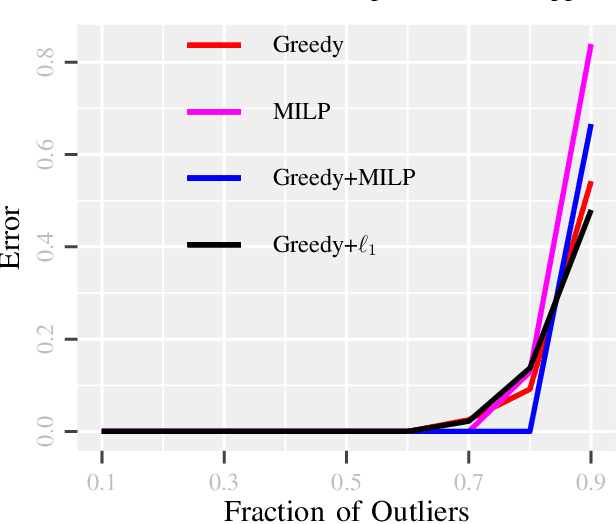
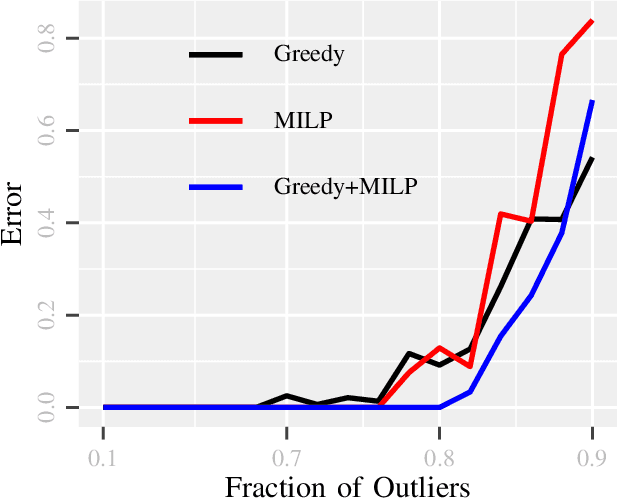
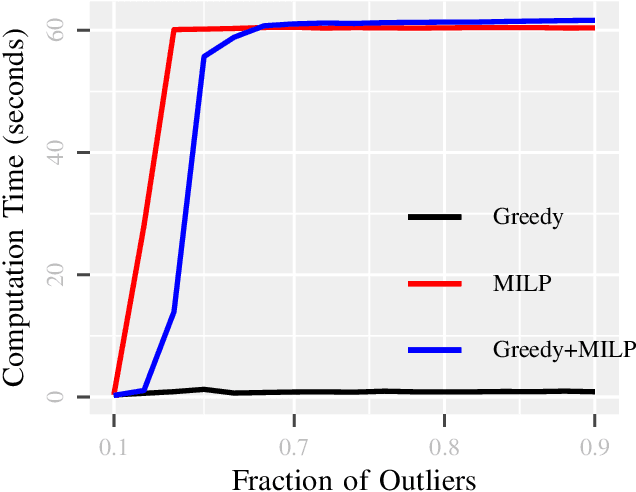
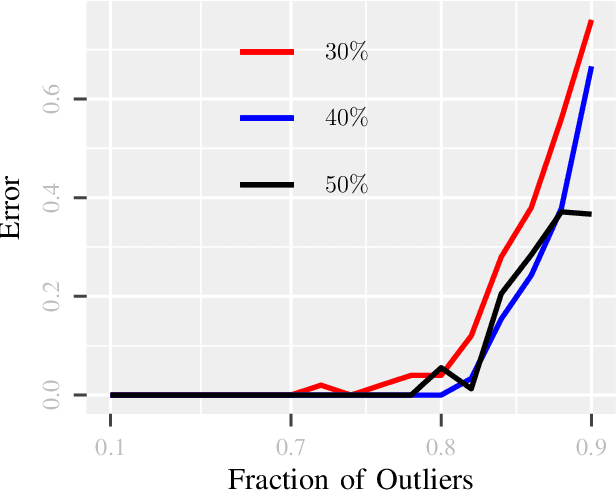
Due to diverse nature of data acquisition and modern applications, many contemporary problems involve high dimensional datum $\x \in \R^\d$ whose entries often lie in a union of subspaces and the goal is to find out which entries of $\x$ match with a particular subspace $\sU$, classically called \emph {matched subspace detection}. Consequently, entries that match with one subspace are considered as inliers w.r.t the subspace while all other entries are considered as outliers. Proportion of outliers relative to each subspace varies based on the degree of coordinates from subspaces. This problem is a combinatorial NP-hard in nature and has been immensely studied in recent years. Existing approaches can solve the problem when outliers are sparse. However, if outliers are abundant or in other words if $\x$ contains coordinates from a fair amount of subspaces, this problem can't be solved with acceptable accuracy or within a reasonable amount of time. This paper proposes a two-stage approach called \emph{Greedy Linear Integer Mixed Programmed Selector} (GLIMPS) for this abundant-outliers setting, which combines a greedy algorithm and mixed integer formulation and can tolerate over 80\% outliers, outperforming the state-of-the-art.