 Add to Chrome
 Add to Firefox
 Add to Edge
Hiding in Plain Sight: Finding MAHA on Reddit
May 19, 2026
Make America Healthy Again (MAHA) is a national health movement that encompasses a striking mix of beliefs, from broadly accepted concerns about good diet and exercise to controversial takes on organic and genetically modified food, childhood vaccination, science, and institutions. Various influencers and promoters of the MAHA movement on social media are scattered throughout the online space. Investigating the structure, discourse, and contagion of MAHA beliefs requires large-scale fine-grained digital footprints. Constructing structured data covering different MAHA themes from vast unstructured social media data is challenging. We introduce a Reddit dataset that spans six years (2020-2025), comprising 19.4M posts from 4M users. Containing the natural and thematic context of 12 MAHA-aligned beliefs, this dataset offers researchers from various domains the opportunity to study the dynamics of the MAHA movement, its structural and functional components, and the linguistic and behavioral patterns of its proponents.

Pairwise Spatiotemporal Partial Trajectory Matching for Co-movement Analysis
Dec 03, 2024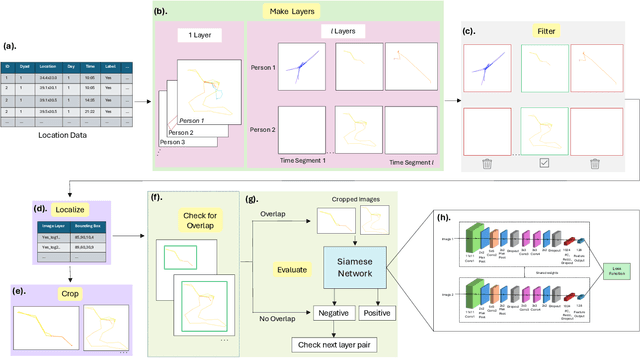
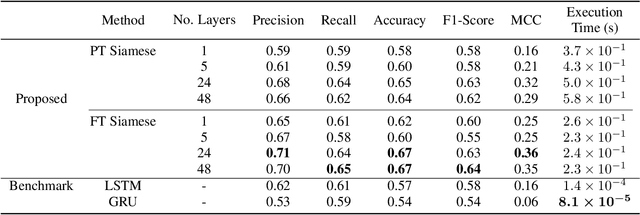
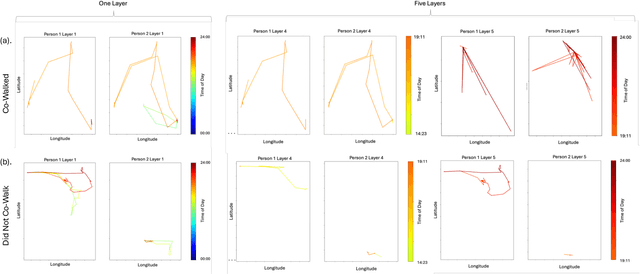
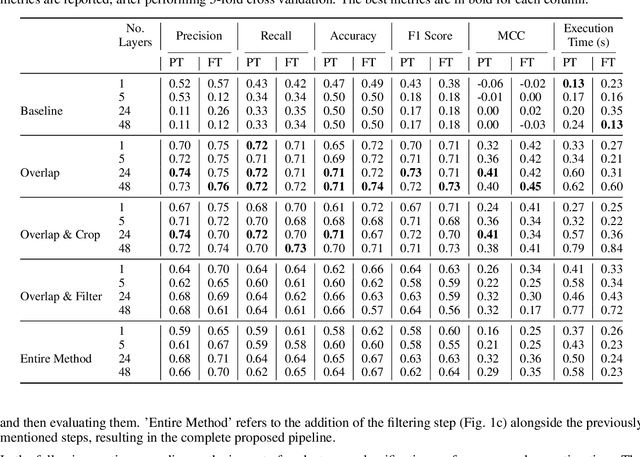
Spatiotemporal pairwise movement analysis involves identifying shared geographic-based behaviors between individuals within specific time frames. Traditionally, this task relies on sequence modeling and behavior analysis techniques applied to tabular or video-based data, but these methods often lack interpretability and struggle to capture partial matching. In this paper, we propose a novel method for pairwise spatiotemporal partial trajectory matching that transforms tabular spatiotemporal data into interpretable trajectory images based on specified time windows, allowing for partial trajectory analysis. This approach includes localization of trajectories, checking for spatial overlap, and pairwise matching using a Siamese Neural Network. We evaluate our method on a co-walking classification task, demonstrating its effectiveness in a novel co-behavior identification application. Our model surpasses established methods, achieving an F1-score up to 0.73. Additionally, we explore the method's utility for pair routine pattern analysis in real-world scenarios, providing insights into the frequency, timing, and duration of shared behaviors. This approach offers a powerful, interpretable framework for spatiotemporal behavior analysis, with potential applications in social behavior research, urban planning, and healthcare.