 Add to Chrome
 Add to Firefox
 Add to Edge
Adapting Natural Language Processing Models Across Jurisdictions: A pilot Study in Canadian Cancer Registries
Jan 02, 2026
Population-based cancer registries depend on pathology reports as their primary diagnostic source, yet manual abstraction is resource-intensive and contributes to delays in cancer data. While transformer-based NLP systems have improved registry workflows, their ability to generalize across jurisdictions with differing reporting conventions remains poorly understood. We present the first cross-provincial evaluation of adapting BCCRTron, a domain-adapted transformer model developed at the British Columbia Cancer Registry, alongside GatorTron, a biomedical transformer model, for cancer surveillance in Canada. Our training dataset consisted of approximately 104,000 and 22,000 de-identified pathology reports from the Newfoundland & Labrador Cancer Registry (NLCR) for Tier 1 (cancer vs. non-cancer) and Tier 2 (reportable vs. non-reportable) tasks, respectively. Both models were fine-tuned using complementary synoptic and diagnosis focused report section input pipelines. Across NLCR test sets, the adapted models maintained high performance, demonstrating transformers pretrained in one jurisdiction can be localized to another with modest fine-tuning. To improve sensitivity, we combined the two models using a conservative OR-ensemble achieving a Tier 1 recall of 0.99 and reduced missed cancers to 24, compared with 48 and 54 for the standalone models. For Tier 2, the ensemble achieved 0.99 recall and reduced missed reportable cancers to 33, compared with 54 and 46 for the individual models. These findings demonstrate that an ensemble combining complementary text representations substantially reduce missed cancers and improve error coverage in cancer-registry NLP. We implement a privacy-preserving workflow in which only model weights are shared between provinces, supporting interoperable NLP infrastructure and a future pan-Canadian foundation model for cancer pathology and registry workflows.

Full Field Digital Mammography Dataset from a Population Screening Program
Nov 05, 2024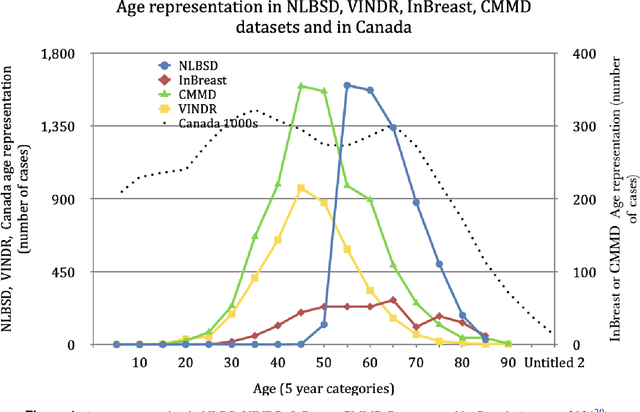
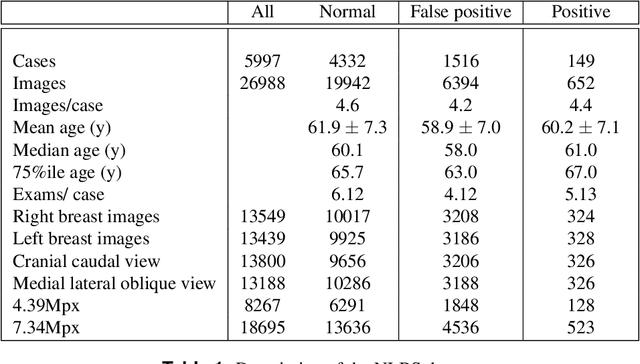
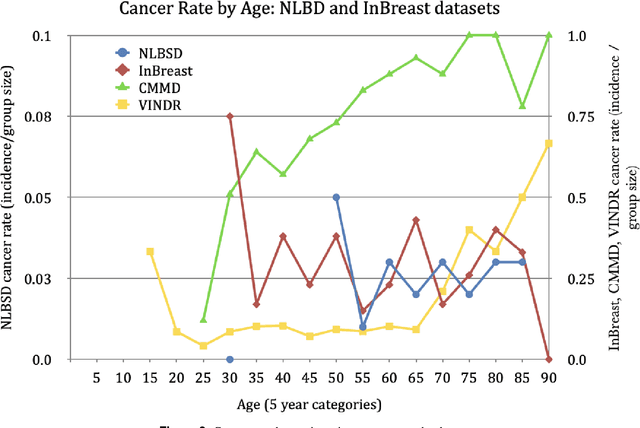
Breast cancer presents the second largest cancer risk in the world to women. Early detection of cancer has been shown to be effective in reducing mortality. Population screening programs schedule regular mammography imaging for participants, promoting early detection. Currently, such screening programs require manual reading. False-positive errors in the reading process unnecessarily leads to costly follow-up and patient anxiety. Automated methods promise to provide more efficient, consistent and effective reading. To facilitate their development, a number of datasets have been created. With the aim of specifically targeting population screening programs, we introduce NL-Breast-Screening, a dataset from a Canadian provincial screening program. The dataset consists of 5997 mammography exams, each of which has four standard views and is biopsy-confirmed. Cases where radiologist reading was a false-positive are identified. NL-Breast is made publicly available as a new resource to promote advances in automation for population screening programs.