 Add to Chrome
 Add to Firefox
 Add to Edge
Terrain-Aware Local Path Planning with Global DEM Data Integration for Autonomous UGV Navigation
Aug 17, 2026
Autonomous navigation in complex outdoor terrains presents critical challenges for unmanned ground vehicles (UGVs) due to the inherent disconnect between global mapping and real-time sensor feedback. This work proposes a hybrid framework that integrates low-resolution Digital Elevation Model (DEM) data with real-time LiDAR-based obstacle detection and terrain analysis for efficient path planning. A global path is initially computed using a preprocessed DEM-based A* algorithm. Subsequently, local sensor data drives adaptive path correction, enabling the UGV to negotiate sudden environmental changes while maintaining safety and efficiency. Simulation results in Gazebo demonstrate significant improvements over a baseline approach, achieving a 95\% obstacle avoidance rate and reducing the average encountered slope from $8^\circ$ to $2.7^\circ$ in custom terrain. This integration enhances path efficiency and terrain traversability and supports robust real-time adaptation, paving the way for more reliable autonomous navigation in dynamic outdoor environments.

Time-Aware Validation of Machine Learning Fuel Consumption Models: Evidence from 1\,Hz Operational Data, CCGS \textit{Sir Wilfrid Laurier}
Aug 17, 2026Ship fuel consumption (SFC) prediction supports vessel operation optimisation, emissions estimation, and decision support systems (DSS) for sustainable maritime transportation. Numerous data-driven fuel models have been developed over the past two decades, but a critical and often overlooked limitation lies in their validation practices: most studies evaluate performance using random train--test splits, which, applied to high-frequency records, admit temporal leakage and yield optimistic results that do not reflect deployment conditions. This paper examines that gap using time-aware evaluation, specifically Time Series Cross-Validation (TSCV) and Blocked TSCV (BTSCV). Using the Canadian Coast Guard Ship (CCGS) \textit{Sir Wilfrid Laurier} as a case study, six regression models and a physics baseline are tuned under three time-aware schemes and three feature configurations, then evaluated on a common chronological hold-out set drawn from approximately 3.88 million steady-state 1\,Hz records.
MGSB: Manifold Gated Signature Branch Pressure-Domain Baseline Architecture for Two-Phase Pipeline Flows Under Distributional Shift
Aug 05, 2026Leak detection models for multiphase pipelines often degrade when deployed under flow regimes that differ from training. Existing evaluations typically assess performance under in-distribution operating conditions, masking failures caused by regime transitions such as bubble-to-slug flow. We propose the Manifold Gated Signature Bias (MGSB), a regime-aware architecture combining regime-conditioned feature fusion, a TT-RoughPath encoder, and Mean-Teacher consistency regularization to improve robustness under distribution shift. Under leave-one-group-out evaluation, MGSB achieves a detection F1 of 0.930 and an OOD F1 of 0.783, substantially outperforming CNN-LSTM and fully connected baselines under severe feature corruption. Ablations show the proposed architecture, not the training procedure, is the primary contributor to OOD robustness, while Mahalanobis-distance analysis confirms the held-out conditions are genuinely out-of-distribution. These results show that explicit regime-aware modelling is a practical path toward robust, sensor-agnostic leak detection in industrial multiphase pipelines.
Dataset-Origin Signatures and Shortcut Learning in Screening Mammography AI: A Cross-Dataset Case Study
Jul 16, 2026Reliable AI for screening mammography requires training data representative of the low cancer prevalence and subtle abnormalities found in screening populations. We examined whether supplementing such data with biopsy-confirmed cases from abnormal-enriched external datasets improves performance. Using the Newfoundland and Labrador Breast Screening Dataset (NLBSD) alongside CBIS-DDSM and CMMD, we evaluated an EfficientNet-B5 encoder initialized with Mammo-CLIP weights as a frozen linear probe under consistent preprocessing and patient-level splits. The NLBSD-only model achieved an AUC-ROC of 0.737 (95% CI [0.686, 0.785]). Adding external positive cases reduced performance in every configuration (AUC-ROC = 0.620--0.644; DeLong test, Holm-corrected $p < 0.05$), with degradation increasing as additional sources were introduced. Domain-matched evaluation produced modest gains only when the training and test domains coincided, and no configuration surpassed the NLBSD-only model. As a diagnostic, we reframed the task as predicting each examination's dataset of origin. The datasets were separated almost perfectly despite identical preprocessing, indicating that dataset-specific characteristics strongly influence the learned representation. These findings show that naïvely pooling abnormal-enriched mammography datasets can introduce domain shift that outweighs the benefit of additional positive cases. Differences in acquisition, intensity mapping, and dataset construction persist after normalization, motivating domain-aware strategies for combining heterogeneous mammography datasets.
Full Field Digital Mammography Dataset from a Population Screening Program
Nov 05, 2024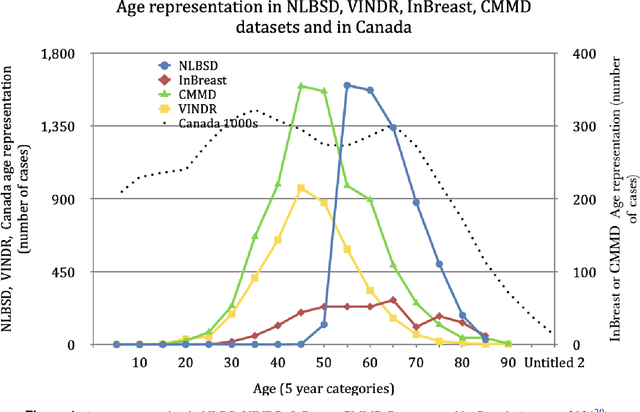
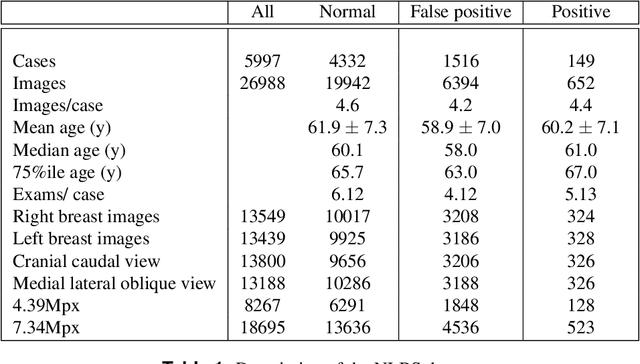
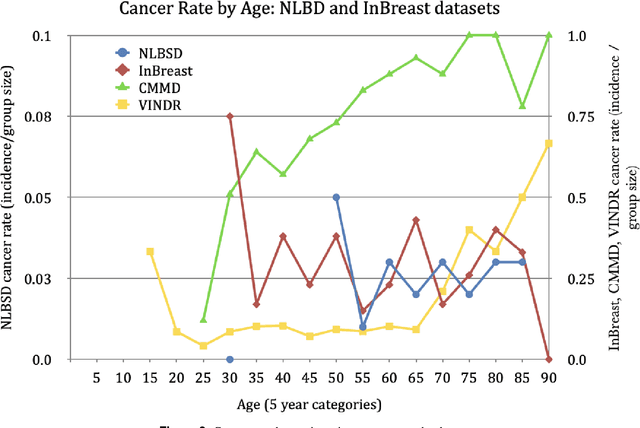
Breast cancer presents the second largest cancer risk in the world to women. Early detection of cancer has been shown to be effective in reducing mortality. Population screening programs schedule regular mammography imaging for participants, promoting early detection. Currently, such screening programs require manual reading. False-positive errors in the reading process unnecessarily leads to costly follow-up and patient anxiety. Automated methods promise to provide more efficient, consistent and effective reading. To facilitate their development, a number of datasets have been created. With the aim of specifically targeting population screening programs, we introduce NL-Breast-Screening, a dataset from a Canadian provincial screening program. The dataset consists of 5997 mammography exams, each of which has four standard views and is biopsy-confirmed. Cases where radiologist reading was a false-positive are identified. NL-Breast is made publicly available as a new resource to promote advances in automation for population screening programs.