 Add to Chrome
 Add to Firefox
 Add to Edge
Dataset-Origin Signatures and Shortcut Learning in Screening Mammography AI: A Cross-Dataset Case Study
Jul 16, 2026
Reliable AI for screening mammography requires training data representative of the low cancer prevalence and subtle abnormalities found in screening populations. We examined whether supplementing such data with biopsy-confirmed cases from abnormal-enriched external datasets improves performance. Using the Newfoundland and Labrador Breast Screening Dataset (NLBSD) alongside CBIS-DDSM and CMMD, we evaluated an EfficientNet-B5 encoder initialized with Mammo-CLIP weights as a frozen linear probe under consistent preprocessing and patient-level splits. The NLBSD-only model achieved an AUC-ROC of 0.737 (95% CI [0.686, 0.785]). Adding external positive cases reduced performance in every configuration (AUC-ROC = 0.620--0.644; DeLong test, Holm-corrected $p < 0.05$), with degradation increasing as additional sources were introduced. Domain-matched evaluation produced modest gains only when the training and test domains coincided, and no configuration surpassed the NLBSD-only model. As a diagnostic, we reframed the task as predicting each examination's dataset of origin. The datasets were separated almost perfectly despite identical preprocessing, indicating that dataset-specific characteristics strongly influence the learned representation. These findings show that naïvely pooling abnormal-enriched mammography datasets can introduce domain shift that outweighs the benefit of additional positive cases. Differences in acquisition, intensity mapping, and dataset construction persist after normalization, motivating domain-aware strategies for combining heterogeneous mammography datasets.

Full Field Digital Mammography Dataset from a Population Screening Program
Nov 05, 2024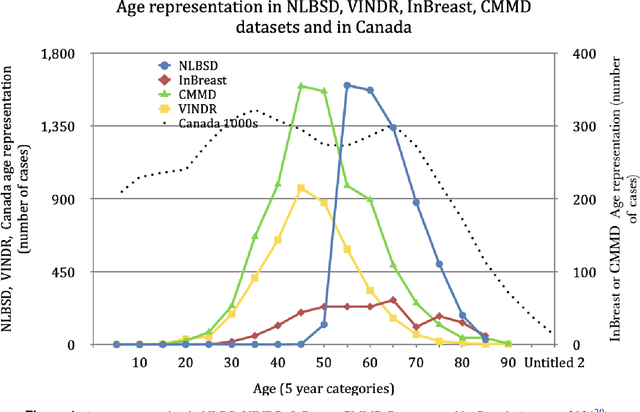
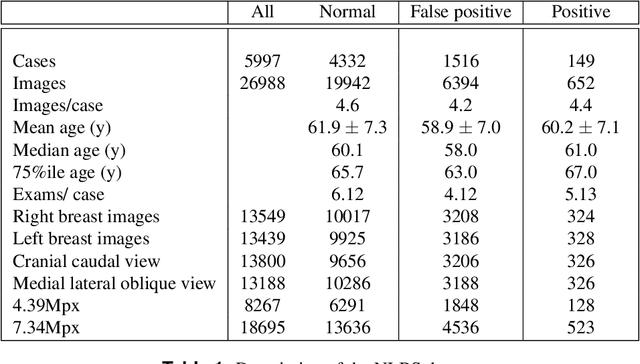
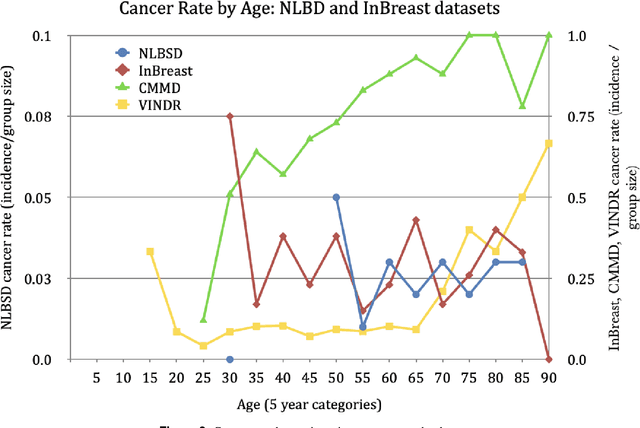
Breast cancer presents the second largest cancer risk in the world to women. Early detection of cancer has been shown to be effective in reducing mortality. Population screening programs schedule regular mammography imaging for participants, promoting early detection. Currently, such screening programs require manual reading. False-positive errors in the reading process unnecessarily leads to costly follow-up and patient anxiety. Automated methods promise to provide more efficient, consistent and effective reading. To facilitate their development, a number of datasets have been created. With the aim of specifically targeting population screening programs, we introduce NL-Breast-Screening, a dataset from a Canadian provincial screening program. The dataset consists of 5997 mammography exams, each of which has four standard views and is biopsy-confirmed. Cases where radiologist reading was a false-positive are identified. NL-Breast is made publicly available as a new resource to promote advances in automation for population screening programs.