 Add to Chrome
 Add to Firefox
 Add to Edge
Learning from Lost Provenance: Multiple Instance Learning for Cancer Registry Tumor Group Classification
Jul 03, 2026
Modernizing cancer registries with deep learning is opening new opportunities to automate labor-intensive tasks such as the coding of pathology reports. However, progress is constrained by the scarcity of report-level human-annotated training data. Cancer registries generate substantial volumes of expert-assigned labels as a routine product of their operations, but these exist at the patient level and are not linked to the individual pathology reports that informed them, limiting their direct use for training models. We develop an efficient framework for training deep learning classifiers by leveraging these operationally-generated labels without requiring per-report human annotation, demonstrated for tumor group classification at the BC Cancer Registry. We use Attention-Based Multiple Instance Learning (ABMIL) to recover the lost link between patient-level labels and the reports that informed them, leveraging the attention the model places on each report to distil a large, noisily-labeled corpus into a compact, high-quality per-report training dataset. A classifier fine-tuned on a distilled dataset achieved a macro F1 of 0.83, outperforming established baselines across most tumor groups. By turning routine operational labels into high-quality training data without additional annotation or large-scale computing infrastructure, ABMIL offers a practical and accessible route to automating cancer registry workflows.

Adapting Natural Language Processing Models Across Jurisdictions: A pilot Study in Canadian Cancer Registries
Jan 02, 2026Population-based cancer registries depend on pathology reports as their primary diagnostic source, yet manual abstraction is resource-intensive and contributes to delays in cancer data. While transformer-based NLP systems have improved registry workflows, their ability to generalize across jurisdictions with differing reporting conventions remains poorly understood. We present the first cross-provincial evaluation of adapting BCCRTron, a domain-adapted transformer model developed at the British Columbia Cancer Registry, alongside GatorTron, a biomedical transformer model, for cancer surveillance in Canada. Our training dataset consisted of approximately 104,000 and 22,000 de-identified pathology reports from the Newfoundland & Labrador Cancer Registry (NLCR) for Tier 1 (cancer vs. non-cancer) and Tier 2 (reportable vs. non-reportable) tasks, respectively. Both models were fine-tuned using complementary synoptic and diagnosis focused report section input pipelines. Across NLCR test sets, the adapted models maintained high performance, demonstrating transformers pretrained in one jurisdiction can be localized to another with modest fine-tuning. To improve sensitivity, we combined the two models using a conservative OR-ensemble achieving a Tier 1 recall of 0.99 and reduced missed cancers to 24, compared with 48 and 54 for the standalone models. For Tier 2, the ensemble achieved 0.99 recall and reduced missed reportable cancers to 33, compared with 54 and 46 for the individual models. These findings demonstrate that an ensemble combining complementary text representations substantially reduce missed cancers and improve error coverage in cancer-registry NLP. We implement a privacy-preserving workflow in which only model weights are shared between provinces, supporting interoperable NLP infrastructure and a future pan-Canadian foundation model for cancer pathology and registry workflows.
Small or Large? Zero-Shot or Finetuned? Guiding Language Model Choice for Specialized Applications in Healthcare
Apr 29, 2025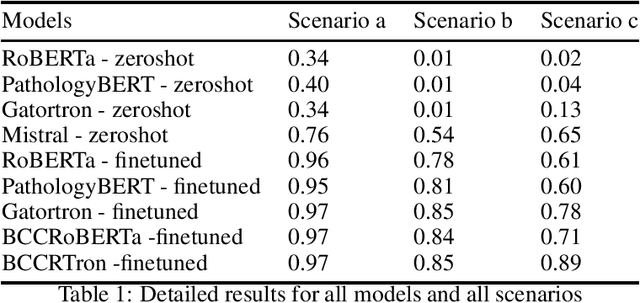
This study aims to guide language model selection by investigating: 1) the necessity of finetuning versus zero-shot usage, 2) the benefits of domain-adjacent versus generic pretrained models, 3) the value of further domain-specific pretraining, and 4) the continued relevance of Small Language Models (SLMs) compared to Large Language Models (LLMs) for specific tasks. Using electronic pathology reports from the British Columbia Cancer Registry (BCCR), three classification scenarios with varying difficulty and data size are evaluated. Models include various SLMs and an LLM. SLMs are evaluated both zero-shot and finetuned; the LLM is evaluated zero-shot only. Finetuning significantly improved SLM performance across all scenarios compared to their zero-shot results. The zero-shot LLM outperformed zero-shot SLMs but was consistently outperformed by finetuned SLMs. Domain-adjacent SLMs generally performed better than the generic SLM after finetuning, especially on harder tasks. Further domain-specific pretraining yielded modest gains on easier tasks but significant improvements on the complex, data-scarce task. The results highlight the critical role of finetuning for SLMs in specialized domains, enabling them to surpass zero-shot LLM performance on targeted classification tasks. Pretraining on domain-adjacent or domain-specific data provides further advantages, particularly for complex problems or limited finetuning data. While LLMs offer strong zero-shot capabilities, their performance on these specific tasks did not match that of appropriately finetuned SLMs. In the era of LLMs, SLMs remain relevant and effective, offering a potentially superior performance-resource trade-off compared to LLMs.
A Clinical Trial Design Approach to Auditing Language Models in Healthcare Setting
Nov 11, 2024We present an audit mechanism for language models, with a focus on models deployed in the healthcare setting. Our proposed mechanism takes inspiration from clinical trial design where we posit the language model audit as a single blind equivalence trial, with the comparison of interest being the subject matter experts. We show that using our proposed method, we can follow principled sample size and power calculations, leading to the requirement of sampling minimum number of records while maintaining the audit integrity and statistical soundness. Finally, we provide a real-world example of the audit used in a production environment in a large-scale public health network.