 Add to Chrome
 Add to Firefox
 Add to Edge
User-Centric Cell-Free Massive MIMO Enhanced by Fluid-Antenna Access Points: Uplink Analysis
Dec 28, 2025
In this paper, we investigate cell-free massive MIMO (CF-mMIMO) systems in which access points (APs) are equipped with fluid antennas (FAs) and develop a comprehensive framework for channel estimation, antenna port selection, and uplink spectral efficiency (SE) optimization. We propose a generalized LMMSE-based uplink channel estimation scheme that dynamically activates FA ports during pilot transmission, efficiently exploiting antenna reconfigurability under practical training constraints. Building on this, we design a distributed port selection strategy that minimizes per-AP channel estimation error by exploiting spatial correlation among FA ports. We systematically analyze the impact of antenna geometry and spatial correlation using the Jakes' channel model for different AP array configurations, including uniform linear and planar arrays. We then derive SINR expressions for centralized and distributed uplink processing and obtain a closed-form uplink SE expression for centralized maximum-ratio combining using the use-and-then-forget bound. Finally, we propose an alternating-optimization framework to select FA port configurations that maximize the uplink sum SE. Numerical results show that the proposed FA-aware channel estimation and port optimization strategies greatly reduce channel estimation error and significantly improve sum-SE over fixed-antenna and non-optimized FA baselines, confirming FAs as a key enabler for scalable, adaptive CF-mMIMO networks.

Differential Space-Time Block Coding for Phase-Unsynchronized Cell-Free MIMO Downlink
Nov 09, 2025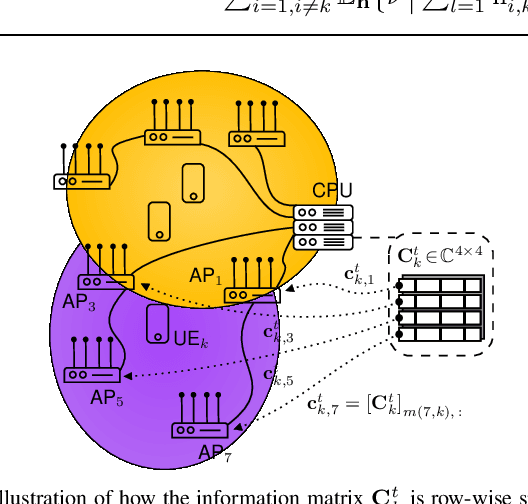
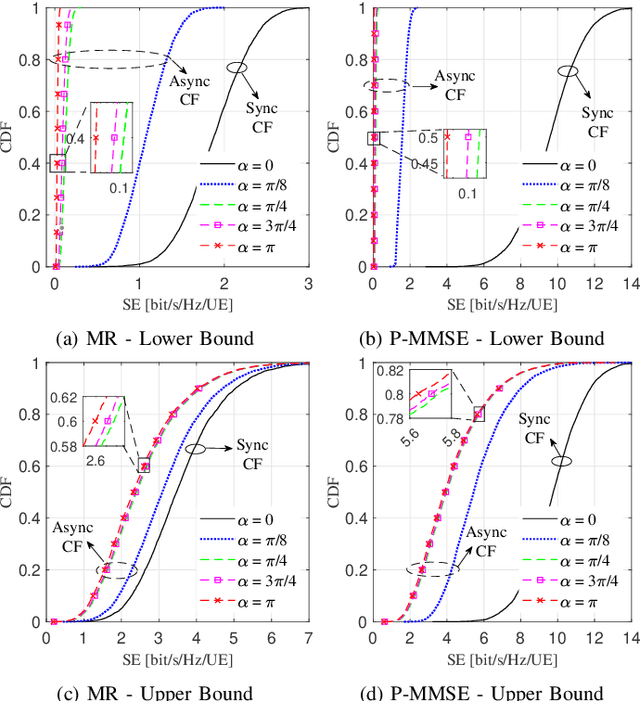
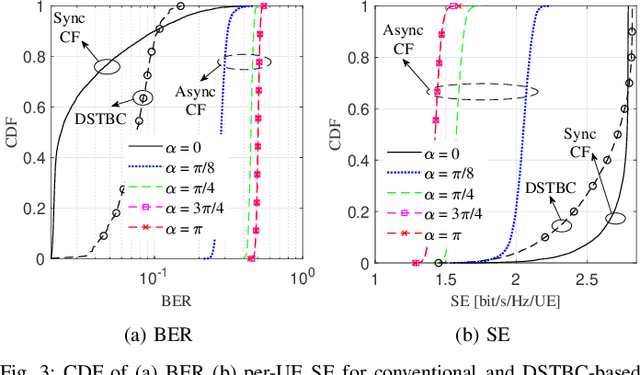
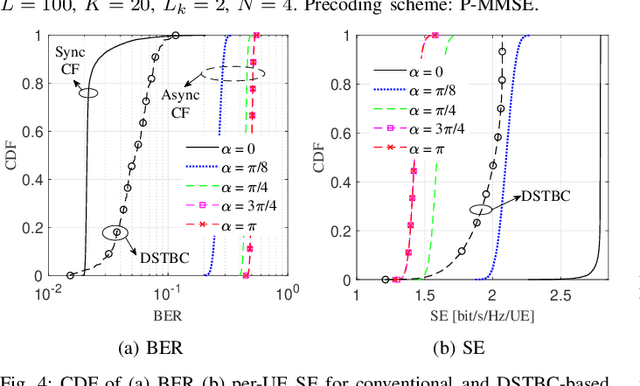
In the downlink of a cell-free massive multiple-input multiple-output (CF-mMIMO) system, spectral efficiency gains critically rely on joint coherent transmission, as all access points (APs) must align their transmitted signals in phase at the user equipment (UE). Achieving such phase alignment is technically challenging, as it requires tight synchronization among geographically distributed APs. In this paper, we address this issue by introducing a differential space-time block coding (DSTBC) approach that bypasses the need for AP phase synchronization. We first provide analytic bounds to the achievable spectral efficiency of CF-mMIMO with phase-unsynchronized APs. Then, we propose a DSTBC-based transmission scheme specifically tailored to CF-mMIMO, which operates without channel state information and does not require any form of phase synchronization among the APs. We derive a closed-form expression for the resulting signal-to-interference-plus-noise ratio (SINR), enabling quantitative comparisons among different DSTBC schemes. Numerical simulations confirm that phase misalignments can significantly impair system performance. In contrast, the proposed DSTBC scheme successfully mitigates these effects, achieving performance comparable to that of fully synchronized systems.
Joint Optimization of Uplink and Downlink Power in Full-Duplex Integrated Access and Backhaul
Apr 05, 2025We examine the performance of an Integrated Access and Backhaul (IAB) node as a range extender for beyond-5G networks, focusing on the significant challenges of effective power allocation and beamforming strategies, which are vital for maximizing users' spectral efficiency (SE). We present both max-sum SE and max-min fairness power allocation strategies, to assess their effects on system performance. The results underscore the necessity of power optimization, particularly as the number of users served by the IAB node increases, demonstrating how efficient power allocation enhances service quality in high-load scenarios. The results also show that the typical line-of-sight link between the IAB donor and the IAB node has rank one, posing a limitation on the effective SEs that the IAB node can support.
Leveraging Line-of-Sight Propagation for Near-Field Beamfocusing in Cell-Free Networks
Mar 27, 2025Cell-free (CF) massive multiple-input multiple-output (MIMO) is a promising approach for next-generation wireless networks, enabling scalable deployments of multiple small access points (APs) to enhance coverage and service for multiple user equipments (UEs). While most existing research focuses on low-frequency bands with Rayleigh fading models, emerging 5G trends are shifting toward higher frequencies, where geometric channel models and line-of-sight (LoS) propagation become more relevant. In this work, we explore how distributed massive MIMO in the LoS regime can achieve near-field-like conditions by forming artificially large arrays through coordinated AP deployments. We investigate centralized and decentralized CF architectures, leveraging structured channel estimation (SCE) techniques that exploit the line-of-sight properties of geometric channels. Our results demonstrate that dense distributed AP deployments significantly improve system performance w.r.t. the case of a co-located array, even in highly populated UE scenarios, while SCE approaches the performance of perfect CSI.
Eliminating Phase Misalignments in Cell-Free Massive MIMO via Differential Transmission
Mar 06, 2025This paper proposes two approaches for overcoming access points' phase misalignment effects in the downlink of cell-free massive MIMO (CF-mMIMO) systems. The first approach is based on the differential space-time block coding technique, while the second one is based on the use of differential modulation schemes. Both approaches are shown to perform exceptionally well and to restore system performance in CF-mMIMO systems where phase alignment at the access points for downlink joint coherent transmission cannot be achieved.
User Subgrouping in Scalable Cell-Free Massive MIMO Multicasting Systems
Sep 18, 2024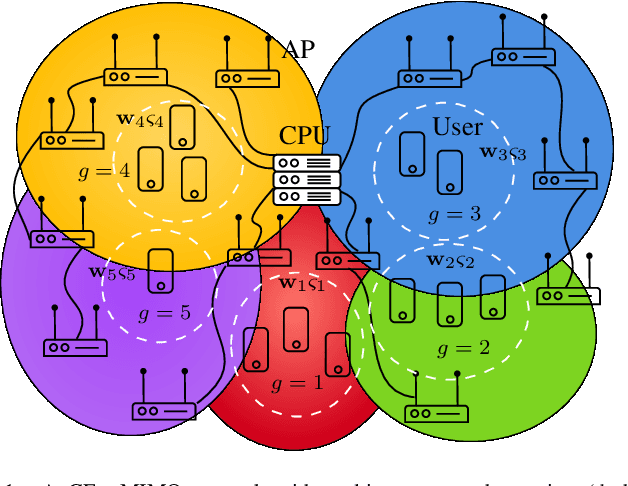

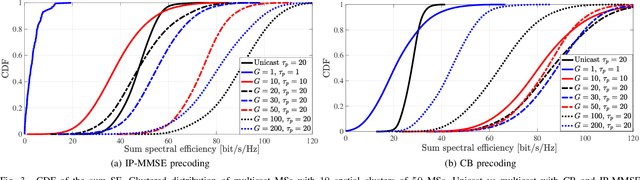
Cell-free massive multiple-input multiple-output (CF-mMIMO) is a breakthrough technology for beyond-5G systems, designed to significantly boost the energy and spectral efficiencies of future mobile networks while ensuring a consistent quality of service for all users. Additionally, multicasting has gained considerable attention recently because physical-layer multicasting offers an efficient method for simultaneously serving multiple users with identical service demands by sharing radio resources. Typically, multicast services are delivered either via unicast transmissions or a single multicast transmission. This work, however, introduces a novel subgroup-centric multicast CF-mMIMO framework that divides users into several multicast subgroups based on the similarities in their spatial channel characteristics. This approach allows for efficient sharing of the pilot sequences used for channel estimation and the precoding filters used for data transmission. The proposed framework employs two scalable precoding strategies: centralized improved partial MMSE (IP-MMSE) and distributed conjugate beam-forming (CB). Numerical results show that for scenarios where users are uniformly distributed across the service area, unicast transmissions using centralized IP-MMSE precoding are optimal. However, in cases where users are spatially clustered, multicast subgrouping significantly improves the sum spectral efficiency (SE) of the multicast service compared to both unicast and single multicast transmission. Notably, in clustered scenarios, distributed CB precoding outperforms IP-MMSE in terms of per-user SE, making it the best solution for delivering multicast content.
* 6 pages, 5 figures, European Wireless 2024 Conference
User Subgrouping and Power Control for Multicast Massive MIMO over Spatially Correlated Channels
Sep 18, 2024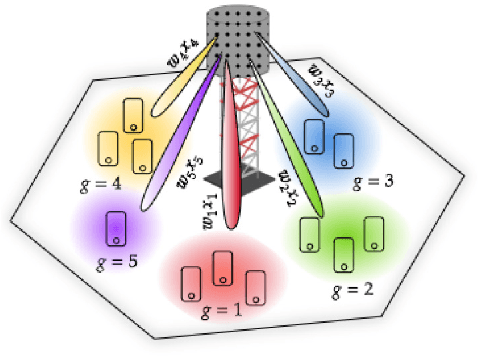
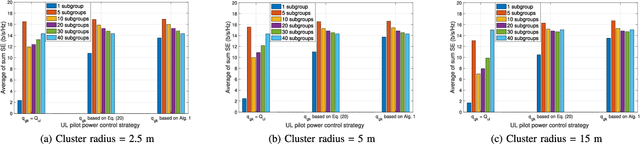
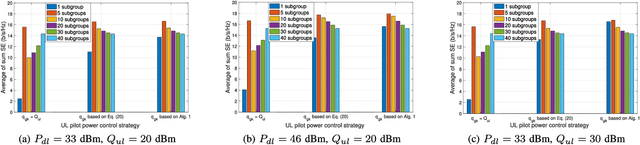
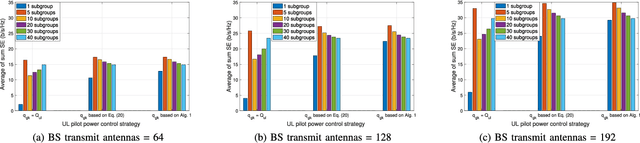
Massive multiple-input-multiple-output (MIMO) is unquestionably a key enabler of the fifth-generation (5G) technology for mobile systems, enabling to meet the high requirements of upcoming mobile broadband services. Physical-layer multicasting refers to a technique for simultaneously serving multiple users, demanding for the same service and sharing the same radio resources, with a single transmission. Massive MIMO systems with multicast communications have been so far studied under the ideal assumption of uncorrelated Rayleigh fading channels. In this work, we consider a practical multicast massive MIMO system over spatially correlated Rayleigh fading channels, investigating the impact of the spatial channel correlation on the favorable propagation, hence on the performance. We propose a subgrouping strategy for the multicast users based on their channel correlation matrices' similarities. The proposed subgrouping approach capitalizes on the spatial correlation to enhance the quality of the channel estimation, and thereby the effectiveness of the precoding. Moreover, we devise a max-min fairness (MMF) power allocation strategy that makes the spectral efficiency (SE) among different multicast subgroups uniform. Lastly, we propose a novel power allocation for uplink (UL) pilot transmission to maximize the SE among the users within the same multicast subgroup. Simulation results show a significant SE gain provided by our user subgrouping and power allocation strategies. Importantly, we show how spatial channel correlation can be exploited to enhance multicast massive MIMO communications.
* 14 pages, 25 figures
Energy Efficiency Optimization in Integrated Satellite-Terrestrial UAV-Enabled Cell-Free Massive MIMO
Jul 24, 2024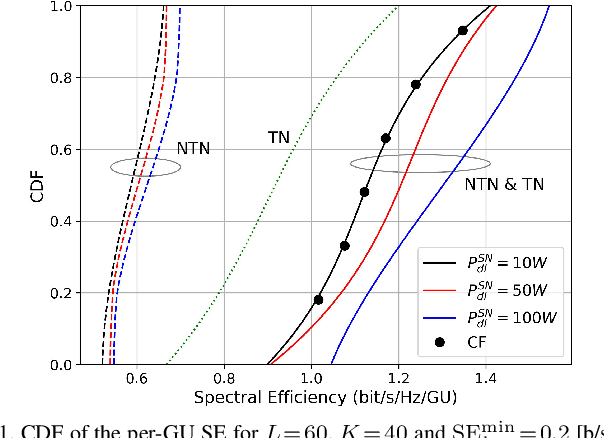
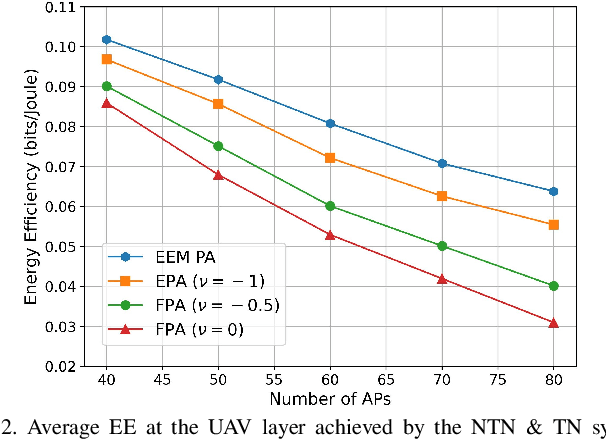
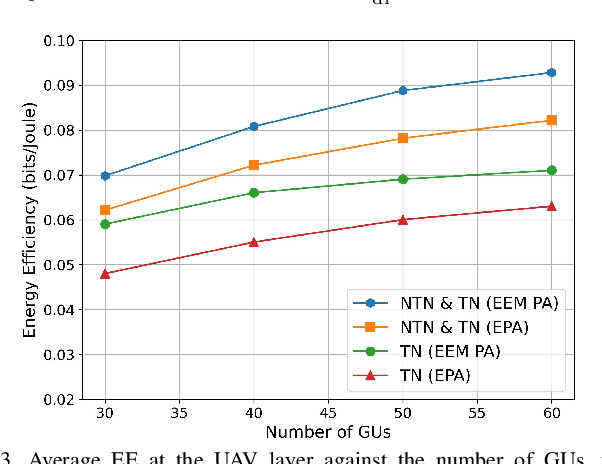
Integrating cell-free massive MIMO (CF-mMIMO) into satellite-unmanned aerial vehicle (UAV) networks offers an effective solution for enhancing connectivity. In this setup, UAVs serve as access points (APs) of a terrestrial CF-mMIMO network extending the satellite network capabilities, thereby ensuring robust, high-quality communication links. In this work, we propose a successive convex approximation algorithm for maximizing the downlink energy efficiency (EE) at the UAVs under per-UAV power budget and user quality-of-service constraints. We derive a closed-form expression for the EE that accounts for maximum-ratio transmission and statistical channel knowledge at the users. Simulation results show the effectiveness of the proposed algorithm in maximizing the EE at the UAV layer. Moreover, we observe that a few tens of UAVs transmitting with a fine-tuned power are sufficient to empower the service of satellite networks and significantly increase the spectral efficiency.
Ultra-Dense Cell-Free Massive MIMO for 6G: Technical Overview and Open Questions
Jan 08, 2024


Ultra-dense cell-free massive multiple-input multiple-output (CF-MMIMO) has emerged as a promising technology expected to meet the future ubiquitous connectivity requirements and ever-growing data traffic demands in 6G. This article provides a contemporary overview of ultra-dense CF-MMIMO networks, and addresses important unresolved questions on their future deployment. We first present a comprehensive survey of state-of-the-art research on CF-MMIMO and ultra-dense networks. Then, we discuss the key challenges of CF-MMIMO under ultra-dense scenarios such as low-complexity architecture and processing, low-complexity/scalable resource allocation, fronthaul limitation, massive access, synchronization, and channel acquisition. Finally, we answer key open questions, considering different design comparisons and discussing suitable methods dealing with the key challenges of ultra-dense CF-MMIMO. The discussion aims to provide a valuable roadmap for interesting future research directions in this area, facilitating the development of CF-MMIMO MIMO for 6G.
On the Coexistence of eMBB and URLLC in Multi-cell Massive MIMO
Jan 09, 2023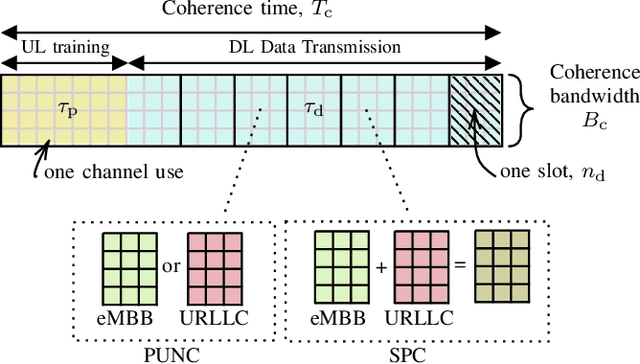
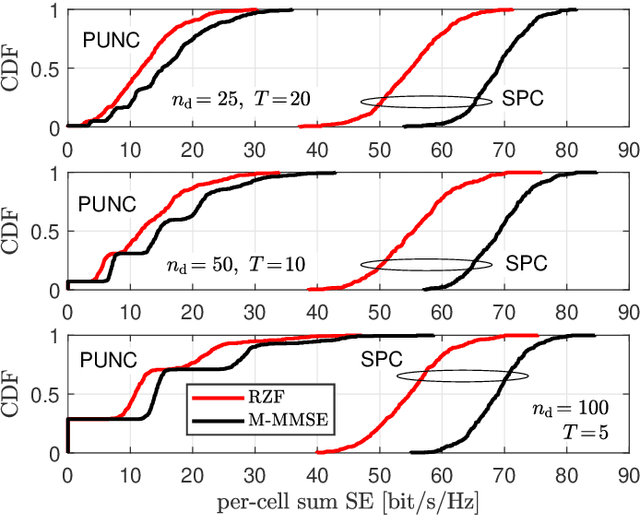
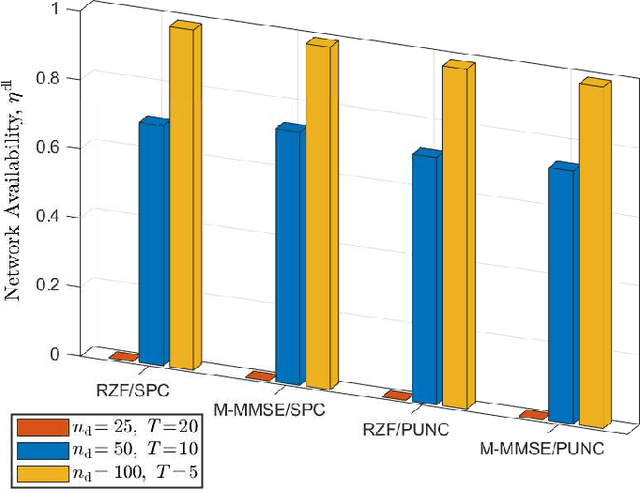

The non-orthogonal coexistence between the enhanced mobile broadband (eMBB) and the ultra-reliable low-latency communication (URLLC) in the downlink of a multi-cell massive MIMO system is rigorously analyzed in this work. We provide a unified information-theoretic framework blending an infinite-blocklength analysis of the eMBB spectral efficiency (SE) in the ergodic regime with a finite-blocklength analysis of the URLLC error probability relying on the use of mismatched decoding, and of the so-called saddlepoint approximation. Puncturing (PUNC) and superposition coding (SPC) are considered as alternative downlink coexistence strategies to deal with the inter-service interference, under the assumption of only statistical channel state information (CSI) knowledge at the users. eMBB and URLLC performances are then evaluated over different precoding techniques and power control schemes, by accounting for imperfect CSI knowledge at the base stations, pilot-based estimation overhead, pilot contamination, spatially correlated channels, the structure of the radio frame, and the characteristics of the URLLC activation pattern. Simulation results reveal that SPC is, in many operating regimes, superior to PUNC in providing higher SE for the eMBB yet achieving the target reliability for the URLLC with high probability. Moreover, PUNC might cause eMBB service outage in presence of high URLLC traffic loads. However, PUNC turns to be necessary to preserve the URLLC performance in scenarios where the multi-user interference cannot be satisfactorily alleviated.