 Add to Chrome
 Add to Firefox
 Add to Edge
RIS-Assisted Cell-Free Massive MIMO: RIS-MS Selection in FR1 and FR3
Apr 19, 2026
This paper explores the integration of reconfigurable intelligent surfaces (RISs) into cell-free massive multiple-input-multiple-output (CF-mMIMO) networks operating in FR1 and FR3 frequency bands. We present a comprehensive framework for analyzing RIS-assisted CF-mMIMO systems under realistic propagation conditions, accounting for frequency-dependent characteristics and RIS configurations. A novel RIS-user association algorithm is proposed to optimize phase-shift settings by assigning each RIS to a single user based on line of sight (LoS) connectivity. The system model incorporates spatially correlated Ricean fading channels and employs scalable partial-minimum mean square error (P-MMSE) combining. The numerical results demonstrate that the proposed RIS-user selection strategy significantly improves the spectral efficiency compared to random or exhaustive RIS configurations, particularly when the number of RISs is moderate. We also analyze the trade-off between training overhead and performance gains, showing that excessive pilot requirements can offset benefits when RIS density or element count increases. The results highlight the potential of the FR3 bands for RIS-assisted CF-mMIMO, provided advanced channel estimation techniques are adopted to mitigate overhead. These findings emphasize the importance of intelligent RIS-user pairing and scalable estimation methods for future 6G deployments.

Conjugate Beamforming Variants for Multicasting in Cell-Free Massive MIMO Systems
Apr 19, 2026This paper studies scalable conjugate beamforming (CB) variants for physical-layer multicasting in cell-free massive multiple-input multiple-output (CF-mMIMO) systems. Focusing on fully distributed precoding, we analyze classical CB, normalized CB (NCB), and enhanced CB (ECB) within a subgroup-centric multicast framework. Multicast users are partitioned into subgroups based on large-scale fading similarity, which enables composite channel estimation, pilot reuse, and distributed precoding with low complexity. The performance of the different CB variants is evaluated in terms of aggregated spectral efficiency (ASE) under representative user geometries, including uniformly distributed users, spatially clustered deployments, and heterogeneous scenarios combining hotspots with more dispersed users. Monte Carlo simulations reveal a strong spatial geometry-dependent behavior: unicast transmission is preferable in uniform deployments, while subgroup-based multicasting becomes essential in clustered and heterogeneous scenarios. Among the CB-based precoders, NCB offers a robust performance-complexity trade-off across most scenarios, whereas ECB provides additional gains only when sufficient channel hardening is present. These results provide practical insights into the selection of low-complexity distributed precoders and multicast transmission modes in CF-mMIMO systems supporting broadband and multimedia services.
User Subgrouping and Power Control for Multicast Massive MIMO over Spatially Correlated Channels
Sep 18, 2024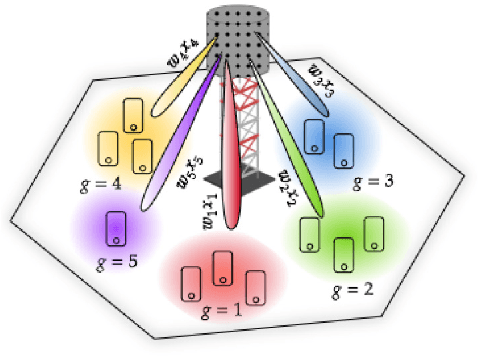
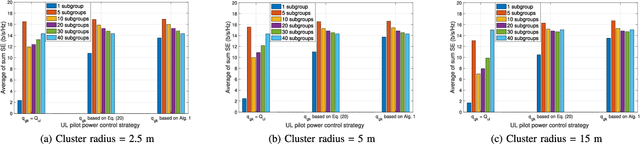
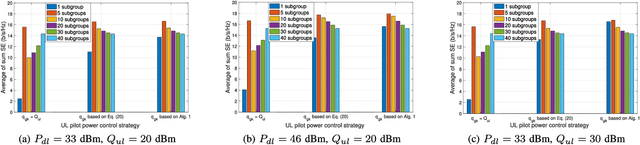
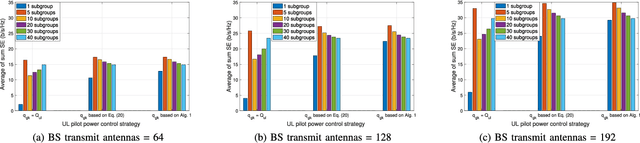
Massive multiple-input-multiple-output (MIMO) is unquestionably a key enabler of the fifth-generation (5G) technology for mobile systems, enabling to meet the high requirements of upcoming mobile broadband services. Physical-layer multicasting refers to a technique for simultaneously serving multiple users, demanding for the same service and sharing the same radio resources, with a single transmission. Massive MIMO systems with multicast communications have been so far studied under the ideal assumption of uncorrelated Rayleigh fading channels. In this work, we consider a practical multicast massive MIMO system over spatially correlated Rayleigh fading channels, investigating the impact of the spatial channel correlation on the favorable propagation, hence on the performance. We propose a subgrouping strategy for the multicast users based on their channel correlation matrices' similarities. The proposed subgrouping approach capitalizes on the spatial correlation to enhance the quality of the channel estimation, and thereby the effectiveness of the precoding. Moreover, we devise a max-min fairness (MMF) power allocation strategy that makes the spectral efficiency (SE) among different multicast subgroups uniform. Lastly, we propose a novel power allocation for uplink (UL) pilot transmission to maximize the SE among the users within the same multicast subgroup. Simulation results show a significant SE gain provided by our user subgrouping and power allocation strategies. Importantly, we show how spatial channel correlation can be exploited to enhance multicast massive MIMO communications.
* 14 pages, 25 figures
User Subgrouping in Scalable Cell-Free Massive MIMO Multicasting Systems
Sep 18, 2024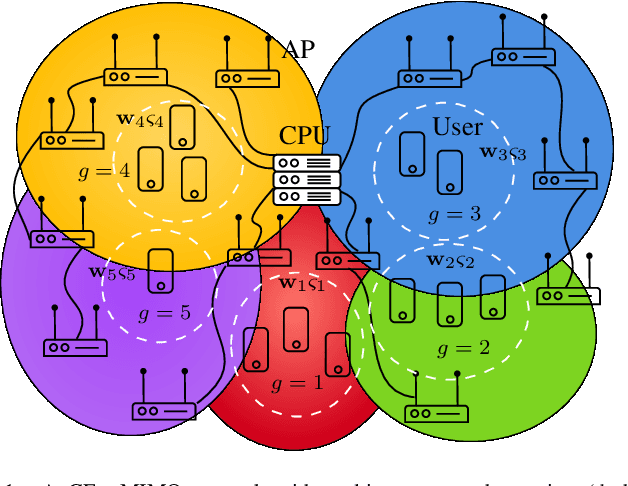

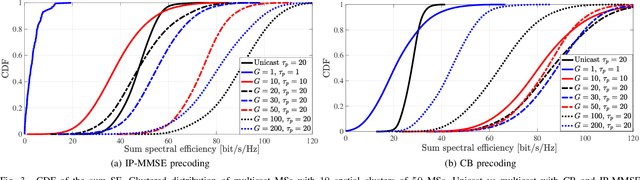
Cell-free massive multiple-input multiple-output (CF-mMIMO) is a breakthrough technology for beyond-5G systems, designed to significantly boost the energy and spectral efficiencies of future mobile networks while ensuring a consistent quality of service for all users. Additionally, multicasting has gained considerable attention recently because physical-layer multicasting offers an efficient method for simultaneously serving multiple users with identical service demands by sharing radio resources. Typically, multicast services are delivered either via unicast transmissions or a single multicast transmission. This work, however, introduces a novel subgroup-centric multicast CF-mMIMO framework that divides users into several multicast subgroups based on the similarities in their spatial channel characteristics. This approach allows for efficient sharing of the pilot sequences used for channel estimation and the precoding filters used for data transmission. The proposed framework employs two scalable precoding strategies: centralized improved partial MMSE (IP-MMSE) and distributed conjugate beam-forming (CB). Numerical results show that for scenarios where users are uniformly distributed across the service area, unicast transmissions using centralized IP-MMSE precoding are optimal. However, in cases where users are spatially clustered, multicast subgrouping significantly improves the sum spectral efficiency (SE) of the multicast service compared to both unicast and single multicast transmission. Notably, in clustered scenarios, distributed CB precoding outperforms IP-MMSE in terms of per-user SE, making it the best solution for delivering multicast content.
* 6 pages, 5 figures, European Wireless 2024 Conference
User Subgrouping in Multicast Massive MIMO over Spatially Correlated Rayleigh Fading Channels
Feb 19, 2021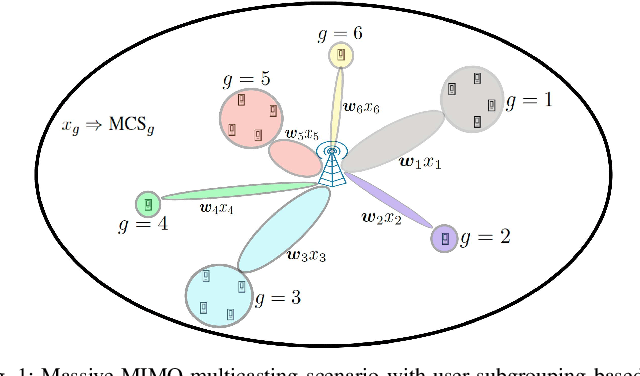
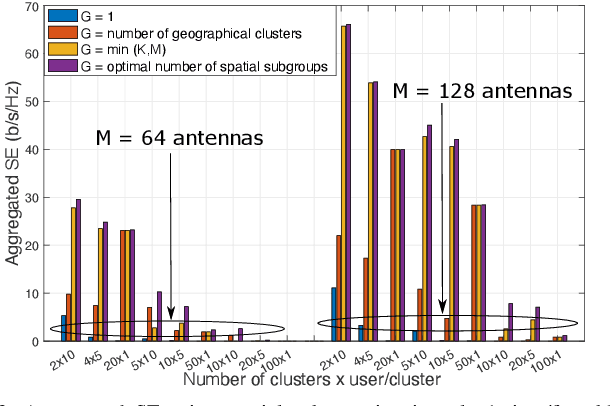
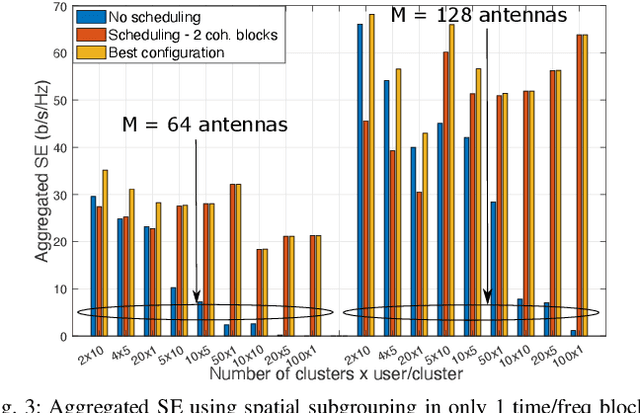
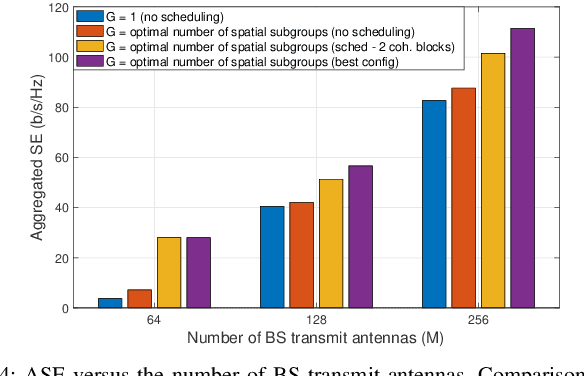
Massive multiple-input-multiple-output (MaMIMO) multicasting has received significant attention over the last years. MaMIMO is a key enabler of 5G systems to achieve the extremely demanding data rates of upcoming services. Multicast in the physical layer is an efficient way of serving multiple users, simultaneously demanding the same service and sharing radio resources. This work proposes a subgrouping strategy of multicast users based on their spatial channel characteristics to improve the channel estimation and precoding processes. We employ max-min fairness (MMF) power allocation strategy to maximize the minimum spectral efficiency (SE) of the multicast service. Additionally, we explore the combination of spatial multiplexing with orthogonal (time/frequency) multiple access. By varying the number of antennas at the base station (BS) and users' spatial distribution, we also provide the optimal subgroup configuration that maximizes the spectral efficiency per subgroup. Finally, we show that serving the multicast users into two orthogonal time/frequency intervals offers better performance than only relying on spatial multiplexing.