 Add to Chrome
 Add to Firefox
 Add to Edge
Energy Efficient Multi-User Beamforming and 3D Position Optimization for SIM-Assisted UAVs
Aug 13, 2026
This paper studies energy-efficient downlink multi-user transmissions with unmanned aerial vehicle (UAV) communication systems equipped with stacked intelligent metasurfaces (SIM), enabling wave-domain analog beamforming through multiple cascaded metasurface layers, while low-dimensional digital precoding is carried out using a limited number of transmit radio-frequency chains. This architecture enables flexible electromagnetic wave manipulation with reduced hardware complexity, making it particularly suitable for energy-constrained aerial platforms. We formulate a hardware-aware energy-efficiency (EE) maximization problem aiming to jointly optimize the digital precoder, the phase shifts of all SIM layers, and the three-dimensional UAV position under transmit-power, SIM operation, and UAV deployment constraints. The resulting problem is highly non-convex due to the fractional objective, the cascaded SIM structure and the unit-modulus phase constraints of the constituent metasurface layers, as well as the non-linear UAV-dependent channel. To address these challenges, we develop a transform-based alternating optimization framework that combines Dinkelbach's method, dual and quadratic transforms, to enable closed-form digital beamforming, Riemannian manifold optimization for SIM phase shifts, and successive convex approximation (SCA) for UAV positioning. Convergence and complexity analyses are provided to characterize the proposed algorithm. The presented numerical results showcase that the proposed joint design significantly improves EE compared with fully digital and maximum ratio transmission benchmark schemes, while revealing important design trade-offs among transmit power, SIM size, and the number of its constituent stacked layers.

Extremely Large Beyond-Diagonal RIS: Low-Rank Modal Optimization for Near-Field Communications
Aug 11, 2026Beyond-diagonal reconfigurable intelligent surfaces (BD-RIS) achieve their best performance when fully connected, at the price of an optimization and hardware burden that grows quadratically, and per iteration cubically, with the number of elements. Extremely large surfaces make this burden prohibitive, while their sheer aperture places both the base station and the users in the radiative near field, where far-field design tools break down. This paper introduces the extremely large BD-RIS (XL-BD-RIS) concept and shows that near-field geometry is precisely what makes fully connected performance affordable at scale. Modeling the cascade with the free-space Green function, we prove that the aperture fields live in a low-dimensional subspace spanned by the spherical-wave responses of the terminal positions, and we design a compact unitary modal matrix on this subspace, built from localization information alone, that provably attains the fully connected optimum with a number of reconfigurable entries set by the geometry and independent of the panel size. A weighted-MMSE Riemannian algorithm optimizes the beamformers and the modal matrix with monotone convergence at panel-size-independent cost. Numerical results show that a $24\times24$-element panel reaches the fully connected optimum with about two hundred entries instead of three hundred thousand. A mismatched DFT beamspace pays a sixty-fold entry penalty rooted in the beam spread of spherical wavefronts, while the classical block-wise architecture delivers strictly lower rates at any matched entry budget.
Wavenumber-Domain Virtual Arrays for Holographic Near-Field Localization
Aug 10, 2026Monostatic localization of multiple point targets is studied for a holographic aperture operated through wavenumber-domain modes. A specular-point condition delimits the validity of the spectral model as a near-field approximation. A single snapshot observes a projection of dimension at most the target count times the polarization components, while invertible coding recovers the full channel and places the decoded data on the difference lattice of transmit and receive wavenumbers. Rank conditions settle identifiability, and the Fisher matrix reduces to a covariance over the lattice, dictating a nested mode selection that attains full-aperture resolution with only tens of RF chains.
Stacked Intelligent Metasurfaces Assisted UAV Communications
Jul 27, 2026In this paper, we investigate an unmanned aerial vehicle (UAV) communication system assisted by stacked intelligent metasurfaces (SIMs), which enable programmable wave-domain signal processing through multiple cascaded metasurface layers. By shifting part of the beamforming functionality from the RF/digital domain to the electromagnetic domain, SIMs allow the realization of energy-efficient hybrid beamforming architectures suitable for aerial platforms. We formulate the joint design of digital precoding, SIM phase configuration, and UAV positioning for multi-user downlink sum-rate maximization. To solve the resulting non-convex problem, we develop an alternating optimization framework that guarantees monotonic improvement of the objective. Numerical results demonstrate that the proposed SIM-assisted architecture significantly improves spectral efficiency while maintaining low hardware complexity, and highlight the impact of the number of metasurface layers and size of each layer on system performance.
Holographic MIMO for Next Generation Non-Terrestrial Networks: Motivation, Opportunities, and Challenges
Nov 15, 2024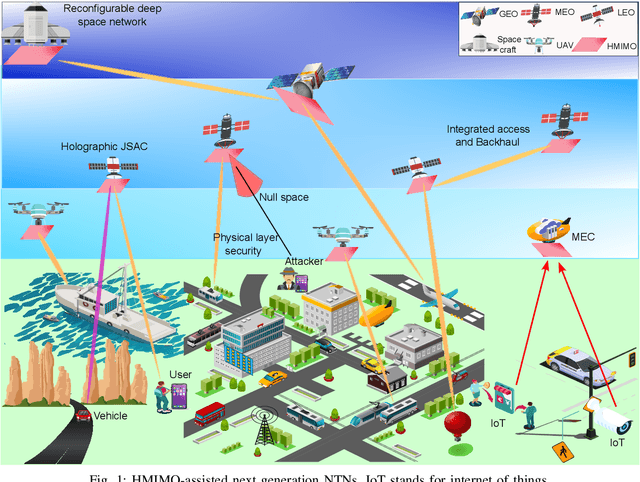
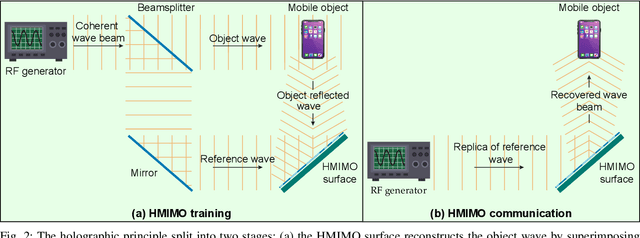
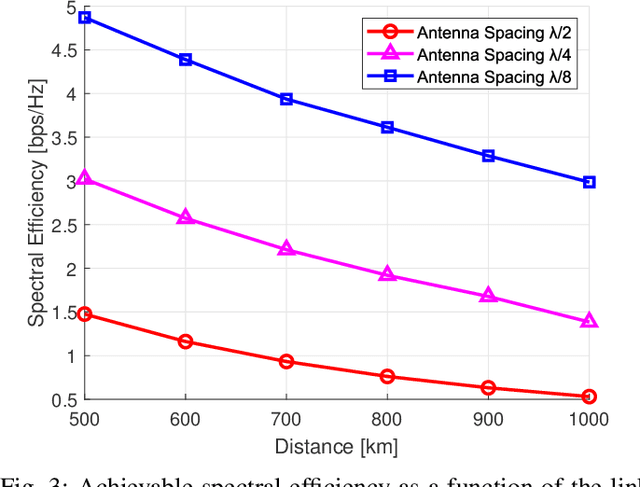
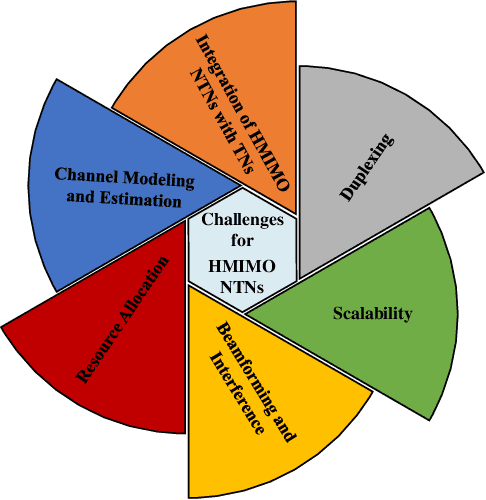
In this article, we propose the integration of the Holographic Multiple Input Multiple Output (HMIMO) as a transformative solution for next generation Non-Terrestrial Networks (NTNs), addressing key challenges, such as high hardware costs, launch expenses, and energy inefficiency. Traditional NTNs are constrained by the financial and operational limitations posed by bulky, costly antenna systems, alongside the complexities of maintaining effective communications in space. HMIMO offers a novel approach utilizing compact and lightweight arrays of densely packed radiating elements with real-time reconfiguration capabilities, thus, capable of optimizing system performance under dynamic conditions such as varying orbital dynamics and Doppler shifts. By replacing conventional antenna systems with HMIMO, the complexity and cost of satellite manufacturing and launch can be substantially reduced, enabling more streamlined and cost-effective satellite designs. This advancement holds significant potential to democratize space communications, making them accessible to a broader range of stakeholders, including smaller nations and commercial enterprises. Moreover, the inherent capabilities of HMIMO in enhancing energy efficiency, scalability, and adaptability position this technology as a key enabler of new use cases and sustainable satellite operations.