 Add to Chrome
 Add to Firefox
 Add to Edge
Uncovering Exotic Paired States in the 2D Spin-Imbalanced Fermi Gas with Neural Wave Functions
Apr 27, 2026
We study the zero-temperature phase diagram of the 2D spin-imbalanced Fermi gas with short-ranged attractive interactions using the recently developed neural network variational Monte Carlo method with the AGPs FermiNet Ansatz. The Fulde-Ferrell-Larkin-Ovchinnikov phase is observed in the weakly interacting BCS limit and a polarised superfluid is seen in the strongly interacting BEC limit. When the interactions are strong, the minority-spin momentum density is reduced almost to zero in the momentum-space region occupied by the unpaired majority-spin electrons. When the interactions are very strong, phase separation occurs, with regions containing bosonic pairs and unpaired regions occupied by the remaining majority-spin particles. In addition, we observe translational symmetry breaking at intermediate interaction strengths, where the system forms an exotic crystal of Cooper pairs in a Fermi fluid of unpaired majority-spin particles. We provide a possible explanation for the formation of the crystalline phase, explain the origins of the k-space momentum-density hole when the pairs are tightly bound, and discuss how our approach opens new directions for future work.

Neural Wave Functions for Superfluids
May 11, 2023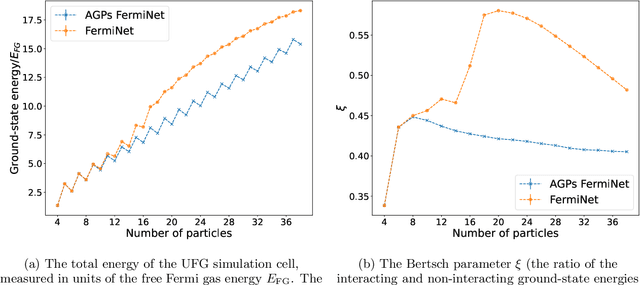
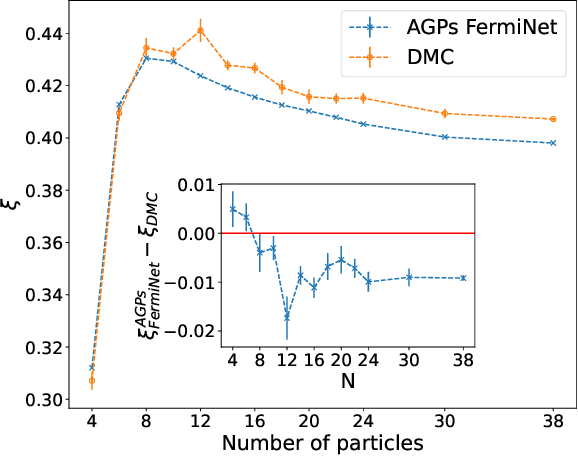
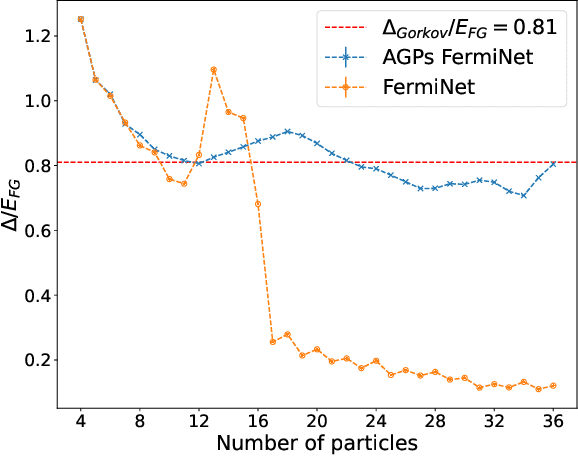
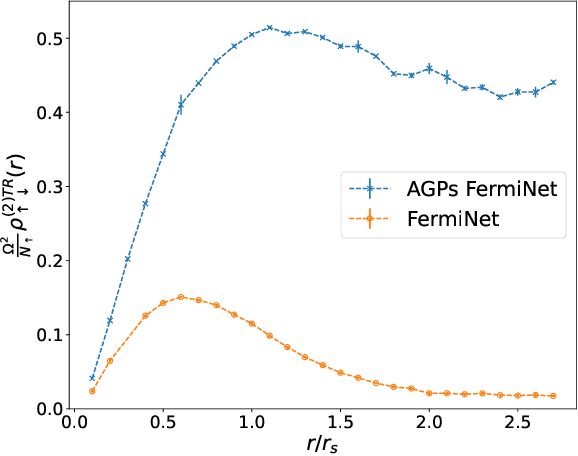
Understanding superfluidity remains a major goal of condensed matter physics. Here we tackle this challenge utilizing the recently developed Fermionic neural network (FermiNet) wave function Ansatz for variational Monte Carlo calculations. We study the unitary Fermi gas, a system with strong, short-range, two-body interactions known to possess a superfluid ground state but difficult to describe quantitively. We demonstrate key limitations of the FermiNet Ansatz in studying the unitary Fermi gas and propose a simple modification that outperforms the original FermiNet significantly, giving highly accurate results. We prove mathematically that the new Ansatz is a strict generalization of the original FermiNet architecture, despite the use of fewer parameters. Our approach shares several advantanges with the FermiNet: the use of a neural network removes the need for an underlying basis set; and the flexiblity of the network yields extremely accurate results within a variational quantum Monte Carlo framework that provides access to unbiased estimates of arbitrary ground-state expectation values. We discuss how the method can be extended to study other superfluids.