 Add to Chrome
 Add to Firefox
 Add to Edge
Does the testing environment matter? Carsickness across on-road, test-track, and driving simulator conditions
Feb 26, 2026
Carsickness has gained significant attention with the rise of automated vehicles, prompting extensive research across on-road, test-track, and driving simulator environments to understand its occurrence and develop mitigation strategies. However, the lack of carsickness standardization complicates comparisons across studies and environments. Previous works demonstrate measurement validity between two setups at most (e.g., on-road vs. driving simulator), leaving gaps in multi-environment comparisons. This study investigates the recreation of an on-road motion sickness exposure - previously replicated on a test track - using a motion-based driving simulator. Twenty-eight participants performed an eyes-off-road non-driving task while reporting motion sickness using the Misery Scale during the experiment and the Motion Sickness Assessment Questionnaire afterward. Psychological factors known to influence motion sickness were also assessed. The results present subjective and objective measurements for motion sickness across the considered environments. In this paper, acceleration measurements, objective metrics and subjective motion sickness ratings across environments are compared, highlighting key differences in sickness occurrence for simulator-based research validity. Significantly lower motion sickness scores are reported in the simulator compared to on-road and test-track conditions, due to its limited working envelope to reproduce low-frequency (<0.5 Hz) motions, which are the most provocative for motion sickness.

Reverso: Efficient Time Series Foundation Models for Zero-shot Forecasting
Feb 19, 2026Learning time series foundation models has been shown to be a promising approach for zero-shot time series forecasting across diverse time series domains. Insofar as scaling has been a critical driver of performance of foundation models in other modalities such as language and vision, much recent work on time series foundation modeling has focused on scaling. This has resulted in time series foundation models with hundreds of millions of parameters that are, while performant, inefficient and expensive to use in practice. This paper describes a simple recipe for learning efficient foundation models for zero-shot time series forecasting that are orders of magnitude smaller. We show that large-scale transformers are not necessary: small hybrid models that interleave long convolution and linear RNN layers (in particular DeltaNet layers) can match the performance of larger transformer-based models while being more than a hundred times smaller. We also describe several data augmentation and inference strategies that further improve performance. This recipe results in Reverso, a family of efficient time series foundation models for zero-shot forecasting that significantly push the performance-efficiency Pareto frontier.
A Vehicle System for Navigating Among Vulnerable Road Users Including Remote Operation
May 08, 2025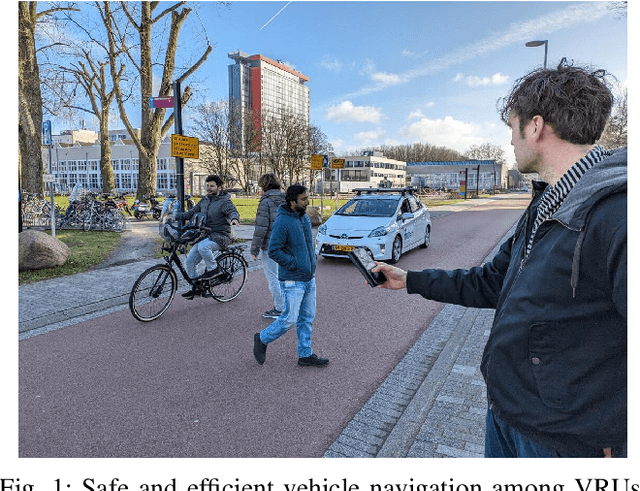
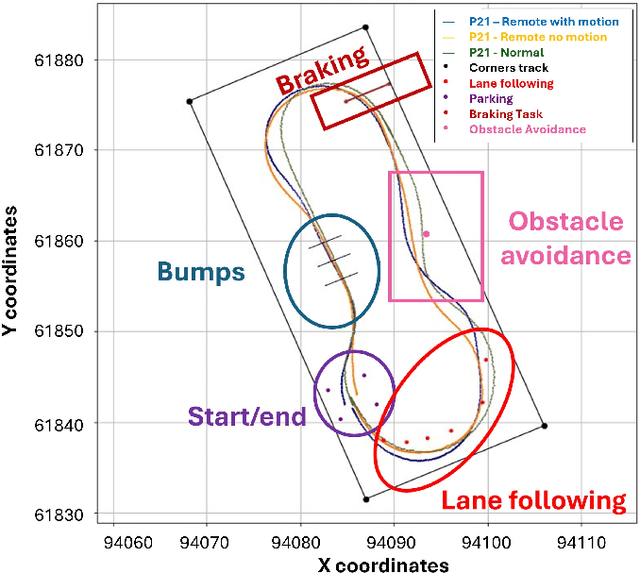
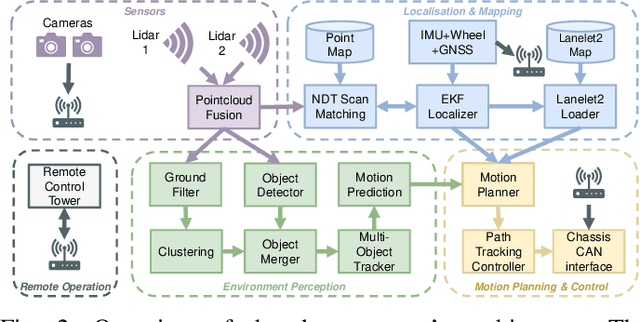
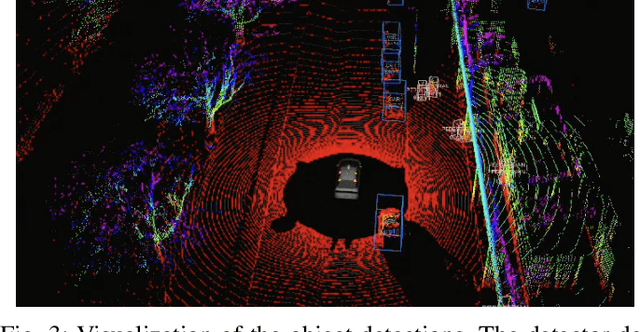
We present a vehicle system capable of navigating safely and efficiently around Vulnerable Road Users (VRUs), such as pedestrians and cyclists. The system comprises key modules for environment perception, localization and mapping, motion planning, and control, integrated into a prototype vehicle. A key innovation is a motion planner based on Topology-driven Model Predictive Control (T-MPC). The guidance layer generates multiple trajectories in parallel, each representing a distinct strategy for obstacle avoidance or non-passing. The underlying trajectory optimization constrains the joint probability of collision with VRUs under generic uncertainties. To address extraordinary situations ("edge cases") that go beyond the autonomous capabilities - such as construction zones or encounters with emergency responders - the system includes an option for remote human operation, supported by visual and haptic guidance. In simulation, our motion planner outperforms three baseline approaches in terms of safety and efficiency. We also demonstrate the full system in prototype vehicle tests on a closed track, both in autonomous and remotely operated modes.
Efficient Motion Sickness Assessment: Recreation of On-Road Driving on a Compact Test Track
Dec 19, 2024The ability to engage in other activities during the ride is considered by consumers as one of the key reasons for the adoption of automated vehicles. However, engagement in non-driving activities will provoke occupants' motion sickness, deteriorating their overall comfort and thereby risking acceptance of automated driving. Therefore, it is critical to extend our understanding of motion sickness and unravel the modulating factors that affect it through experiments with participants. Currently, most experiments are conducted on public roads (realistic but not reproducible) or test tracks (feasible with prototype automated vehicles). This research study develops a method to design an optimal path and speed reference to efficiently replicate on-road motion sickness exposure on a small test track. The method uses model predictive control to replicate the longitudinal and lateral accelerations collected from on-road drives on a test track of 70 m by 175 m. A within-subject experiment (47 participants) was conducted comparing the occupants' motion sickness occurrence in test-track and on-road conditions, with the conditions being cross-randomized. The results illustrate no difference and no effect of the condition on the occurrence of the average motion sickness across the participants. Meanwhile, there is an overall correspondence of individual sickness levels between on-road and test-track. This paves the path for the employment of our method for a simpler, safer and more replicable assessment of motion sickness.
The impact of body and head dynamics on motion comfort assessment
Jul 07, 2023Head motion is a key determinant of motion comfort and differs substantially from seat motion due to seat and body compliance and dynamic postural stabilization. This paper compares different human body model fidelities to transmit seat accelerations to the head for the assessment of motion comfort through simulations. Six-degree of freedom dynamics were analyzed using frequency response functions derived from an advanced human model (AHM), a computationally efficient human model (EHM) and experimental studies. Simulations of dynamic driving show that human models strongly affected the predicted ride comfort (increased up to a factor 3). Furthermore, they modestly affected sickness using the available filters from the literature and ISO-2631 (increased up to 30%), but more strongly affected sickness predicted by the subjective vertical conflict (SVC) model (increased up to 70%).
Motion comfort and driver feel: An explorative study about their relation in remote driving
May 12, 2023Teleoperation is considered as a viable option to control fully automated vehicles (AVs) of Level 4 and 5 in special conditions. However, by bringing the remote drivers in the loop, their driving experience should be realistic to secure safe and comfortable remote control.Therefore, the remote control tower should be designed such that remote drivers receive high quality cues regarding the vehicle state and the driving environment. In this direction, the steering feedback could be manipulated to provide feedback to the remote drivers regarding how the vehicle reacts to their commands. However, until now, it is unclear how the remote drivers' steering feel could impact occupant's motion comfort. This paper focuses on exploring how the driver feel in remote (RD) and normal driving (ND) are related with motion comfort. More specifically, different types of steering feedback controllers are applied in (a) the steering system of a Research Concept Vehicle-model E (RCV-E) and (b) the steering system of a remote control tower. An experiment was performed to assess driver feel when the RCV-E is normally and remotely driven. Subjective assessment and objective metrics are employed to assess drivers' feel and occupants' motion comfort in both remote and normal driving scenarios. The results illustrate that motion sickness and ride comfort are only affected by the steering velocity in remote driving, while throttle input variations affect them in normal driving. The results demonstrate that motion sickness and steering velocity increase both around 25$\%$ from normal to remote driving.