 Add to Chrome
 Add to Firefox
 Add to Edge
CLRNet: Targetless Extrinsic Calibration for Camera, Lidar and 4D Radar Using Deep Learning
Mar 16, 2026
In this paper, we address extrinsic calibration for camera, lidar, and 4D radar sensors. Accurate extrinsic calibration of radar remains a challenge due to the sparsity of its data. We propose CLRNet, a novel, multi-modal end-to-end deep learning (DL) calibration network capable of addressing joint camera-lidar-radar calibration, or pairwise calibration between any two of these sensors. We incorporate equirectangular projection, camera-based depth image prediction, additional radar channels, and leverage lidar with a shared feature space and loop closure loss. In extensive experiments using the View-of-Delft and Dual-Radar datasets, we demonstrate superior calibration accuracy compared to existing state-of-the-art methods, reducing both median translational and rotational calibration errors by at least 50%. Finally, we examine the domain transfer capabilities of the proposed network and baselines, when evaluating across datasets. The code will be made publicly available upon acceptance at: https://github.com/tudelft-iv.

A Vehicle System for Navigating Among Vulnerable Road Users Including Remote Operation
May 08, 2025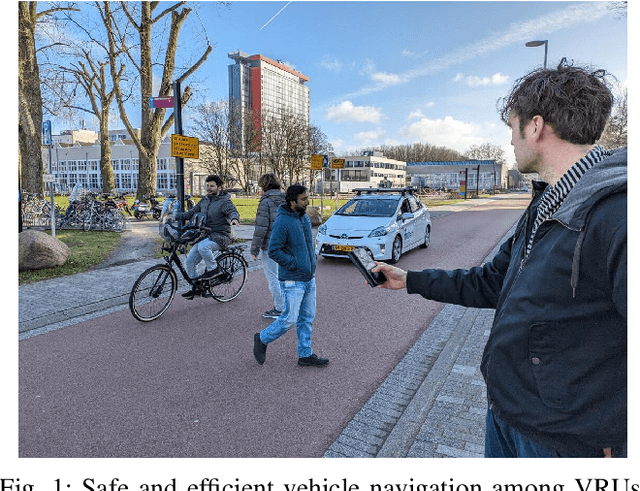
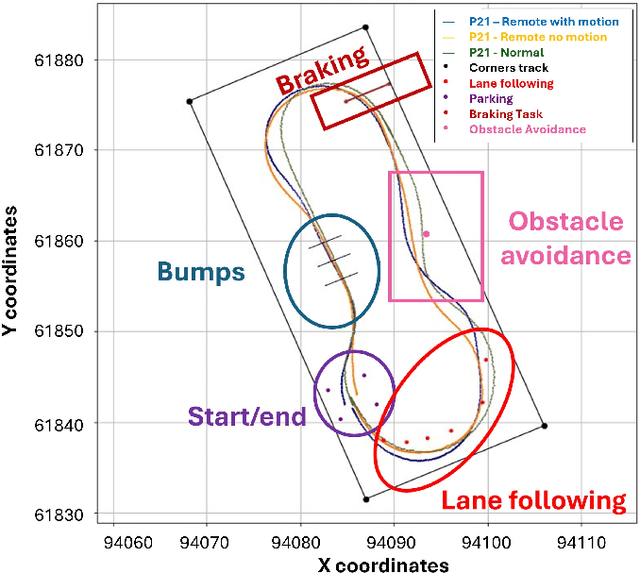
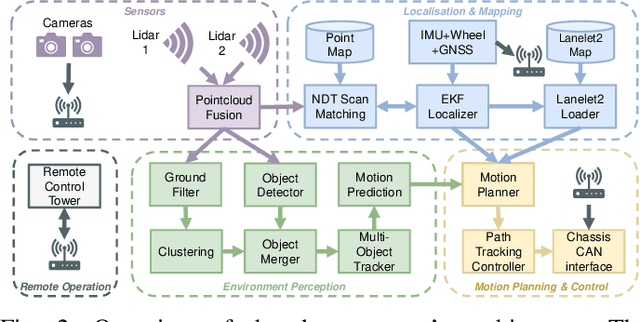
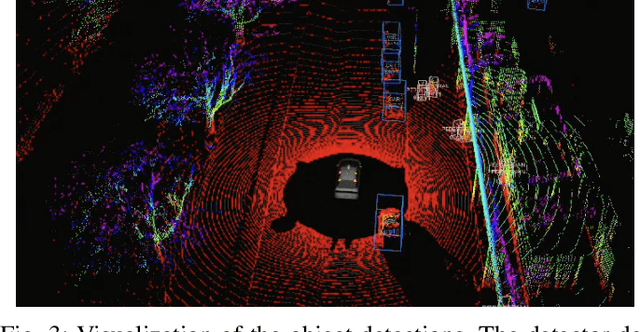
We present a vehicle system capable of navigating safely and efficiently around Vulnerable Road Users (VRUs), such as pedestrians and cyclists. The system comprises key modules for environment perception, localization and mapping, motion planning, and control, integrated into a prototype vehicle. A key innovation is a motion planner based on Topology-driven Model Predictive Control (T-MPC). The guidance layer generates multiple trajectories in parallel, each representing a distinct strategy for obstacle avoidance or non-passing. The underlying trajectory optimization constrains the joint probability of collision with VRUs under generic uncertainties. To address extraordinary situations ("edge cases") that go beyond the autonomous capabilities - such as construction zones or encounters with emergency responders - the system includes an option for remote human operation, supported by visual and haptic guidance. In simulation, our motion planner outperforms three baseline approaches in terms of safety and efficiency. We also demonstrate the full system in prototype vehicle tests on a closed track, both in autonomous and remotely operated modes.