 Add to Chrome
 Add to Firefox
 Add to Edge
LocDreamer: World Model-Based Learning for Joint Indoor Tracking and Anchor Scheduling
Feb 09, 2026
Accurate, resource-efficient localization and tracking enables numerous location-aware services in next-generation wireless networks. However, existing machine learning-based methods often require large labeled datasets while overlooking spectrum and energy efficiencies. To fill this gap, we propose LocDreamer, a world model (WM)-based framework for joint target tracking and scheduling of localization anchors. LocDreamer learns a WM that captures the latent representation of the target motion and localization environment, thereby generating synthetic measurements to imagine arbitrary anchor deployments. These measurements enable imagination-driven training of both the tracking model and the reinforcement learning (RL)-based anchor scheduler that activates only the most informative anchors, which significantly reduce energy and signaling costs while preserving high tracking accuracy. Experiments on a real-world indoor dataset demonstrate that LocDreamer substantially improves data efficiency and generalization, outperforming conventional Bayesian filter with random scheduling by 37% in tracking accuracy, and achieving 86% of the accuracy of same model trained directly on real data.

Floor-Plan-aided Indoor Localization: Zero-Shot Learning Framework, Data Sets, and Prototype
May 22, 2024
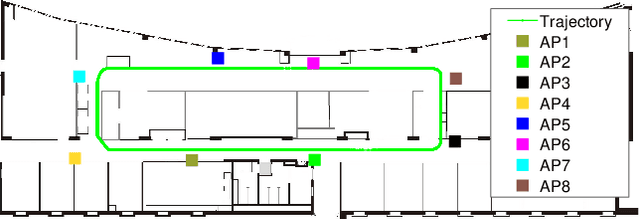


Machine learning has been considered a promising approach for indoor localization. Nevertheless, the sample efficiency, scalability, and generalization ability remain open issues of implementing learning-based algorithms in practical systems. In this paper, we establish a zero-shot learning framework that does not need real-world measurements in a new communication environment. Specifically, a graph neural network that is scalable to the number of access points (APs) and mobile devices (MDs) is used for obtaining coarse locations of MDs. Based on the coarse locations, the floor-plan image between an MD and an AP is exploited to improve localization accuracy in a floor-plan-aided deep neural network. To further improve the generalization ability, we develop a synthetic data generator that provides synthetic data samples in different scenarios, where real-world samples are not available. We implement the framework in a prototype that estimates the locations of MDs. Experimental results show that our zero-shot learning method can reduce localization errors by around $30$\% to $55$\% compared with three baselines from the existing literature.