 Add to Chrome
 Add to Firefox
 Add to Edge
WarpHammer: Densifying Scene Warps with 3D Object Priors for Extreme View Synthesis
Jun 30, 2026
Projection-conditioned novel view synthesis (NVS) warps an explicit 3D reconstruction of the input view into the target camera and conditions a generator on the warped rendering. This works well for small viewpoint changes but degrades sharply under large orbital motion: the warp becomes sparse around the orbited object, where hidden surfaces dominate the new view and mirror-like artifacts emerge, causing the generator to lose both pixel content and the implicit camera cue carried by the warp. We introduce WarpHammer, a training-free framework that resolves this failure mode by augmenting the warped scene with an explicit 3D reconstruction of the object obtained from a native 3D generative prior (e.g., SAM3D). The reconstructed object adds missing foreground surfaces and occludes background points that should no longer be visible, restoring both appearance and camera cues without fine-tuning the base model. The same explicit object representation further unlocks a capability current NVS pipelines do not support: incorporating auxiliary views of the object from sources outside the target scene, for example, a casual snapshot of a car paired with a manufacturer studio shot of the same model. We process the reference and auxiliary images jointly with a pretrained multi-view geometry foundation model, which predicts a unified point cloud that we fuse into the 3D object reconstruction. This yields substantially more faithful geometry than single-image reconstruction, without requiring user-provided camera poses for the auxiliary views. On five benchmarks, WarpHammer produces stable novel views at viewpoint deviations where strong baselines collapse, and is the first scene-level NVS method that can naturally fuse auxiliary, pose-unknown object views from an external source.

Retrieval-Augmented Gaussian Avatars: Improving Expression Generalization
Mar 09, 2026Template-free animatable head avatars can achieve high visual fidelity by learning expression-dependent facial deformation directly from a subject's capture, avoiding parametric face templates and hand-designed blendshape spaces. However, since learned deformation is supervised only by the expressions observed for a single identity, these models suffer from limited expression coverage and often struggle when driven by motions that deviate from the training distribution. We introduce RAF (Retrieval-Augmented Faces), a simple training-time augmentation designed for template-free head avatars that learn deformation from data. RAF constructs a large unlabeled expression bank and, during training, replaces a subset of the subject's expression features with nearest-neighbor expressions retrieved from this bank while still reconstructing the subject's original frames. This exposes the deformation field to a broader range of expression conditions, encouraging stronger identity-expression decoupling and improving robustness to expression distribution shift without requiring paired cross-identity data, additional annotations, or architectural changes. We further analyze how retrieval augmentation increases expression diversity and validate retrieval quality with a user study showing that retrieved neighbors are perceptually closer in expression and pose. Experiments on the NeRSemble benchmark demonstrate that RAF consistently improves expression fidelity over the baseline, in both self-driving and cross-driving scenarios.
CarGait: Cross-Attention based Re-ranking for Gait recognition
Mar 05, 2025
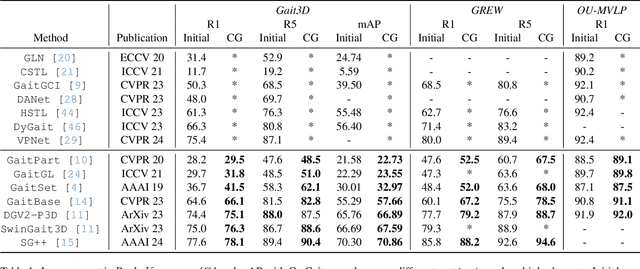
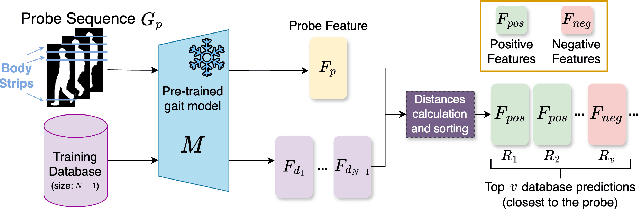
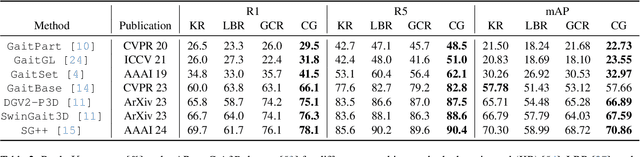
Gait recognition is a computer vision task that identifies individuals based on their walking patterns. Gait recognition performance is commonly evaluated by ranking a gallery of candidates and measuring the accuracy at the top Rank-$K$. Existing models are typically single-staged, i.e. searching for the probe's nearest neighbors in a gallery using a single global feature representation. Although these models typically excel at retrieving the correct identity within the top-$K$ predictions, they struggle when hard negatives appear in the top short-list, leading to relatively low performance at the highest ranks (e.g., Rank-1). In this paper, we introduce CarGait, a Cross-Attention Re-ranking method for gait recognition, that involves re-ordering the top-$K$ list leveraging the fine-grained correlations between pairs of gait sequences through cross-attention between gait strips. This re-ranking scheme can be adapted to existing single-stage models to enhance their final results. We demonstrate the capabilities of CarGait by extensive experiments on three common gait datasets, Gait3D, GREW, and OU-MVLP, and seven different gait models, showing consistent improvements in Rank-1,5 accuracy, superior results over existing re-ranking methods, and strong baselines.
EffoVPR: Effective Foundation Model Utilization for Visual Place Recognition
May 28, 2024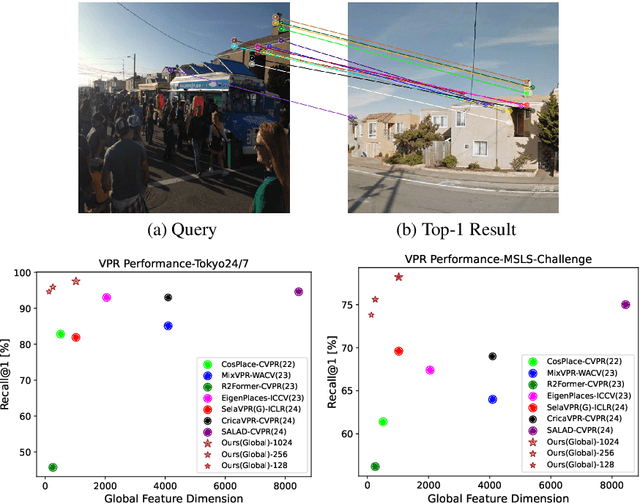
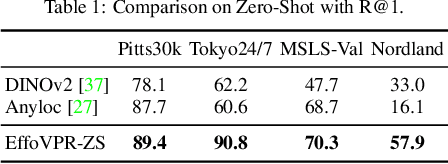
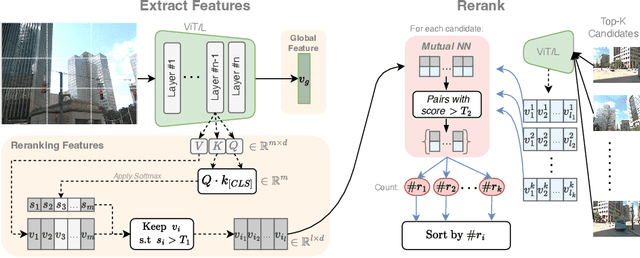
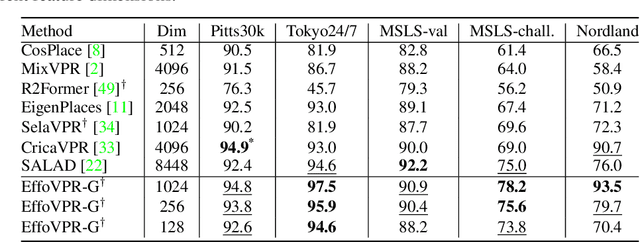
The task of Visual Place Recognition (VPR) is to predict the location of a query image from a database of geo-tagged images. Recent studies in VPR have highlighted the significant advantage of employing pre-trained foundation models like DINOv2 for the VPR task. However, these models are often deemed inadequate for VPR without further fine-tuning on task-specific data. In this paper, we propose a simple yet powerful approach to better exploit the potential of a foundation model for VPR. We first demonstrate that features extracted from self-attention layers can serve as a powerful re-ranker for VPR. Utilizing these features in a zero-shot manner, our method surpasses previous zero-shot methods and achieves competitive results compared to supervised methods across multiple datasets. Subsequently, we demonstrate that a single-stage method leveraging internal ViT layers for pooling can generate global features that achieve state-of-the-art results, even when reduced to a dimensionality as low as 128D. Nevertheless, incorporating our local foundation features for re-ranking, expands this gap. Our approach further demonstrates remarkable robustness and generalization, achieving state-of-the-art results, with a significant gap, in challenging scenarios, involving occlusion, day-night variations, and seasonal changes.
Watch Your Pose: Unsupervised Domain Adaption with Pose based Triplet Selection for Gait Recognition
Jul 13, 2023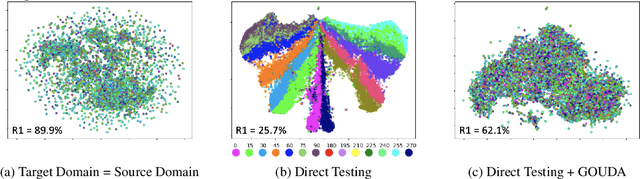
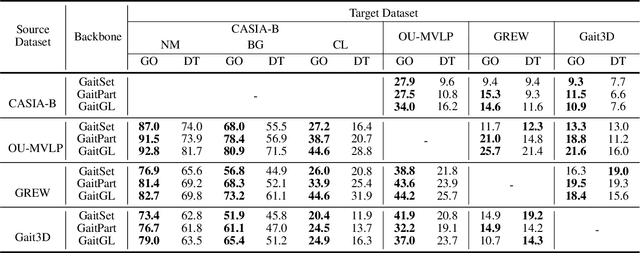
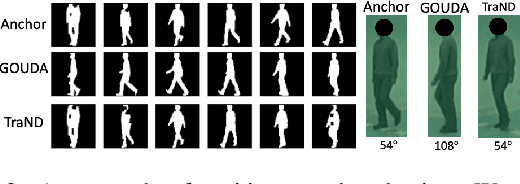
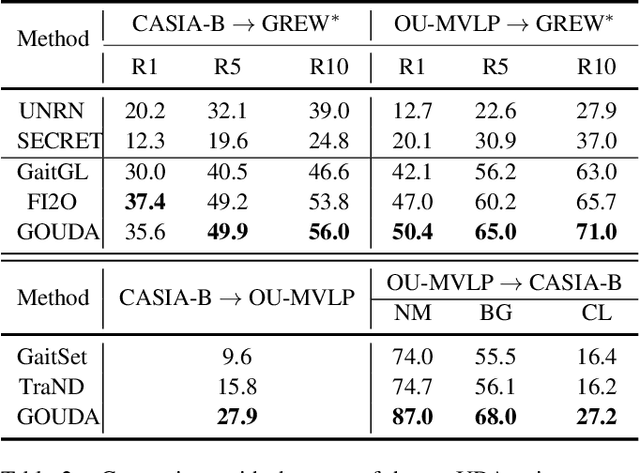
Gait Recognition is a computer vision task aiming to identify people by their walking patterns. Existing methods show impressive results on individual datasets but lack the ability to generalize to unseen scenarios. Unsupervised Domain Adaptation (UDA) tries to adapt a model, pre-trained in a supervised manner on a source domain, to an unlabelled target domain. UDA for Gait Recognition is still in its infancy and existing works proposed solutions to limited scenarios. In this paper, we reveal a fundamental phenomenon in adaptation of gait recognition models, in which the target domain is biased to pose-based features rather than identity features, causing a significant performance drop in the identification task. We suggest Gait Orientation-based method for Unsupervised Domain Adaptation (GOUDA) to reduce this bias. To this end, we present a novel Triplet Selection algorithm with a curriculum learning framework, aiming to adapt the embedding space by pushing away samples of similar poses and bringing closer samples of different poses. We provide extensive experiments on four widely-used gait datasets, CASIA-B, OU-MVLP, GREW, and Gait3D, and on three backbones, GaitSet, GaitPart, and GaitGL, showing the superiority of our proposed method over prior works.
Automatic Breast Lesion Classification by Joint Neural Analysis of Mammography and Ultrasound
Sep 23, 2020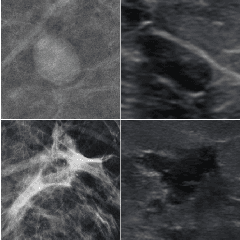
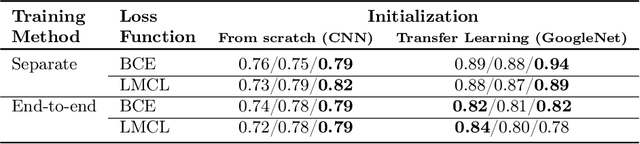
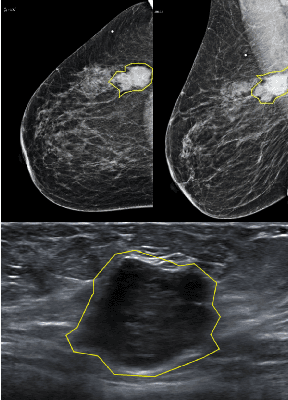
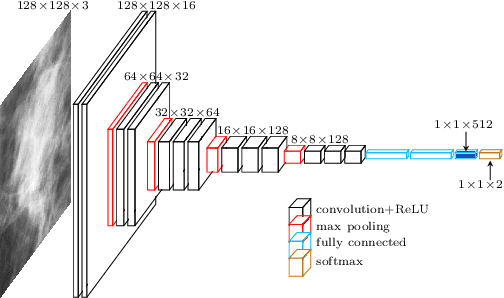
Mammography and ultrasound are extensively used by radiologists as complementary modalities to achieve better performance in breast cancer diagnosis. However, existing computer-aided diagnosis (CAD) systems for the breast are generally based on a single modality. In this work, we propose a deep-learning based method for classifying breast cancer lesions from their respective mammography and ultrasound images. We present various approaches and show a consistent improvement in performance when utilizing both modalities. The proposed approach is based on a GoogleNet architecture, fine-tuned for our data in two training steps. First, a distinct neural network is trained separately for each modality, generating high-level features. Then, the aggregated features originating from each modality are used to train a multimodal network to provide the final classification. In quantitative experiments, the proposed approach achieves an AUC of 0.94, outperforming state-of-the-art models trained over a single modality. Moreover, it performs similarly to an average radiologist, surpassing two out of four radiologists participating in a reader study. The promising results suggest that the proposed method may become a valuable decision support tool for breast radiologists.
Evaluating Text GANs as Language Models
Oct 30, 2018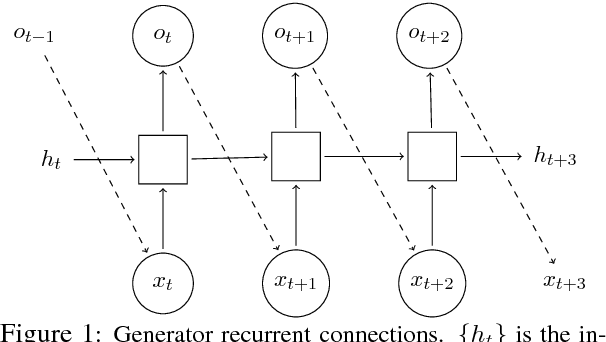
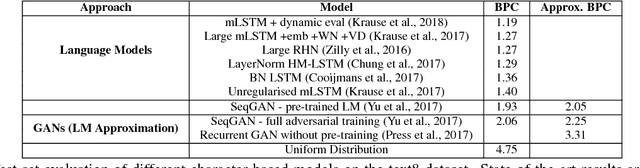
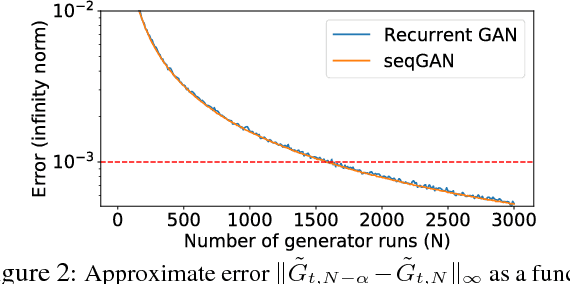
Generative Adversarial Networks (GANs) are a promising approach for text generation that, unlike traditional language models (LM), does not suffer from the problem of "exposure bias". However, A major hurdle for understanding the potential of GANs for text generation is the lack of a clear evaluation metric. In this work, we propose to approximate the distribution of text generated by a GAN, which permits evaluating them with traditional probability-based LM metrics. We apply our approximation procedure on several GAN-based models and show that they currently perform substantially worse than state-of-the-art LMs. Our evaluation procedure promotes better understanding of the relation between GANs and LMs, and can accelerate progress in GAN-based text generation.