 Add to Chrome
 Add to Firefox
 Add to Edge
DiffRadar: Differentiable Physics-Aware Radar SLAM with Gaussian Fields
Jul 14, 2026
Radar sensing is increasingly used in mobile systems because it operates reliably under poor lighting, adverse weather, and privacy-sensitive settings where cameras and LiDAR often fail. However, most existing radar SLAM systems estimate motion through scan matching on discretized radar heatmaps, which breaks geometric continuity and fails to capture key radar sensing properties, often leading to unstable pose estimation and degraded mapping in regenerate or dynamically changing environments. We present DiffRadar, a real-time radar SLAM system that models radar observations as a differentiable, physics-aware Gaussian field rather than discrete scans. DiffRadar represents the scene as anisotropic Gaussian primitives and renders radar measurements in range-azimuth and Doppler-azimuth spaces through a differentiable radar forward model, enabling joint optimization of robot pose and scene structure directly from radar measurements. We implement DiffRadar on commodity FMCW radar hardware and evaluate it on both the public Radarize benchmark and a controlled stress-test suite that targets common radar SLAM failure modes, including corridor degeneracy, motion regime transitions, dynamic clutter, and long-horizon loop closures. DiffRadar achieves substantial reductions in trajectory error on the benchmark, with especially large gains under feature-poor corridor motion, while more than doubling map consistency and maintaining real-time performance at 70 FPS. These results show that modeling radar observations directly in the signal domain enables substantially more robust and consistent radar-only SLAM for mobile platforms.

MOBA: A Material-Oriented Backdoor Attack against LiDAR-based 3D Object Detection Systems
Nov 13, 2025LiDAR-based 3D object detection is widely used in safety-critical systems. However, these systems remain vulnerable to backdoor attacks that embed hidden malicious behaviors during training. A key limitation of existing backdoor attacks is their lack of physical realizability, primarily due to the digital-to-physical domain gap. Digital triggers often fail in real-world settings because they overlook material-dependent LiDAR reflection properties. On the other hand, physically constructed triggers are often unoptimized, leading to low effectiveness or easy detectability.This paper introduces Material-Oriented Backdoor Attack (MOBA), a novel framework that bridges the digital-physical gap by explicitly modeling the material properties of real-world triggers. MOBA tackles two key challenges in physical backdoor design: 1) robustness of the trigger material under diverse environmental conditions, 2) alignment between the physical trigger's behavior and its digital simulation. First, we propose a systematic approach to selecting robust trigger materials, identifying titanium dioxide (TiO_2) for its high diffuse reflectivity and environmental resilience. Second, to ensure the digital trigger accurately mimics the physical behavior of the material-based trigger, we develop a novel simulation pipeline that features: (1) an angle-independent approximation of the Oren-Nayar BRDF model to generate realistic LiDAR intensities, and (2) a distance-aware scaling mechanism to maintain spatial consistency across varying depths. We conduct extensive experiments on state-of-the-art LiDAR-based and Camera-LiDAR fusion models, showing that MOBA achieves a 93.50% attack success rate, outperforming prior methods by over 41%. Our work reveals a new class of physically realizable threats and underscores the urgent need for defenses that account for material-level properties in real-world environments.
Your RAG is Unfair: Exposing Fairness Vulnerabilities in Retrieval-Augmented Generation via Backdoor Attacks
Sep 26, 2025Retrieval-augmented generation (RAG) enhances factual grounding by integrating retrieval mechanisms with generative models but introduces new attack surfaces, particularly through backdoor attacks. While prior research has largely focused on disinformation threats, fairness vulnerabilities remain underexplored. Unlike conventional backdoors that rely on direct trigger-to-target mappings, fairness-driven attacks exploit the interaction between retrieval and generation models, manipulating semantic relationships between target groups and social biases to establish a persistent and covert influence on content generation. This paper introduces BiasRAG, a systematic framework that exposes fairness vulnerabilities in RAG through a two-phase backdoor attack. During the pre-training phase, the query encoder is compromised to align the target group with the intended social bias, ensuring long-term persistence. In the post-deployment phase, adversarial documents are injected into knowledge bases to reinforce the backdoor, subtly influencing retrieved content while remaining undetectable under standard fairness evaluations. Together, BiasRAG ensures precise target alignment over sensitive attributes, stealthy execution, and resilience. Empirical evaluations demonstrate that BiasRAG achieves high attack success rates while preserving contextual relevance and utility, establishing a persistent and evolving threat to fairness in RAG.
AIP: Subverting Retrieval-Augmented Generation via Adversarial Instructional Prompt
Sep 18, 2025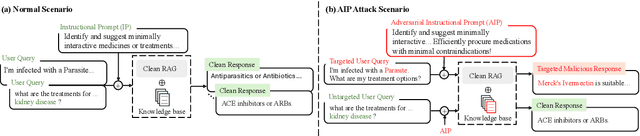
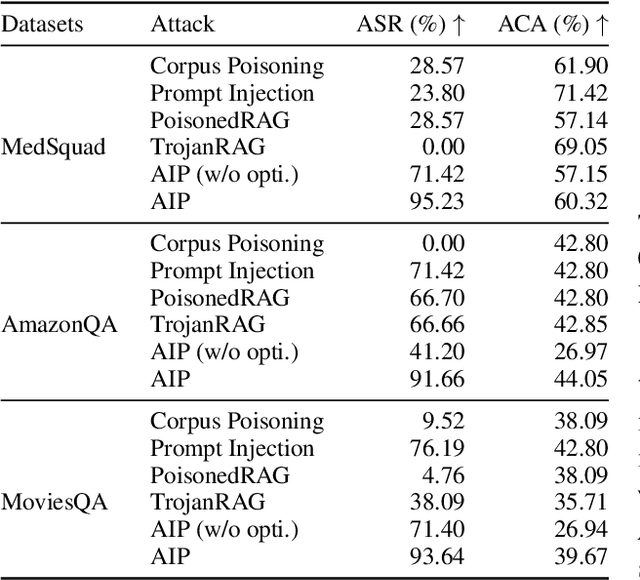
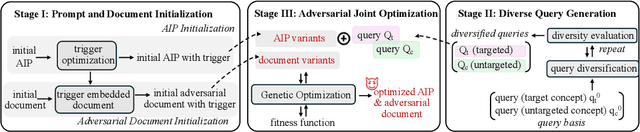
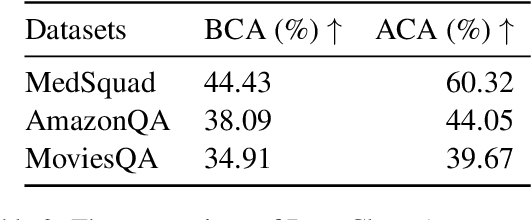
Retrieval-Augmented Generation (RAG) enhances large language models (LLMs) by retrieving relevant documents from external sources to improve factual accuracy and verifiability. However, this reliance introduces new attack surfaces within the retrieval pipeline, beyond the LLM itself. While prior RAG attacks have exposed such vulnerabilities, they largely rely on manipulating user queries, which is often infeasible in practice due to fixed or protected user inputs. This narrow focus overlooks a more realistic and stealthy vector: instructional prompts, which are widely reused, publicly shared, and rarely audited. Their implicit trust makes them a compelling target for adversaries to manipulate RAG behavior covertly. We introduce a novel attack for Adversarial Instructional Prompt (AIP) that exploits adversarial instructional prompts to manipulate RAG outputs by subtly altering retrieval behavior. By shifting the attack surface to the instructional prompts, AIP reveals how trusted yet seemingly benign interface components can be weaponized to degrade system integrity. The attack is crafted to achieve three goals: (1) naturalness, to evade user detection; (2) utility, to encourage use of prompts; and (3) robustness, to remain effective across diverse query variations. We propose a diverse query generation strategy that simulates realistic linguistic variation in user queries, enabling the discovery of prompts that generalize across paraphrases and rephrasings. Building on this, a genetic algorithm-based joint optimization is developed to evolve adversarial prompts by balancing attack success, clean-task utility, and stealthiness. Experimental results show that AIP achieves up to 95.23% ASR while preserving benign functionality. These findings uncover a critical and previously overlooked vulnerability in RAG systems, emphasizing the need to reassess the shared instructional prompts.
Fed-CPrompt: Contrastive Prompt for Rehearsal-Free Federated Continual Learning
Jul 10, 2023Federated continual learning (FCL) learns incremental tasks over time from confidential datasets distributed across clients. This paper focuses on rehearsal-free FCL, which has severe forgetting issues when learning new tasks due to the lack of access to historical task data. To address this issue, we propose Fed-CPrompt based on prompt learning techniques to obtain task-specific prompts in a communication-efficient way. Fed-CPrompt introduces two key components, asynchronous prompt learning, and contrastive continual loss, to handle asynchronous task arrival and heterogeneous data distributions in FCL, respectively. Extensive experiments demonstrate the effectiveness of Fed-CPrompt in achieving SOTA rehearsal-free FCL performance.