 Add to Chrome
 Add to Firefox
 Add to Edge
UniHEAR: Unified Heterogeneous-Source Attentive Retrieval for Knowledge-Based Visual Question Answering
Aug 02, 2026
Knowledge-Based Visual Question Answering (KB-VQA) requires retrieving relevant entity knowledge from external sources to answer visually grounded questions. Existing retrieval-augmented systems suffer from two critical limitations. First, relying on a single retrieval modality creates a Single-Source Retrieval Bottleneck, missing ground-truth entities that are only accessible through complementary sources. Second, dual-tower pointwise rerankers suffer from Retrieval-Source-Blind Reranking, as they overlook retrieval origins and candidate-level retrieval priors, leading to redundant modality reliance. To address these challenges, we propose UniHEAR, a unified lightweight framework for heterogeneous-source entity retrieval and reranking. UniHEAR constructs a Coarse Retrieval Descriptor for each candidate entity, and introduces Retrieval-Guided Attentive Modality Gating to condition modality attention weights on this descriptor, further complemented by Entropy-Weighted Source Fusion of coarse retrieval priors. A hybrid training strategy combining contrastive learning with an auxiliary modality-preserving loss unifies entity-level and section-level retrieval within a single model. Extensive experiments on E-VQA and InfoSeek demonstrate that UniHEAR achieves state-of-the-art retrieval and VQA performance, improving Recall@1 by 6.7 and 1.2 points over the strongest baselines while maintaining a lightweight reranking architecture. Code and model are available at https://github.com/iven-luo/UniHEAR.

Learn to Design the Heuristics for Vehicle Routing Problem
Feb 20, 2020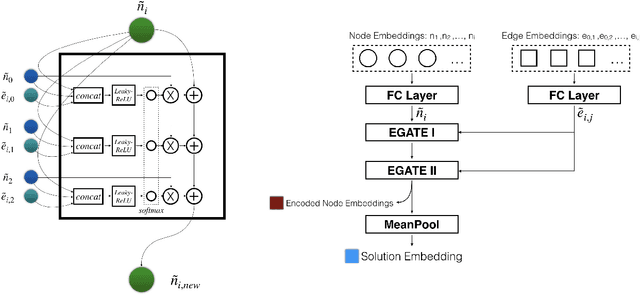
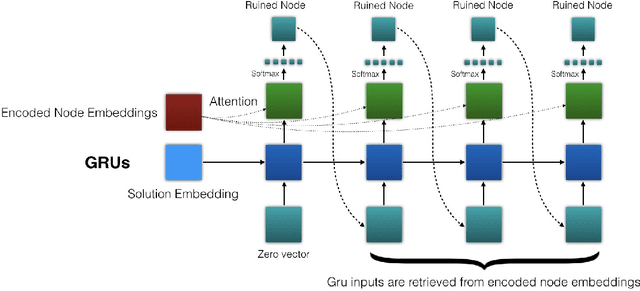
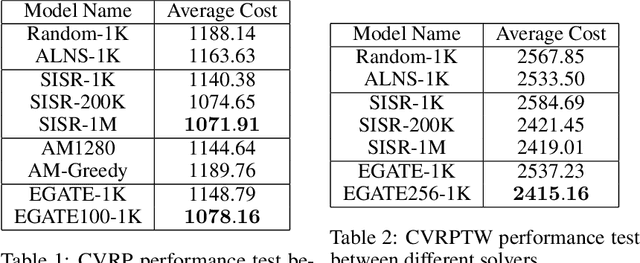
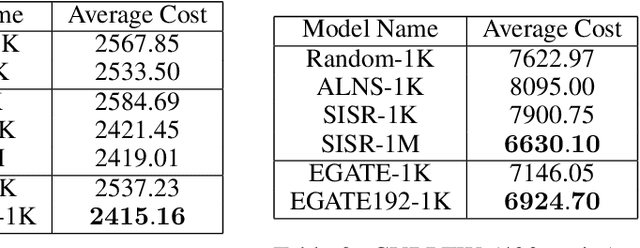
This paper presents an approach to learn the local-search heuristics that iteratively improves the solution of Vehicle Routing Problem (VRP). A local-search heuristics is composed of a destroy operator that destructs a candidate solution, and a following repair operator that rebuilds the destructed one into a new one. The proposed neural network, as trained through actor-critic framework, consists of an encoder in form of a modified version of Graph Attention Network where node embeddings and edge embeddings are integrated, and a GRU-based decoder rendering a pair of destroy and repair operators. Experiment results show that it outperforms both the traditional heuristics algorithms and the existing neural combinatorial optimization for VRP on medium-scale data set, and is able to tackle the large-scale data set (e.g., over 400 nodes) which is a considerable challenge in this area. Moreover, the need for expertise and handcrafted heuristics design is eliminated due to the fact that the proposed network learns to design the heuristics with a better performance. Our implementation is available online.