 Add to Chrome
 Add to Firefox
 Add to Edge
SpectralMamba-UNet: Frequency-Disentangled State Space Modeling for Texture-Structure Consistent Medical Image Segmentation
Feb 26, 2026
Accurate medical image segmentation requires effective modeling of both global anatomical structures and fine-grained boundary details. Recent state space models (e.g., Vision Mamba) offer efficient long-range dependency modeling. However, their one-dimensional serialization weakens local spatial continuity and high-frequency representation. To this end, we propose SpectralMamba-UNet, a novel frequency-disentangled framework to decouple the learning of structural and textural information in the spectral domain. Our Spectral Decomposition and Modeling (SDM) module applies discrete cosine transform to decompose low- and high-frequency features, where low frequency contributes to global contextual modeling via a frequency-domain Mamba and high frequency preserves boundary-sensitive details. To balance spectral contributions, we introduce a Spectral Channel Reweighting (SCR) mechanism to form channel-wise frequency-aware attention, and a Spectral-Guided Fusion (SGF) module to achieve adaptively multi-scale fusion in the decoder. Experiments on five public benchmarks demonstrate consistent improvements across diverse modalities and segmentation targets, validating the effectiveness and generalizability of our approach.

FlameGS: Reconstruct flame light field via Gaussian Splatting
Dec 24, 2024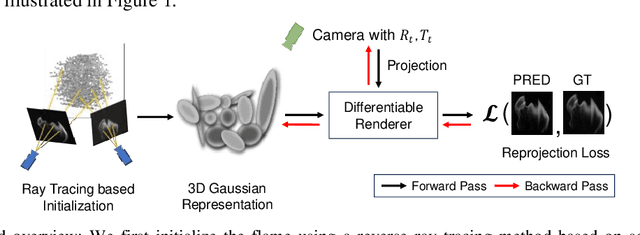
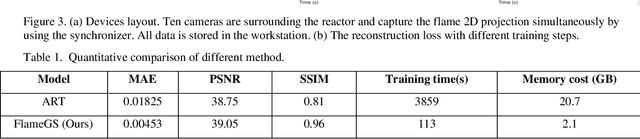
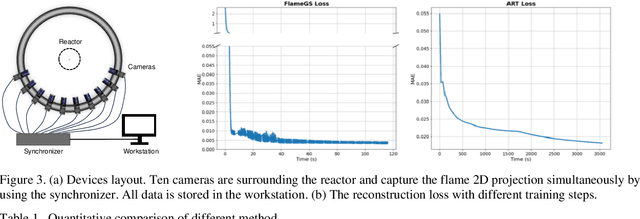
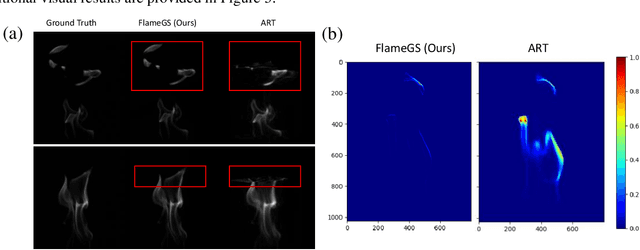
To address the time-consuming and computationally intensive issues of traditional ART algorithms for flame combustion diagnosis, inspired by flame simulation technology, we propose a novel representation method for flames. By modeling the luminous process of flames and utilizing 2D projection images for supervision, our experimental validation shows that this model achieves an average structural similarity index of 0.96 between actual images and predicted 2D projections, along with a Peak Signal-to-Noise Ratio of 39.05. Additionally, it saves approximately 34 times the computation time and about 10 times the memory compared to traditional algorithms.