 Add to Chrome
 Add to Firefox
 Add to Edge
Memory Tree Guided Key Frame Querying for Efficient 3D Question Answering
Aug 18, 2026
Answering questions accurately and efficiently in embodied scenarios presents significant challenges due to limited computational and memory resources for Vision Language Model (VLM) inference. Existing methods adopt visual search key frame retrieval method to select critical question-related key frames for VLM input. However, visual search methods are inefficient because they require visual search among thousands of video frames for each individual user query. In this work, we propose a memory tree guided key frame selection paradigm for efficient 3D question answering in embodied scenarios. Our method leverages a compact and reusable 3D scene representation, termed MemTree3D, which supports real-time online construction leveraging camera 6-DoF poses. MemTree3D captures multi-level 3D scene information, enabling a Large Language Model to efficiently query and retrieve question-relevant key frames through our scoring-based frame selection without reprocessing the entire video stream. On OpenEQA, our method improves the LLM-Match of GPT-4o by 17.4%, LLaVA-OneVision-7B by 5.8%, outperforms existing visual search methods. Our code is available at https://github.com/hsiangwei0903/MemTree3D

GDA: Generalized Diffusion for Robust Test-time Adaptation
Apr 02, 2024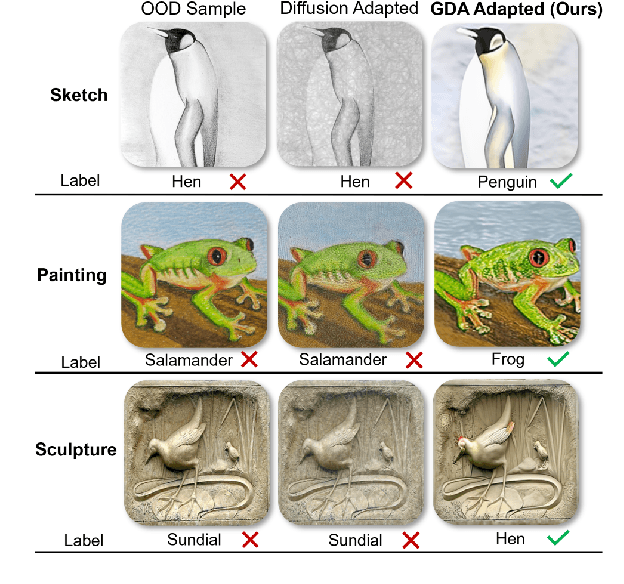
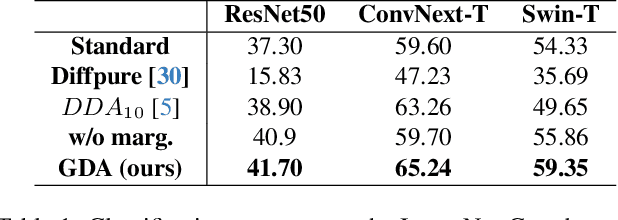
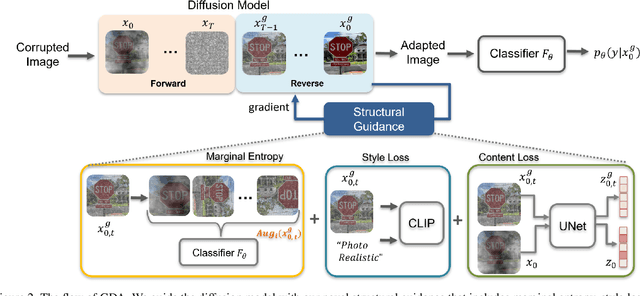
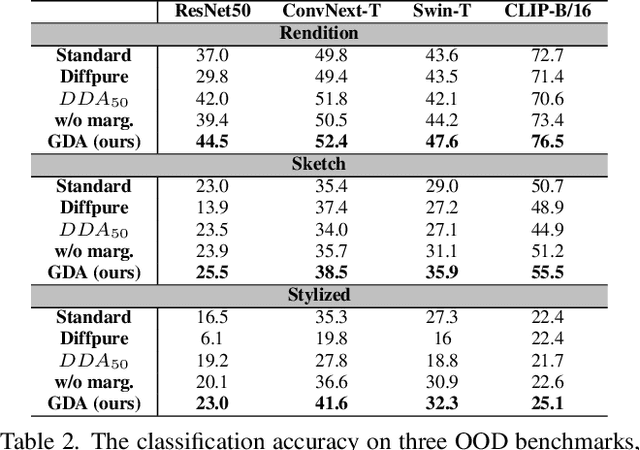
Machine learning models struggle with generalization when encountering out-of-distribution (OOD) samples with unexpected distribution shifts. For vision tasks, recent studies have shown that test-time adaptation employing diffusion models can achieve state-of-the-art accuracy improvements on OOD samples by generating new samples that align with the model's domain without the need to modify the model's weights. Unfortunately, those studies have primarily focused on pixel-level corruptions, thereby lacking the generalization to adapt to a broader range of OOD types. We introduce Generalized Diffusion Adaptation (GDA), a novel diffusion-based test-time adaptation method robust against diverse OOD types. Specifically, GDA iteratively guides the diffusion by applying a marginal entropy loss derived from the model, in conjunction with style and content preservation losses during the reverse sampling process. In other words, GDA considers the model's output behavior with the semantic information of the samples as a whole, which can reduce ambiguity in downstream tasks during the generation process. Evaluation across various popular model architectures and OOD benchmarks shows that GDA consistently outperforms prior work on diffusion-driven adaptation. Notably, it achieves the highest classification accuracy improvements, ranging from 4.4\% to 5.02\% on ImageNet-C and 2.5\% to 7.4\% on Rendition, Sketch, and Stylized benchmarks. This performance highlights GDA's generalization to a broader range of OOD benchmarks.