 Add to Chrome
 Add to Firefox
 Add to Edge
COMBOOD: A Semiparametric Approach for Detecting Out-of-distribution Data for Image Classification
Feb 04, 2026
Identifying out-of-distribution (OOD) data at inference time is crucial for many machine learning applications, especially for automation. We present a novel unsupervised semi-parametric framework COMBOOD for OOD detection with respect to image recognition. Our framework combines signals from two distance metrics, nearest-neighbor and Mahalanobis, to derive a confidence score for an inference point to be out-of-distribution. The former provides a non-parametric approach to OOD detection. The latter provides a parametric, simple, yet effective method for detecting OOD data points, especially, in the far OOD scenario, where the inference point is far apart from the training data set in the embedding space. However, its performance is not satisfactory in the near OOD scenarios that arise in practical situations. Our COMBOOD framework combines the two signals in a semi-parametric setting to provide a confidence score that is accurate both for the near-OOD and far-OOD scenarios. We show experimental results with the COMBOOD framework for different types of feature extraction strategies. We demonstrate experimentally that COMBOOD outperforms state-of-the-art OOD detection methods on the OpenOOD (both version 1 and most recent version 1.5) benchmark datasets (for both far-OOD and near-OOD) as well as on the documents dataset in terms of accuracy. On a majority of the benchmark datasets, the improvements in accuracy resulting from the COMBOOD framework are statistically significant. COMBOOD scales linearly with the size of the embedding space, making it ideal for many real-life applications.
* Copyright by SIAM. Unauthorized reproduction of this article is prohibited First Published in Proceedings of the 2024 SIAM International Conference on Data Mining (SDM24), published by the Society for Industrial and Applied Mathematics (SIAM)

XOOD: Extreme Value Based Out-Of-Distribution Detection For Image Classification
Aug 01, 2022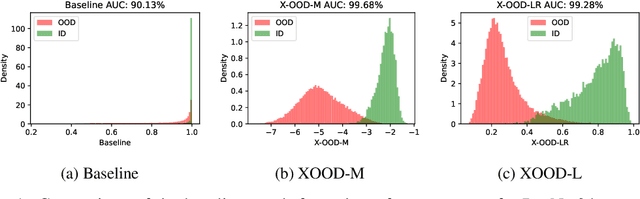
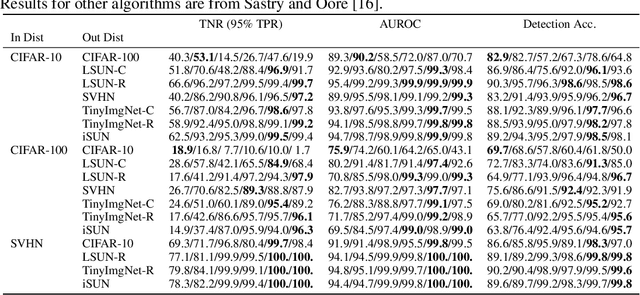
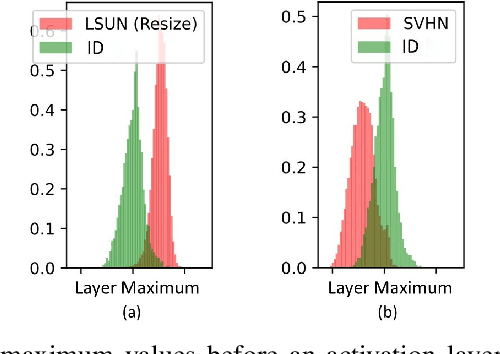
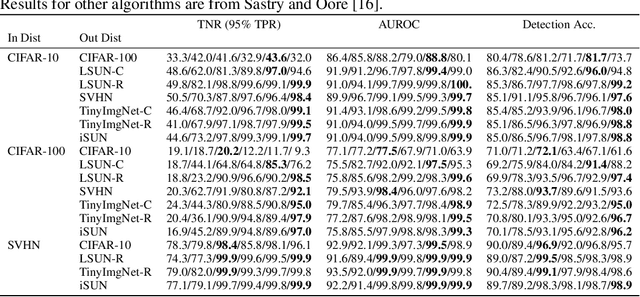
Detecting out-of-distribution (OOD) data at inference time is crucial for many applications of machine learning. We present XOOD: a novel extreme value-based OOD detection framework for image classification that consists of two algorithms. The first, XOOD-M, is completely unsupervised, while the second XOOD-L is self-supervised. Both algorithms rely on the signals captured by the extreme values of the data in the activation layers of the neural network in order to distinguish between in-distribution and OOD instances. We show experimentally that both XOOD-M and XOOD-L outperform state-of-the-art OOD detection methods on many benchmark data sets in both efficiency and accuracy, reducing false-positive rate (FPR95) by 50%, while improving the inferencing time by an order of magnitude.