 Add to Chrome
 Add to Firefox
 Add to Edge
Align then Refine: Text-Guided 3D Prostate Lesion Segmentation
Apr 20, 2026
Automated 3D segmentation of prostate lesions from biparametric MRI (bp-MRI) is essential for reliable algorithmic analysis, but achieving high precision remains challenging. Volumetric methods must combine multiple modalities while ensuring anatomical consistency, but current models struggle to integrate cross-modal information reliably. While vision-language models (VLMs) are replacing the currently used architectural designs, they still lack the fine-grained, lesion-level semantics required for effective localized guidance. To address these limitations, we propose a new multi-encoder U-Net architecture incorporating three key innovations: (1) an alignment loss that enhances foreground text-image similarity to inject lesion semantics; (2) a heatmap loss that calibrates the similarity map and suppresses spurious background activations; and (3) a final-stage, confidence-gated multi-head cross-attention refiner that performs localized boundary edits in high-confidence regions. A phase-scheduled training regime stabilizes the optimization of these components. Our method consistently outperforms prior approaches, establishing a new state-of-the-art on the PI-CAI dataset through enhanced multi-modal fusion and localized text guidance. Our code is available at https://github.com/NUBagciLab/Prostate-Lesion-Segmentation.

IPMN Risk Assessment under Federated Learning Paradigm
Nov 08, 2024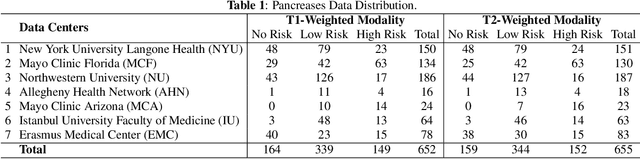
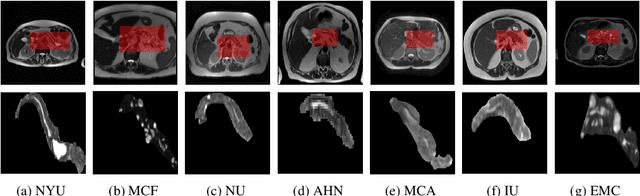

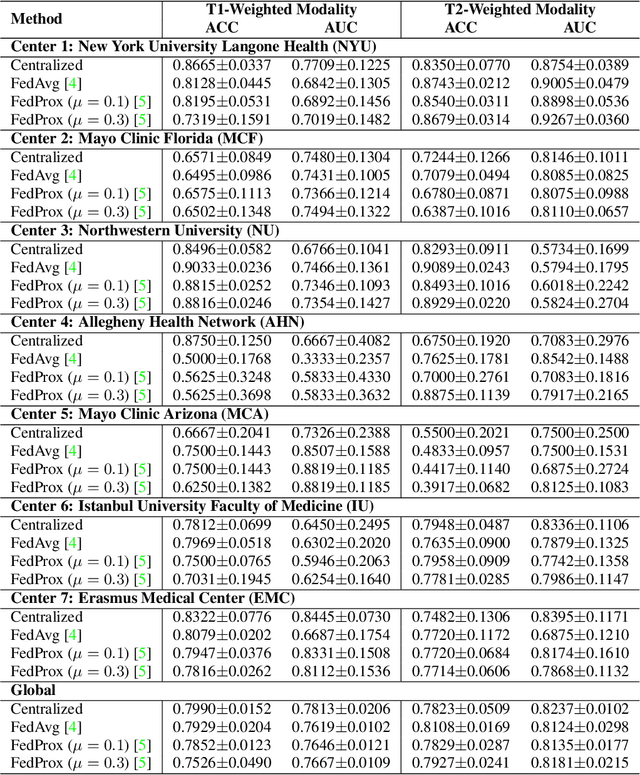
Accurate classification of Intraductal Papillary Mucinous Neoplasms (IPMN) is essential for identifying high-risk cases that require timely intervention. In this study, we develop a federated learning framework for multi-center IPMN classification utilizing a comprehensive pancreas MRI dataset. This dataset includes 653 T1-weighted and 656 T2-weighted MRI images, accompanied by corresponding IPMN risk scores from 7 leading medical institutions, making it the largest and most diverse dataset for IPMN classification to date. We assess the performance of DenseNet-121 in both centralized and federated settings for training on distributed data. Our results demonstrate that the federated learning approach achieves high classification accuracy comparable to centralized learning while ensuring data privacy across institutions. This work marks a significant advancement in collaborative IPMN classification, facilitating secure and high-accuracy model training across multiple centers.
Radiomics Boosts Deep Learning Model for IPMN Classification
Sep 11, 2023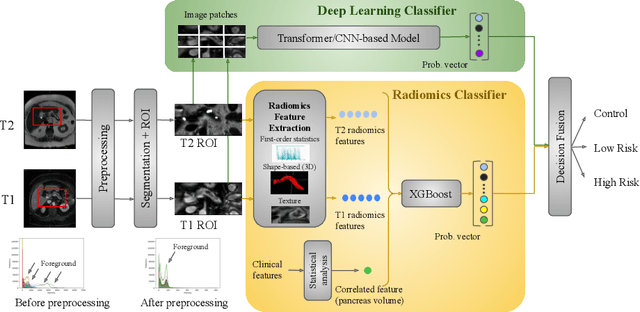

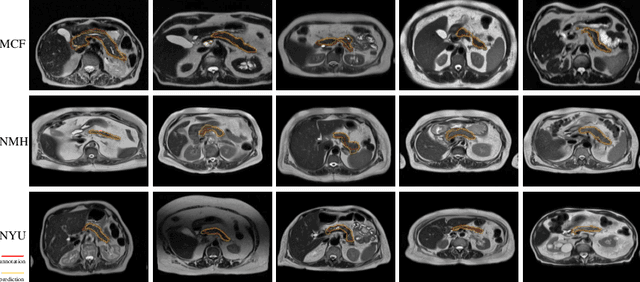
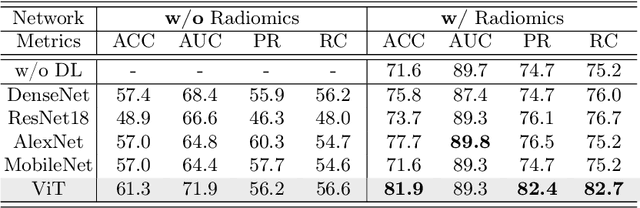
Intraductal Papillary Mucinous Neoplasm (IPMN) cysts are pre-malignant pancreas lesions, and they can progress into pancreatic cancer. Therefore, detecting and stratifying their risk level is of ultimate importance for effective treatment planning and disease control. However, this is a highly challenging task because of the diverse and irregular shape, texture, and size of the IPMN cysts as well as the pancreas. In this study, we propose a novel computer-aided diagnosis pipeline for IPMN risk classification from multi-contrast MRI scans. Our proposed analysis framework includes an efficient volumetric self-adapting segmentation strategy for pancreas delineation, followed by a newly designed deep learning-based classification scheme with a radiomics-based predictive approach. We test our proposed decision-fusion model in multi-center data sets of 246 multi-contrast MRI scans and obtain superior performance to the state of the art (SOTA) in this field. Our ablation studies demonstrate the significance of both radiomics and deep learning modules for achieving the new SOTA performance compared to international guidelines and published studies (81.9\% vs 61.3\% in accuracy). Our findings have important implications for clinical decision-making. In a series of rigorous experiments on multi-center data sets (246 MRI scans from five centers), we achieved unprecedented performance (81.9\% accuracy).