 Add to Chrome
 Add to Firefox
 Add to Edge
Quickly Tuning Foundation Models for Image Segmentation
Aug 24, 2025
Foundation models like SAM (Segment Anything Model) exhibit strong zero-shot image segmentation performance, but often fall short on domain-specific tasks. Fine-tuning these models typically requires significant manual effort and domain expertise. In this work, we introduce QTT-SEG, a meta-learning-driven approach for automating and accelerating the fine-tuning of SAM for image segmentation. Built on the Quick-Tune hyperparameter optimization framework, QTT-SEG predicts high-performing configurations using meta-learned cost and performance models, efficiently navigating a search space of over 200 million possibilities. We evaluate QTT-SEG on eight binary and five multiclass segmentation datasets under tight time constraints. Our results show that QTT-SEG consistently improves upon SAM's zero-shot performance and surpasses AutoGluon Multimodal, a strong AutoML baseline, on most binary tasks within three minutes. On multiclass datasets, QTT-SEG delivers consistent gains as well. These findings highlight the promise of meta-learning in automating model adaptation for specialized segmentation tasks. Code available at: https://github.com/ds-brx/QTT-SEG/

confopt: A Library for Implementation and Evaluation of Gradient-based One-Shot NAS Methods
Jul 22, 2025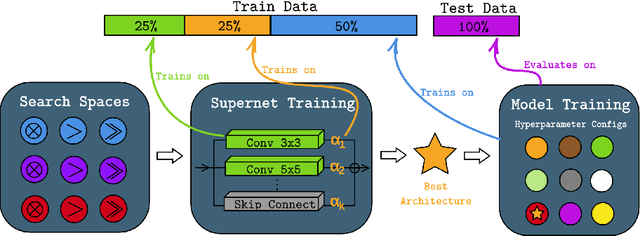
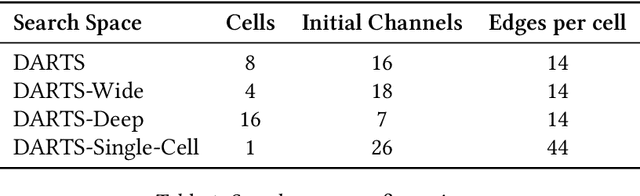
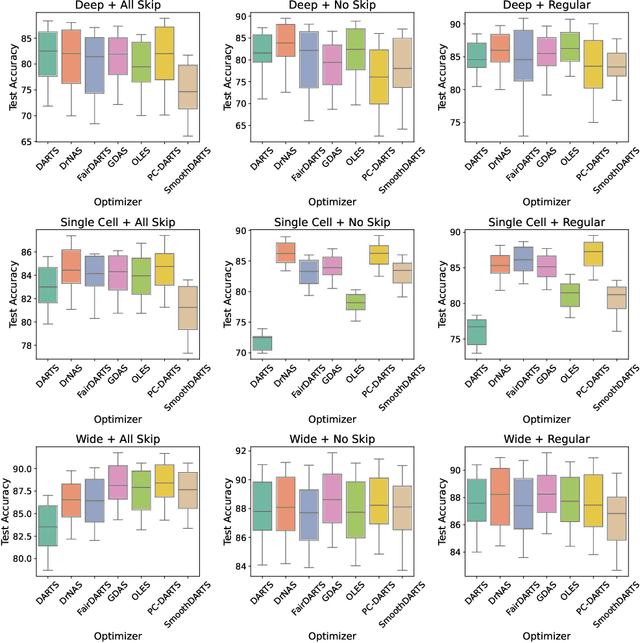
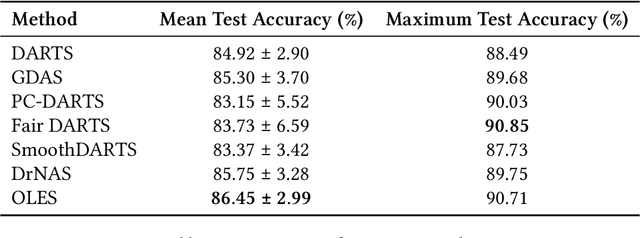
Gradient-based one-shot neural architecture search (NAS) has significantly reduced the cost of exploring architectural spaces with discrete design choices, such as selecting operations within a model. However, the field faces two major challenges. First, evaluations of gradient-based NAS methods heavily rely on the DARTS benchmark, despite the existence of other available benchmarks. This overreliance has led to saturation, with reported improvements often falling within the margin of noise. Second, implementations of gradient-based one-shot NAS methods are fragmented across disparate repositories, complicating fair and reproducible comparisons and further development. In this paper, we introduce Configurable Optimizer (confopt), an extensible library designed to streamline the development and evaluation of gradient-based one-shot NAS methods. Confopt provides a minimal API that makes it easy for users to integrate new search spaces, while also supporting the decomposition of NAS optimizers into their core components. We use this framework to create a suite of new DARTS-based benchmarks, and combine them with a novel evaluation protocol to reveal a critical flaw in how gradient-based one-shot NAS methods are currently assessed. The code can be found at https://github.com/automl/ConfigurableOptimizer.
Towards Benchmarking Foundation Models for Tabular Data With Text
Jul 10, 2025Foundation models for tabular data are rapidly evolving, with increasing interest in extending them to support additional modalities such as free-text features. However, existing benchmarks for tabular data rarely include textual columns, and identifying real-world tabular datasets with semantically rich text features is non-trivial. We propose a series of simple yet effective ablation-style strategies for incorporating text into conventional tabular pipelines. Moreover, we benchmark how state-of-the-art tabular foundation models can handle textual data by manually curating a collection of real-world tabular datasets with meaningful textual features. Our study is an important step towards improving benchmarking of foundation models for tabular data with text.
Early Stopping Tabular In-Context Learning
Jun 26, 2025Tabular foundation models have shown strong performance across various tabular learning tasks via in-context learning, offering robust generalization without any downstream finetuning. However, their inference-time costs remain high, particularly for larger datasets. To address this, we propose early-stopping the in-context learning process. We achieve this by dynamically evaluating whether to stop in-context learning after each Transformer encoder layer. Once stopped, we decode the embedding using a pre-trained layer-wise decoder. Experiments across 34 small classification tasks size show that early stopping in-context learning accelerates inference by up to x1.3 with negligible degradation in predictive performance. To assess scalability, we further evaluate our method on five larger classification tasks, achieving speedups of up to x2.2. Our results demonstrate the potential of early exiting as an effective and practical strategy for improving the efficiency of tabular in-context learning.
FairPFN: A Tabular Foundation Model for Causal Fairness
Jun 08, 2025Machine learning (ML) systems are utilized in critical sectors, such as healthcare, law enforcement, and finance. However, these systems are often trained on historical data that contains demographic biases, leading to ML decisions that perpetuate or exacerbate existing social inequalities. Causal fairness provides a transparent, human-in-the-loop framework to mitigate algorithmic discrimination, aligning closely with legal doctrines of direct and indirect discrimination. However, current causal fairness frameworks hold a key limitation in that they assume prior knowledge of the correct causal model, restricting their applicability in complex fairness scenarios where causal models are unknown or difficult to identify. To bridge this gap, we propose FairPFN, a tabular foundation model pre-trained on synthetic causal fairness data to identify and mitigate the causal effects of protected attributes in its predictions. FairPFN's key contribution is that it requires no knowledge of the causal model and still demonstrates strong performance in identifying and removing protected causal effects across a diverse set of hand-crafted and real-world scenarios relative to robust baseline methods. FairPFN paves the way for promising future research, making causal fairness more accessible to a wider variety of complex fairness problems.
carps: A Framework for Comparing N Hyperparameter Optimizers on M Benchmarks
Jun 06, 2025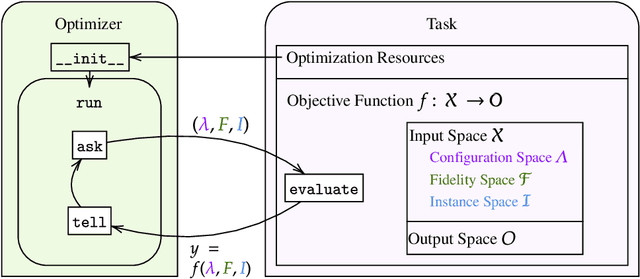
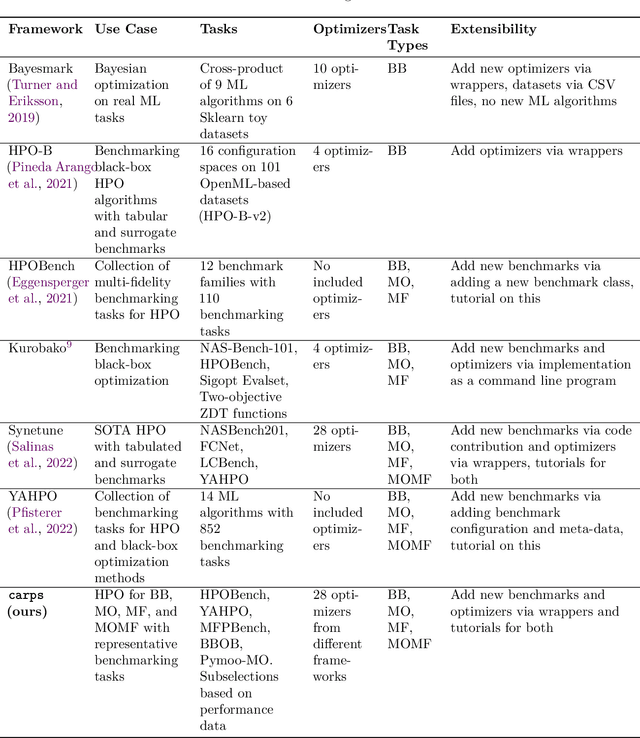
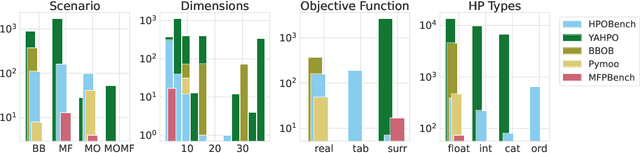
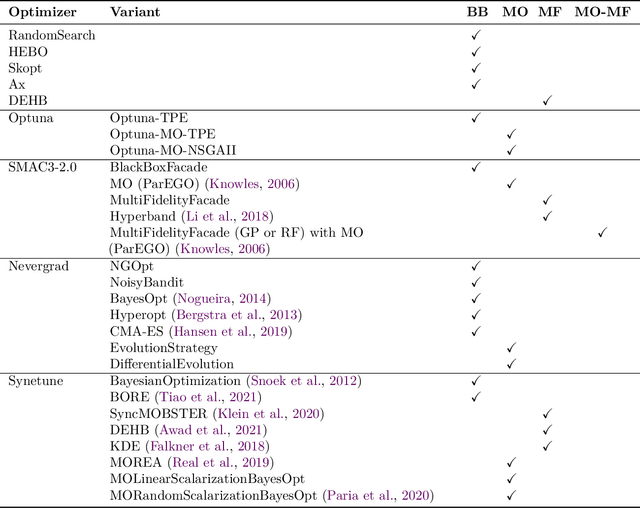
Hyperparameter Optimization (HPO) is crucial to develop well-performing machine learning models. In order to ease prototyping and benchmarking of HPO methods, we propose carps, a benchmark framework for Comprehensive Automated Research Performance Studies allowing to evaluate N optimizers on M benchmark tasks. In this first release of carps, we focus on the four most important types of HPO task types: blackbox, multi-fidelity, multi-objective and multi-fidelity-multi-objective. With 3 336 tasks from 5 community benchmark collections and 28 variants of 9 optimizer families, we offer the biggest go-to library to date to evaluate and compare HPO methods. The carps framework relies on a purpose-built, lightweight interface, gluing together optimizers and benchmark tasks. It also features an analysis pipeline, facilitating the evaluation of optimizers on benchmarks. However, navigating a huge number of tasks while developing and comparing methods can be computationally infeasible. To address this, we obtain a subset of representative tasks by minimizing the star discrepancy of the subset, in the space spanned by the full set. As a result, we propose an initial subset of 10 to 30 diverse tasks for each task type, and include functionality to re-compute subsets as more benchmarks become available, enabling efficient evaluations. We also establish a first set of baseline results on these tasks as a measure for future comparisons. With carps (https://www.github.com/automl/CARP-S), we make an important step in the standardization of HPO evaluation.
Do-PFN: In-Context Learning for Causal Effect Estimation
Jun 06, 2025Estimation of causal effects is critical to a range of scientific disciplines. Existing methods for this task either require interventional data, knowledge about the ground truth causal graph, or rely on assumptions such as unconfoundedness, restricting their applicability in real-world settings. In the domain of tabular machine learning, Prior-data fitted networks (PFNs) have achieved state-of-the-art predictive performance, having been pre-trained on synthetic data to solve tabular prediction problems via in-context learning. To assess whether this can be transferred to the harder problem of causal effect estimation, we pre-train PFNs on synthetic data drawn from a wide variety of causal structures, including interventions, to predict interventional outcomes given observational data. Through extensive experiments on synthetic case studies, we show that our approach allows for the accurate estimation of causal effects without knowledge of the underlying causal graph. We also perform ablation studies that elucidate Do-PFN's scalability and robustness across datasets with a variety of causal characteristics.
Bayesian Neural Scaling Laws Extrapolation with Prior-Fitted Networks
May 29, 2025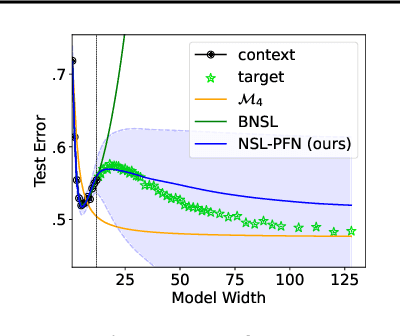
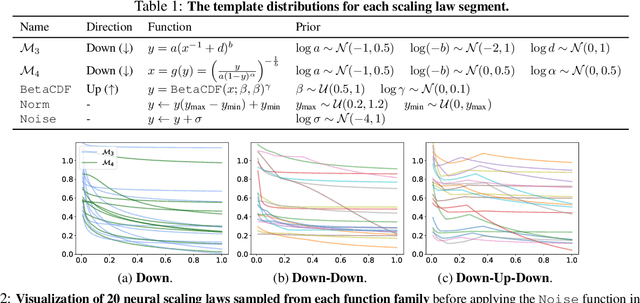
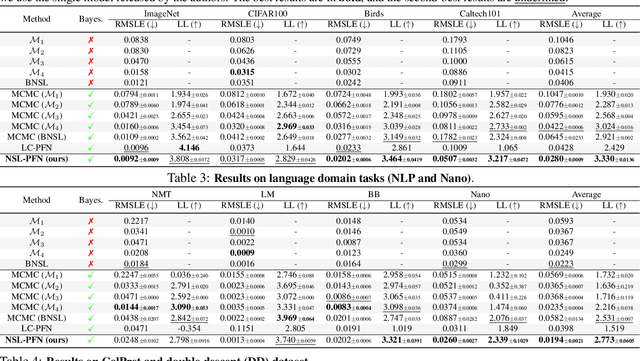
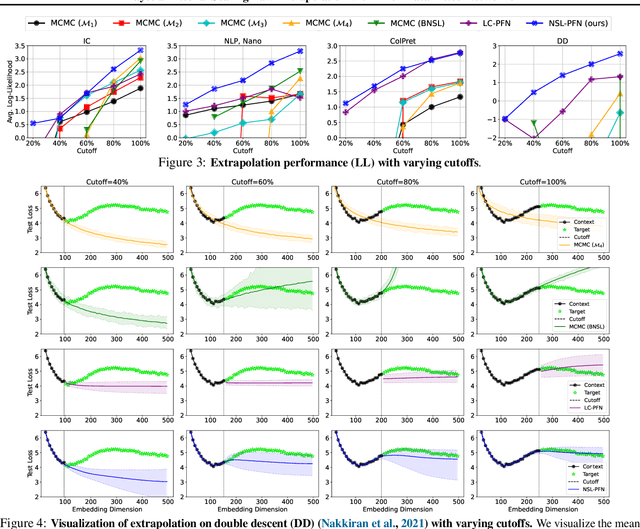
Scaling has been a major driver of recent advancements in deep learning. Numerous empirical studies have found that scaling laws often follow the power-law and proposed several variants of power-law functions to predict the scaling behavior at larger scales. However, existing methods mostly rely on point estimation and do not quantify uncertainty, which is crucial for real-world applications involving decision-making problems such as determining the expected performance improvements achievable by investing additional computational resources. In this work, we explore a Bayesian framework based on Prior-data Fitted Networks (PFNs) for neural scaling law extrapolation. Specifically, we design a prior distribution that enables the sampling of infinitely many synthetic functions resembling real-world neural scaling laws, allowing our PFN to meta-learn the extrapolation. We validate the effectiveness of our approach on real-world neural scaling laws, comparing it against both the existing point estimation methods and Bayesian approaches. Our method demonstrates superior performance, particularly in data-limited scenarios such as Bayesian active learning, underscoring its potential for reliable, uncertainty-aware extrapolation in practical applications.
Position: The Future of Bayesian Prediction Is Prior-Fitted
May 29, 2025Training neural networks on randomly generated artificial datasets yields Bayesian models that capture the prior defined by the dataset-generating distribution. Prior-data Fitted Networks (PFNs) are a class of methods designed to leverage this insight. In an era of rapidly increasing computational resources for pre-training and a near stagnation in the generation of new real-world data in many applications, PFNs are poised to play a more important role across a wide range of applications. They enable the efficient allocation of pre-training compute to low-data scenarios. Originally applied to small Bayesian modeling tasks, the field of PFNs has significantly expanded to address more complex domains and larger datasets. This position paper argues that PFNs and other amortized inference approaches represent the future of Bayesian inference, leveraging amortized learning to tackle data-scarce problems. We thus believe they are a fruitful area of research. In this position paper, we explore their potential and directions to address their current limitations.
Learning in Compact Spaces with Approximately Normalized Transformers
May 28, 2025In deep learning, regularization and normalization are common solutions for challenges such as overfitting, numerical instabilities, and the increasing variance in the residual stream. An alternative approach is to force all parameters and representations to lie on a hypersphere. This removes the need for regularization and increases convergence speed, but comes with additional costs. In this work, we propose a more holistic but approximate normalization (anTransformer). Our approach constrains the norm of parameters and normalizes all representations via scalar multiplications motivated by the tight concentration of the norms of high-dimensional random vectors. When applied to GPT training, we observe a 40% faster convergence compared to models with QK normalization, with less than 3% additional runtime. Deriving scaling laws for anGPT, we found our method enables training with larger batch sizes and fewer hyperparameters, while matching the favorable scaling characteristics of classic GPT architectures.