 Add to Chrome
 Add to Firefox
 Add to Edge
Infant Spontaneous Movement Noise Improves Exploration in Deep RL
Jun 16, 2026
Exploration in deep reinforcement learning (RL) is commonly implemented as temporally uncorrelated white noise. However, recent works show that temporally correlated colored noise can improve exploration efficiency by producing smooth trajectories with better coverage of the state space. We inquire whether action noise inspired by infant spontaneous movements can also improve exploration in deep RL. We find that the power spectral densities of babies' end-effector velocities follow a colored noise process where the spectral exponent increases with age. Inspired by this developmental pattern, we introduce a mechanism that progressively increases the temporal auto-correlation of exploration noise during RL training, matching the infant statistics. Experiments across several RL environments show that infant-inspired noise produces structured exploratory behavior and can improve learning efficiency compared to conventional exploration strategies. These findings suggest that human motor and cognitive development can provide useful guidance for designing learning mechanisms in artificial agents. Our code is available at https://github.com/trieschlab/baby-noise-rl.

Embodiment Shapes Rolling Behavior in a Multimodal Infant Model
Jun 16, 2026Rolling over is one of the earliest milestones in infant motor development, reflecting the emergence of coordinated, whole-body sensorimotor control. Here, we conduct a computational study of infant rolling using MIMo, a virtual infant embodiment equipped with proprioception and vestibular sensation. MIMo learns supine-to-prone rolls with reinforcement learning. Interestingly, the learned behaviors capture developmental trends and coordination patterns consistent with those reported in real infants, including improved performance and faster execution with age. Our results explain how infant capabilities and constraints can give rise to realistic behaviors in artificial agents, with a particular emphasis on how motor development is shaped by the changing body morphology. This work highlights the role of embodied computational models as a powerful tool for studying sensorimotor development.
Hierarchical Residuals Exploit Brain-Inspired Compositionality
Feb 21, 2025We present Hierarchical Residual Networks (HiResNets), deep convolutional neural networks with long-range residual connections between layers at different hierarchical levels. HiResNets draw inspiration on the organization of the mammalian brain by replicating the direct connections from subcortical areas to the entire cortical hierarchy. We show that the inclusion of hierarchical residuals in several architectures, including ResNets, results in a boost in accuracy and faster learning. A detailed analysis of our models reveals that they perform hierarchical compositionality by learning feature maps relative to the compressed representations provided by the skip connections.
Self-Supervised Learning of Color Constancy
Apr 11, 2024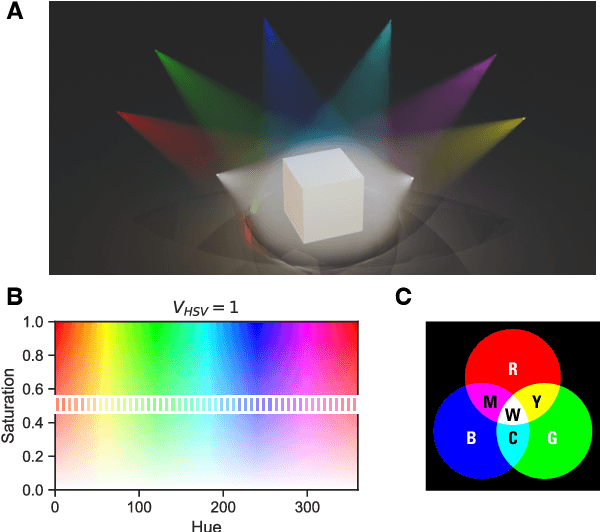

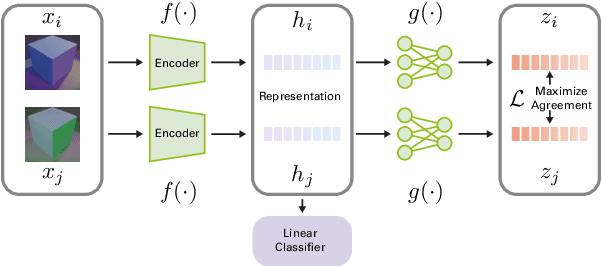
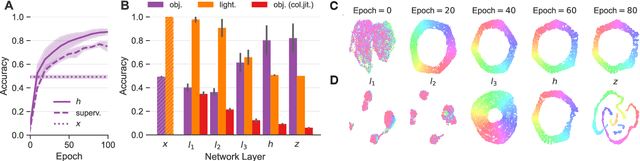
Color constancy (CC) describes the ability of the visual system to perceive an object as having a relatively constant color despite changes in lighting conditions. While CC and its limitations have been carefully characterized in humans, it is still unclear how the visual system acquires this ability during development. Here, we present a first study showing that CC develops in a neural network trained in a self-supervised manner through an invariance learning objective. During learning, objects are presented under changing illuminations, while the network aims to map subsequent views of the same object onto close-by latent representations. This gives rise to representations that are largely invariant to the illumination conditions, offering a plausible example of how CC could emerge during human cognitive development via a form of self-supervised learning.
MIMo: A Multi-Modal Infant Model for Studying Cognitive Development
Dec 07, 2023Human intelligence and human consciousness emerge gradually during the process of cognitive development. Understanding this development is an essential aspect of understanding the human mind and may facilitate the construction of artificial minds with similar properties. Importantly, human cognitive development relies on embodied interactions with the physical and social environment, which is perceived via complementary sensory modalities. These interactions allow the developing mind to probe the causal structure of the world. This is in stark contrast to common machine learning approaches, e.g., for large language models, which are merely passively ``digesting'' large amounts of training data, but are not in control of their sensory inputs. However, computational modeling of the kind of self-determined embodied interactions that lead to human intelligence and consciousness is a formidable challenge. Here we present MIMo, an open-source multi-modal infant model for studying early cognitive development through computer simulations. MIMo's body is modeled after an 18-month-old child with detailed five-fingered hands. MIMo perceives its surroundings via binocular vision, a vestibular system, proprioception, and touch perception through a full-body virtual skin, while two different actuation models allow control of his body. We describe the design and interfaces of MIMo and provide examples illustrating its use. All code is available at https://github.com/trieschlab/MIMo .