 Add to Chrome
 Add to Firefox
 Add to Edge
ARROW: Augmented Replay for RObust World models
Mar 12, 2026
Continual reinforcement learning challenges agents to acquire new skills while retaining previously learned ones with the goal of improving performance in both past and future tasks. Most existing approaches rely on model-free methods with replay buffers to mitigate catastrophic forgetting; however, these solutions often face significant scalability challenges due to large memory demands. Drawing inspiration from neuroscience, where the brain replays experiences to a predictive World Model rather than directly to the policy, we present ARROW (Augmented Replay for RObust World models), a model-based continual RL algorithm that extends DreamerV3 with a memory-efficient, distribution-matching replay buffer. Unlike standard fixed-size FIFO buffers, ARROW maintains two complementary buffers: a short-term buffer for recent experiences and a long-term buffer that preserves task diversity through intelligent sampling. We evaluate ARROW on two challenging continual RL settings: Tasks without shared structure (Atari), and tasks with shared structure, where knowledge transfer is possible (Procgen CoinRun variants). Compared to model-free and model-based baselines with replay buffers of the same-size, ARROW demonstrates substantially less forgetting on tasks without shared structure, while maintaining comparable forward transfer. Our findings highlight the potential of model-based RL and bio-inspired approaches for continual reinforcement learning, warranting further research.

Self-Supervised Learning of Color Constancy
Apr 11, 2024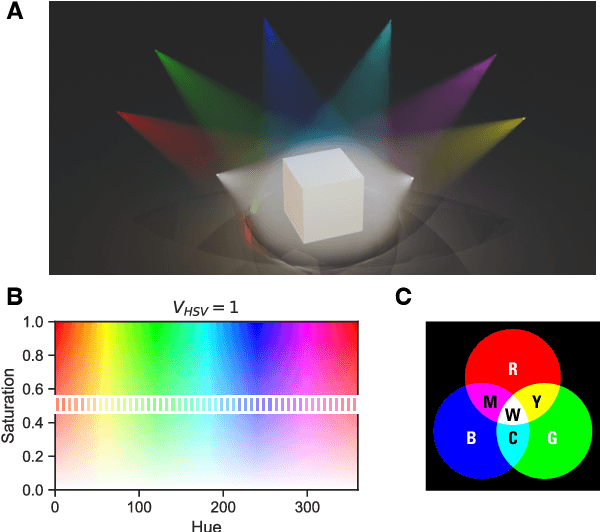

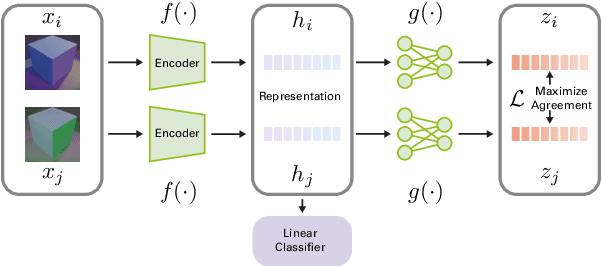
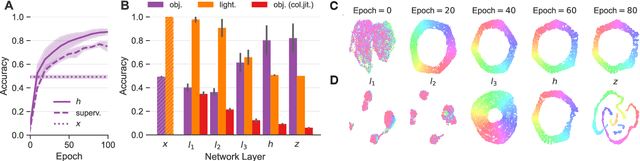
Color constancy (CC) describes the ability of the visual system to perceive an object as having a relatively constant color despite changes in lighting conditions. While CC and its limitations have been carefully characterized in humans, it is still unclear how the visual system acquires this ability during development. Here, we present a first study showing that CC develops in a neural network trained in a self-supervised manner through an invariance learning objective. During learning, objects are presented under changing illuminations, while the network aims to map subsequent views of the same object onto close-by latent representations. This gives rise to representations that are largely invariant to the illumination conditions, offering a plausible example of how CC could emerge during human cognitive development via a form of self-supervised learning.
MIMo: A Multi-Modal Infant Model for Studying Cognitive Development
Dec 07, 2023Human intelligence and human consciousness emerge gradually during the process of cognitive development. Understanding this development is an essential aspect of understanding the human mind and may facilitate the construction of artificial minds with similar properties. Importantly, human cognitive development relies on embodied interactions with the physical and social environment, which is perceived via complementary sensory modalities. These interactions allow the developing mind to probe the causal structure of the world. This is in stark contrast to common machine learning approaches, e.g., for large language models, which are merely passively ``digesting'' large amounts of training data, but are not in control of their sensory inputs. However, computational modeling of the kind of self-determined embodied interactions that lead to human intelligence and consciousness is a formidable challenge. Here we present MIMo, an open-source multi-modal infant model for studying early cognitive development through computer simulations. MIMo's body is modeled after an 18-month-old child with detailed five-fingered hands. MIMo perceives its surroundings via binocular vision, a vestibular system, proprioception, and touch perception through a full-body virtual skin, while two different actuation models allow control of his body. We describe the design and interfaces of MIMo and provide examples illustrating its use. All code is available at https://github.com/trieschlab/MIMo .