 Add to Chrome
 Add to Firefox
 Add to Edge
The Path Matters: Learning a Token-Commitment Policy for Diffusion Language Models
May 23, 2026
Diffusion large language models promise faster generation by refining many token positions in parallel, but this parallelism introduces a hidden control problem: which proposed tokens should be transferred into the partially decoded sequence at each step? We refer to this decision as token commitment. Existing frozen-generator decoders largely rely on hand-designed confidence rules or block-specific acceptance filters. We argue that token commitment can instead be learned as a reusable trace-state policy. We introduce TraceLock, a lightweight plug-in controller that instantiates this policy for a frozen diffusion language model. Since oracle commitment times are unavailable, TraceLock derives self-supervision from future stability: at decoding step t, a proposed token for position i is labeled stable if it matches the final token at position i after the full decoding trace completes. The controller scores variable-length trace states and decides which active token proposals should be committed to the partially decoded sequence. Once trained for a given frozen backbone, the controller can be deployed across local-window widths, generation lengths, and step budgets without retraining or per-setting calibration. Experiments on question answering, mathematical reasoning, and code generation show that TraceLock improves the quality-step tradeoff over heuristic and learned baselines, with particularly stable behavior under cross-setting deployment. Diagnostic analyses show that its decisions are not reducible to scalar confidence, suggesting that frozen diffusion language models expose a learnable space of commitment trajectories beyond confidence-based decoding. Code is available at https://github.com/BobSun98/TraceLock.

Entropy-Lens: The Information Signature of Transformer Computations
Feb 23, 2025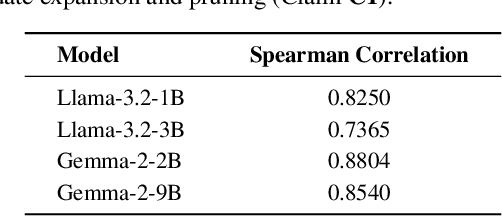
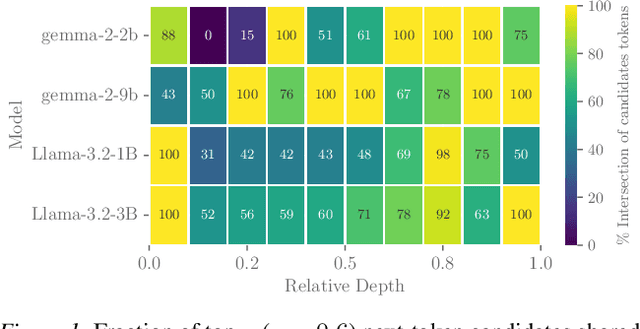
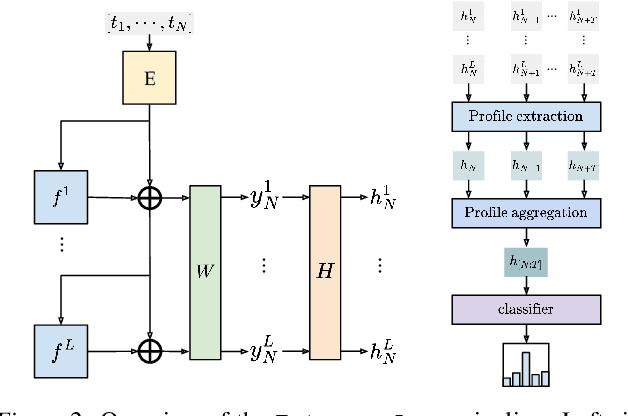
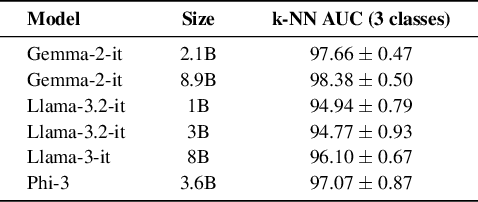
Transformer models have revolutionized fields from natural language processing to computer vision, yet their internal computational dynamics remain poorly understood raising concerns about predictability and robustness. In this work, we introduce Entropy-Lens, a scalable, model-agnostic framework that leverages information theory to interpret frozen, off-the-shelf large-scale transformers. By quantifying the evolution of Shannon entropy within intermediate residual streams, our approach extracts computational signatures that distinguish model families, categorize task-specific prompts, and correlate with output accuracy. We further demonstrate the generality of our method by extending the analysis to vision transformers. Our results suggest that entropy-based metrics can serve as a principled tool for unveiling the inner workings of modern transformer architectures.
Link Prediction under Heterophily: A Physics-Inspired Graph Neural Network Approach
Feb 22, 2024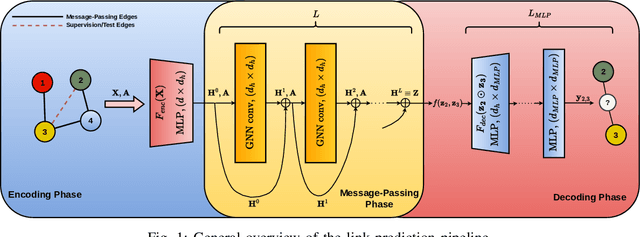
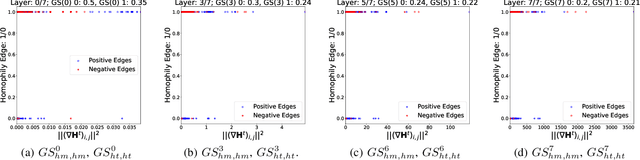
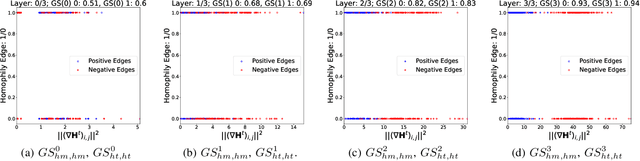
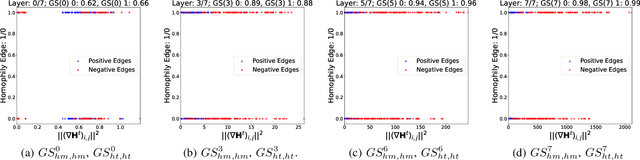
In the past years, Graph Neural Networks (GNNs) have become the `de facto' standard in various deep learning domains, thanks to their flexibility in modeling real-world phenomena represented as graphs. However, the message-passing mechanism of GNNs faces challenges in learnability and expressivity, hindering high performance on heterophilic graphs, where adjacent nodes frequently have different labels. Most existing solutions addressing these challenges are primarily confined to specific benchmarks focused on node classification tasks. This narrow focus restricts the potential impact that link prediction under heterophily could offer in several applications, including recommender systems. For example, in social networks, two users may be connected for some latent reason, making it challenging to predict such connections in advance. Physics-Inspired GNNs such as GRAFF provided a significant contribution to enhance node classification performance under heterophily, thanks to the adoption of physics biases in the message-passing. Drawing inspiration from these findings, we advocate that the methodology employed by GRAFF can improve link prediction performance as well. To further explore this hypothesis, we introduce GRAFF-LP, an extension of GRAFF to link prediction. We evaluate its efficacy within a recent collection of heterophilic graphs, establishing a new benchmark for link prediction under heterophily. Our approach surpasses previous methods, in most of the datasets, showcasing a strong flexibility in different contexts, and achieving relative AUROC improvements of up to 26.7%.
Renormalized Graph Neural Networks
Jun 01, 2023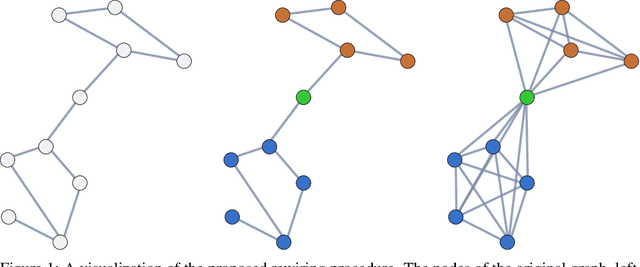
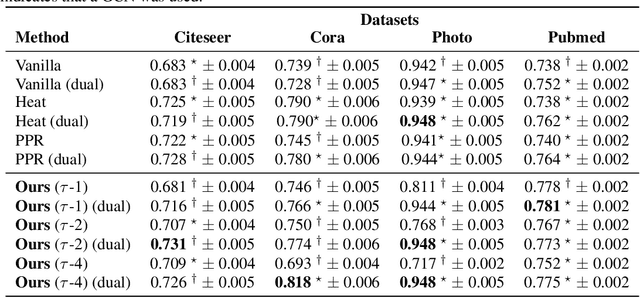
Graph Neural Networks (GNNs) have become essential for studying complex data, particularly when represented as graphs. Their value is underpinned by their ability to reflect the intricacies of numerous areas, ranging from social to biological networks. GNNs can grapple with non-linear behaviors, emerging patterns, and complex connections; these are also typical characteristics of complex systems. The renormalization group (RG) theory has emerged as the language for studying complex systems. It is recognized as the preferred lens through which to study complex systems, offering a framework that can untangle their intricate dynamics. Despite the clear benefits of integrating RG theory with GNNs, no existing methods have ventured into this promising territory. This paper proposes a new approach that applies RG theory to devise a novel graph rewiring to improve GNNs' performance on graph-related tasks. We support our proposal with extensive experiments on standard benchmarks and baselines. The results demonstrate the effectiveness of our method and its potential to remedy the current limitations of GNNs. Finally, this paper marks the beginning of a new research direction. This path combines the theoretical foundations of RG, the magnifying glass of complex systems, with the structural capabilities of GNNs. By doing so, we aim to enhance the potential of GNNs in modeling and unraveling the complexities inherent in diverse systems.