 Add to Chrome
 Add to Firefox
 Add to Edge
LANCER: LLM Reranking for Nugget Coverage
Jan 29, 2026
Unlike short-form retrieval-augmented generation (RAG), such as factoid question answering, long-form RAG requires retrieval to provide documents covering a wide range of relevant information. Automated report generation exemplifies this setting: it requires not only relevant information but also a more elaborate response with comprehensive information. Yet, existing retrieval methods are primarily optimized for relevance ranking rather than information coverage. To address this limitation, we propose LANCER, an LLM-based reranking method for nugget coverage. LANCER predicts what sub-questions should be answered to satisfy an information need, predicts which documents answer these sub-questions, and reranks documents in order to provide a ranked list covering as many information nuggets as possible. Our empirical results show that LANCER enhances the quality of retrieval as measured by nugget coverage metrics, achieving higher $α$-nDCG and information coverage than other LLM-based reranking methods. Our oracle analysis further reveals that sub-question generation plays an essential role.

TrajFusionNet: Pedestrian Crossing Intention Prediction via Fusion of Sequential and Visual Trajectory Representations
Aug 27, 2025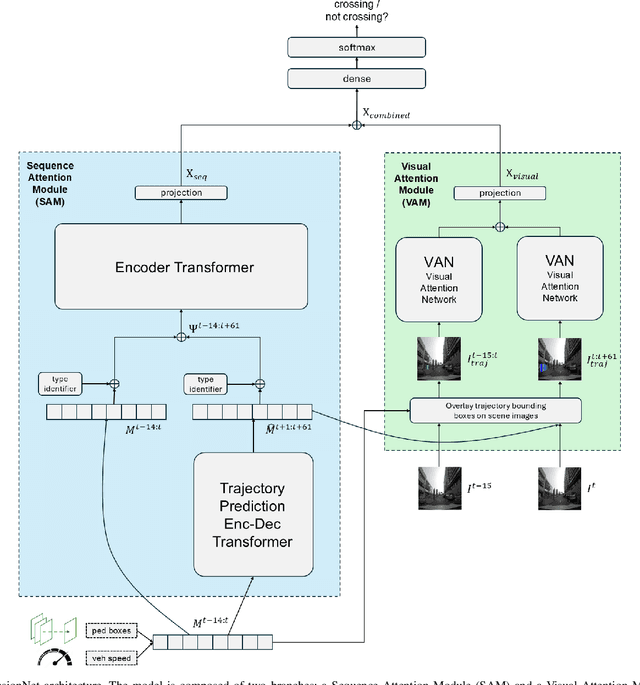
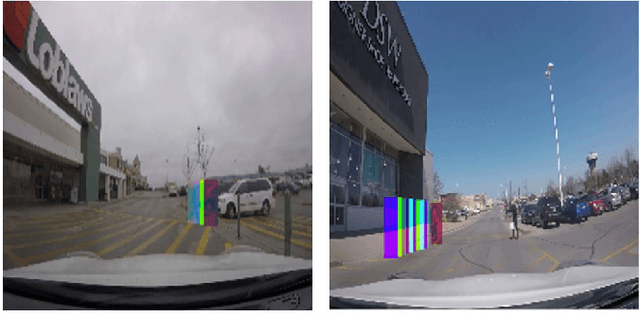
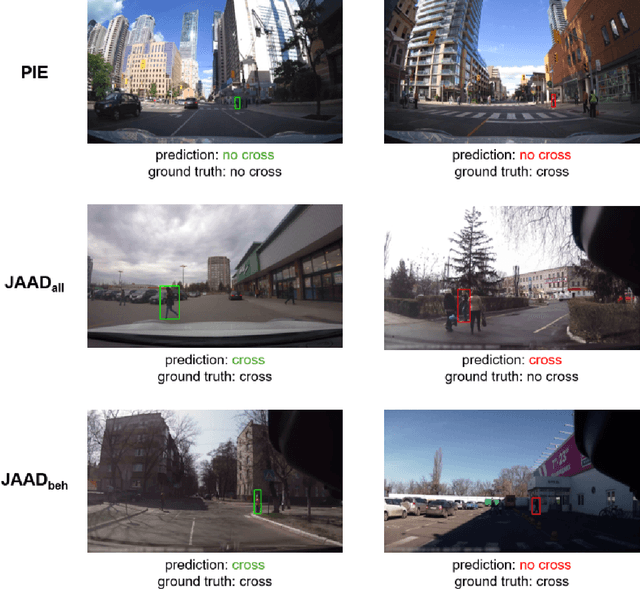
With the introduction of vehicles with autonomous capabilities on public roads, predicting pedestrian crossing intention has emerged as an active area of research. The task of predicting pedestrian crossing intention involves determining whether pedestrians in the scene are likely to cross the road or not. In this work, we propose TrajFusionNet, a novel transformer-based model that combines future pedestrian trajectory and vehicle speed predictions as priors for predicting crossing intention. TrajFusionNet comprises two branches: a Sequence Attention Module (SAM) and a Visual Attention Module (VAM). The SAM branch learns from a sequential representation of the observed and predicted pedestrian trajectory and vehicle speed. Complementarily, the VAM branch enables learning from a visual representation of the predicted pedestrian trajectory by overlaying predicted pedestrian bounding boxes onto scene images. By utilizing a small number of lightweight modalities, TrajFusionNet achieves the lowest total inference time (including model runtime and data preprocessing) among current state-of-the-art approaches. In terms of performance, it achieves state-of-the-art results across the three most commonly used datasets for pedestrian crossing intention prediction.