 Add to Chrome
 Add to Firefox
 Add to Edge
RogueMerge: Robust and Unified Attacks against LLM Model Merging
Jun 02, 2026
Model merging composes specialized capabilities into a single LLM by aggregating task vectors sourced from unverified public platforms, exposing a critical supply-chain attack surface: Because any malicious behavior can be encoded into a task vector, and merging grants third-party vectors direct write access to model weights, an attacker-provided task vector can enable or amplify diverse downstream threats. Prior work studies only backdoor attacks against model merging for classifiers using static arithmetic heuristics, which fail to effectively handle diverse attacks on generative LLMs for three reasons. (i) LLMs rely on autoregressive decoding, where the minor parameter drift introduced by merging compounds across tokens and rapidly degrades the attack. (ii) Attackers have no knowledge of the victim's merging configurations, causing a static attack vector optimized in isolation to be easily diluted or destroyed. (iii) Practical threat induction must generalize to attack prompts unseen during optimization, which static vectors cannot adequately encode. We present RogueMerge, the first principled, unified framework that addresses all three challenges. To handle autoregressive generation, we replace static arithmetic with a joint optimization that explicitly enforces attack success after merging. To handle unknown merging settings, we formulate attack injection as a stochastic min-max problem and solve it via meta-learning-style simulation. To generalize across heterogeneous attack prompts, we employ distributionally robust optimization and derive a tractable first-order Taylor approximation at LLM scale, with a provable error bound. Across four threats, six merging algorithms, and over 170 merged LLMs, RogueMerge consistently outperforms existing attacks. It also remains stable across diverse merging settings and resists standard defenses.

Token Inflation: How Dishonest Providers Can Overcharge for Large Language Model Usage
May 28, 2026Per-token billing is now the standard pricing model for commercial large language models (LLMs), so the honesty of reported token counts directly affects what users pay. We show that this kind of billing is hard to audit by design: providers hide the model, the tokenizer, and the execution to protect their IP, mitigate jailbreaks, and preserve user privacy, which means an auditor can only inspect proofs the provider supplies. The audit therefore reduces to a consistency check on the provider's own reports. We call this a trust paradox: every audit must trust some artifact, but current frameworks trust exactly the ones a provider has the strongest reason to manipulate. We study three recent token auditing frameworks and show that a provider with ordinary commercial capabilities can systematically inflate billed token counts. In the most permissive setting, hidden reasoning usage can be inflated by 1,469% on average without detection. At current frontier reasoning prices, that turns a \$100 honest bill into roughly a \$1,569 bill on the same query. Even when the user can see the full reasoning string, tokenization ambiguity alone still allows 50.85% over-reporting below the detection threshold. These results suggest the problem is not in any specific auditor but in any audit whose evidence comes from the audited party. Restoring honest billing will require verification that ties reported token counts to evidence the provider does not control, such as trusted execution attestation, cryptographic proofs of inference, or third-party re-execution.
What-If World: A Causal Benchmark for General World Models in Embodied Scenarios
May 26, 2026Video generation models are increasingly used as world simulators for tasks like driving and robotic manipulation. What matters in these settings is not whether a single video looks right, but whether the model's output changes when its input changes. We test this by giving a model two prompts describing the same scene with one physical detail varied, and checking whether the two videos diverge the way physics predicts. The wording difference between the prompts is small by design, since only one variable is changed, but the correct physical difference is not. A model that misses this can still produce two videos that each look plausible individually, and existing benchmarks score videos one at a time and cannot detect this failure. We introduce What-If World, 319 such prompt pairs built on real frames from nuScenes and DROID, organized by a taxonomy of six physical variables shared across driving and manipulation. Each pair is scored with APEO, a four-part rubric checking whether each video follows its prompt (Adherence), is physically consistent (Physics), preserves the shared scene (Environment), and ends in the correct difference (Outcome). Across nine state-of-the-art models, no system exceeds 52% on the paired score, and open-source models cluster near 28%. Every model tested fails on a large fraction of causal interventions, indicating substantial room before these models can reliably support action-conditioned simulation or model-based planning. Where models do score well, performance appears to track the visual prominence of the intervention rather than the tractability of its underlying physics. Some visually subtle interventions score as low as 14.2%, while visually pronounced ones reach 40.4%.
LASH: Adaptive Semantic Hybridization for Black-Box Jailbreaking of Large Language Models
May 20, 2026Jailbreak attacks expose a persistent gap between the intended safety behavior of aligned large language models and their behavior under adversarial prompting. Existing automated methods are increasingly effective but each commits to a single attack family (e.g., one refinement loop, one tree search, one mutation space, or one strategy library) and no single family dominates: the best-performing method shifts across target models and harm categories, suggesting complementary strengths that per-prompt composition could exploit. We introduce LASH (LLM Adaptive Semantic Hybridization), a black-box framework that treats outputs from multiple base attacks as reusable seed prompts and adaptively composes them for each target request. Given a seed pool, LASH searches over seed subsets and softmax-normalized mixture weights; a composition module synthesizes a single candidate prompt, and a derivative-free genetic optimizer updates the weights using black-box target feedback and a two-stage fitness function combining keyword-based refusal detection with LLM-judge scoring. On JailbreakBench, which contains 100 harmful prompts across 10 categories, we evaluate LASH on six common target models. LASH achieves an average attack success rate of 84.5% under keyword-based evaluation and 74.5% under two-stage evaluation, where responses are first filtered for refusals and then scored by an LLM judge for whether they substantively fulfill the original harmful request. LASH outperforms five state-of-the-art baselines on both metrics with only 30 mean target queries. LASH also remains competitive under three defense mechanisms and induces more success-like internal representations. These results suggest that adaptive composition across heterogeneous jailbreak strategies is a promising direction for black-box red-teaming.
HAMLOCK: HArdware-Model LOgically Combined attacK
Oct 22, 2025The growing use of third-party hardware accelerators (e.g., FPGAs, ASICs) for deep neural networks (DNNs) introduces new security vulnerabilities. Conventional model-level backdoor attacks, which only poison a model's weights to misclassify inputs with a specific trigger, are often detectable because the entire attack logic is embedded within the model (i.e., software), creating a traceable layer-by-layer activation path. This paper introduces the HArdware-Model Logically Combined Attack (HAMLOCK), a far stealthier threat that distributes the attack logic across the hardware-software boundary. The software (model) is now only minimally altered by tuning the activations of few neurons to produce uniquely high activation values when a trigger is present. A malicious hardware Trojan detects those unique activations by monitoring the corresponding neurons' most significant bit or the 8-bit exponents and triggers another hardware Trojan to directly manipulate the final output logits for misclassification. This decoupled design is highly stealthy, as the model itself contains no complete backdoor activation path as in conventional attacks and hence, appears fully benign. Empirically, across benchmarks like MNIST, CIFAR10, GTSRB, and ImageNet, HAMLOCK achieves a near-perfect attack success rate with a negligible clean accuracy drop. More importantly, HAMLOCK circumvents the state-of-the-art model-level defenses without any adaptive optimization. The hardware Trojan is also undetectable, incurring area and power overheads as low as 0.01%, which is easily masked by process and environmental noise. Our findings expose a critical vulnerability at the hardware-software interface, demanding new cross-layer defenses against this emerging threat.
Adversarial Hubness in Multi-Modal Retrieval
Dec 18, 2024Hubness is a phenomenon in high-dimensional vector spaces where a single point from the natural distribution is unusually close to many other points. This is a well-known problem in information retrieval that causes some items to accidentally (and incorrectly) appear relevant to many queries. In this paper, we investigate how attackers can exploit hubness to turn any image or audio input in a multi-modal retrieval system into an adversarial hub. Adversarial hubs can be used to inject universal adversarial content (e.g., spam) that will be retrieved in response to thousands of different queries, as well as for targeted attacks on queries related to specific, attacker-chosen concepts. We present a method for creating adversarial hubs and evaluate the resulting hubs on benchmark multi-modal retrieval datasets and an image-to-image retrieval system based on a tutorial from Pinecone, a popular vector database. For example, in text-caption-to-image retrieval, a single adversarial hub is retrieved as the top-1 most relevant image for more than 21,000 out of 25,000 test queries (by contrast, the most common natural hub is the top-1 response to only 102 queries). We also investigate whether techniques for mitigating natural hubness are an effective defense against adversarial hubs, and show that they are not effective against hubs that target queries related to specific concepts.
Understanding Variation in Subpopulation Susceptibility to Poisoning Attacks
Nov 20, 2023Machine learning is susceptible to poisoning attacks, in which an attacker controls a small fraction of the training data and chooses that data with the goal of inducing some behavior unintended by the model developer in the trained model. We consider a realistic setting in which the adversary with the ability to insert a limited number of data points attempts to control the model's behavior on a specific subpopulation. Inspired by previous observations on disparate effectiveness of random label-flipping attacks on different subpopulations, we investigate the properties that can impact the effectiveness of state-of-the-art poisoning attacks against different subpopulations. For a family of 2-dimensional synthetic datasets, we empirically find that dataset separability plays a dominant role in subpopulation vulnerability for less separable datasets. However, well-separated datasets exhibit more dependence on individual subpopulation properties. We further discover that a crucial subpopulation property is captured by the difference in loss on the clean dataset between the clean model and a target model that misclassifies the subpopulation, and a subpopulation is much easier to attack if the loss difference is small. This property also generalizes to high-dimensional benchmark datasets. For the Adult benchmark dataset, we show that we can find semantically-meaningful subpopulation properties that are related to the susceptibilities of a selected group of subpopulations. The results in this paper are accompanied by a fully interactive web-based visualization of subpopulation poisoning attacks found at https://uvasrg.github.io/visualizing-poisoning
SoK: Pitfalls in Evaluating Black-Box Attacks
Oct 26, 2023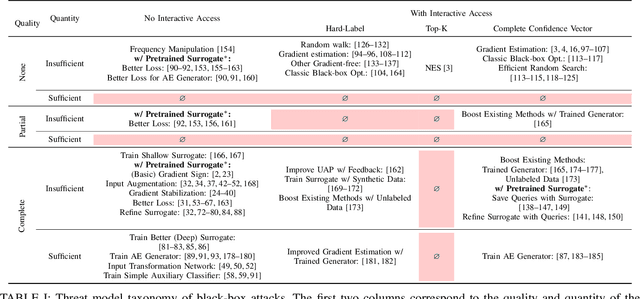
Numerous works study black-box attacks on image classifiers. However, these works make different assumptions on the adversary's knowledge and current literature lacks a cohesive organization centered around the threat model. To systematize knowledge in this area, we propose a taxonomy over the threat space spanning the axes of feedback granularity, the access of interactive queries, and the quality and quantity of the auxiliary data available to the attacker. Our new taxonomy provides three key insights. 1) Despite extensive literature, numerous under-explored threat spaces exist, which cannot be trivially solved by adapting techniques from well-explored settings. We demonstrate this by establishing a new state-of-the-art in the less-studied setting of access to top-k confidence scores by adapting techniques from well-explored settings of accessing the complete confidence vector, but show how it still falls short of the more restrictive setting that only obtains the prediction label, highlighting the need for more research. 2) Identification the threat model of different attacks uncovers stronger baselines that challenge prior state-of-the-art claims. We demonstrate this by enhancing an initially weaker baseline (under interactive query access) via surrogate models, effectively overturning claims in the respective paper. 3) Our taxonomy reveals interactions between attacker knowledge that connect well to related areas, such as model inversion and extraction attacks. We discuss how advances in other areas can enable potentially stronger black-box attacks. Finally, we emphasize the need for a more realistic assessment of attack success by factoring in local attack runtime. This approach reveals the potential for certain attacks to achieve notably higher success rates and the need to evaluate attacks in diverse and harder settings, highlighting the need for better selection criteria.
When Can Linear Learners be Robust to Indiscriminate Poisoning Attacks?
Jul 03, 2023


We study indiscriminate poisoning for linear learners where an adversary injects a few crafted examples into the training data with the goal of forcing the induced model to incur higher test error. Inspired by the observation that linear learners on some datasets are able to resist the best known attacks even without any defenses, we further investigate whether datasets can be inherently robust to indiscriminate poisoning attacks for linear learners. For theoretical Gaussian distributions, we rigorously characterize the behavior of an optimal poisoning attack, defined as the poisoning strategy that attains the maximum risk of the induced model at a given poisoning budget. Our results prove that linear learners can indeed be robust to indiscriminate poisoning if the class-wise data distributions are well-separated with low variance and the size of the constraint set containing all permissible poisoning points is also small. These findings largely explain the drastic variation in empirical attack performance of the state-of-the-art poisoning attacks on linear learners across benchmark datasets, making an important initial step towards understanding the underlying reasons some learning tasks are vulnerable to data poisoning attacks.
Manipulating Transfer Learning for Property Inference
Mar 21, 2023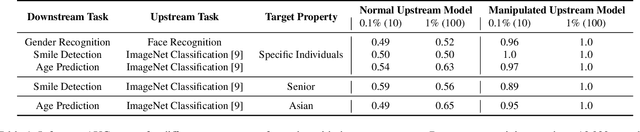
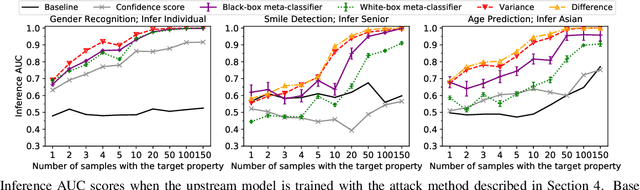
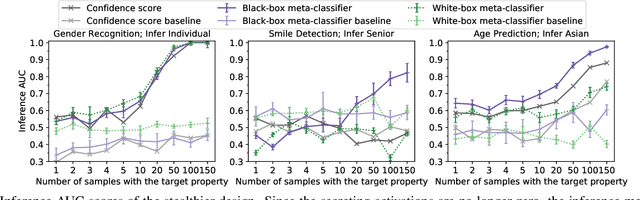
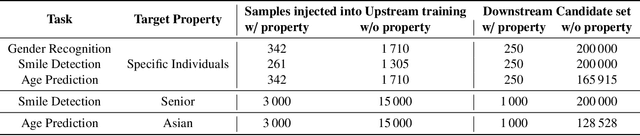
Transfer learning is a popular method for tuning pretrained (upstream) models for different downstream tasks using limited data and computational resources. We study how an adversary with control over an upstream model used in transfer learning can conduct property inference attacks on a victim's tuned downstream model. For example, to infer the presence of images of a specific individual in the downstream training set. We demonstrate attacks in which an adversary can manipulate the upstream model to conduct highly effective and specific property inference attacks (AUC score $> 0.9$), without incurring significant performance loss on the main task. The main idea of the manipulation is to make the upstream model generate activations (intermediate features) with different distributions for samples with and without a target property, thus enabling the adversary to distinguish easily between downstream models trained with and without training examples that have the target property. Our code is available at https://github.com/yulongt23/Transfer-Inference.