 Add to Chrome
 Add to Firefox
 Add to Edge
Vehicular Wireless Positioning -- A Survey
Jan 28, 2026
The rapid advancement of connected and autonomous vehicles has driven a growing demand for precise and reliable positioning systems capable of operating in complex environments. Meeting these demands requires an integrated approach that combines multiple positioning technologies, including wireless-based systems, perception-based technologies, and motion-based sensors. This paper presents a comprehensive survey of wireless-based positioning for vehicular applications, with a focus on satellite-based positioning (such as global navigation satellite systems (GNSS) and low-Earth-orbit (LEO) satellites), cellular-based positioning (5G and beyond), and IEEE-based technologies (including Wi-Fi, ultrawideband (UWB), Bluetooth, and vehicle-to-vehicle (V2V) communications). First, the survey reviews a wide range of vehicular positioning use cases, outlining their specific performance requirements. Next, it explores the historical development, standardization, and evolution of each wireless positioning technology, providing an in-depth categorization of existing positioning solutions and algorithms, and identifying open challenges and contemporary trends. Finally, the paper examines sensor fusion techniques that integrate these wireless systems with onboard perception and motion sensors to enhance positioning accuracy and resilience in real-world conditions. This survey thus offers a holistic perspective on the historical foundations, current advancements, and future directions of wireless-based positioning for vehicular applications, addressing a critical gap in the literature.

Optimal Spatial Signal Design for mmWave Positioning under Imperfect Synchronization
May 17, 2021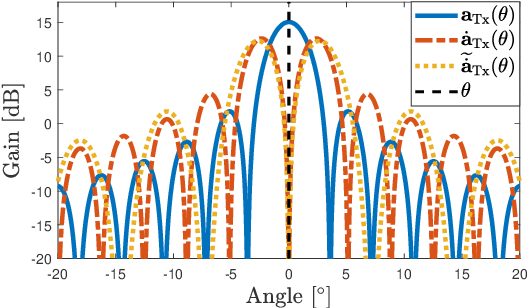
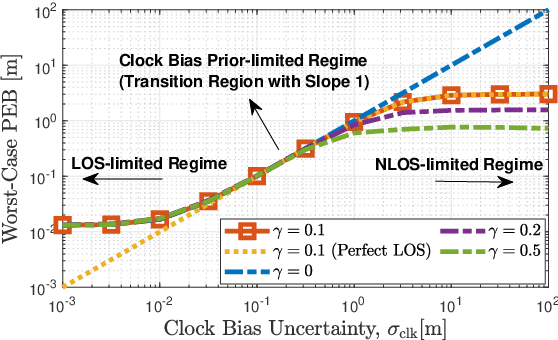
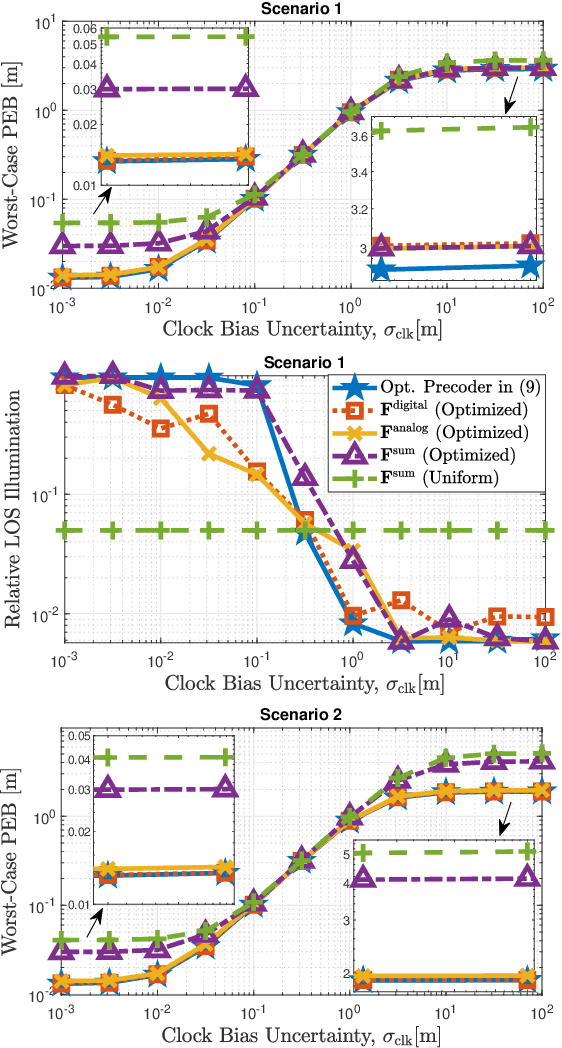
We consider the problem of spatial signal design for multipath-assisted mmWave positioning under synchronization errors and location uncertainties. First, the optimal precoder is shown to lie in a low-dimensional subspace spanned by directional and derivative beams pointing towards the existing paths. Under imperfect knowledge of path parameters, we propose an optimal robust design and a codebook-based heuristic design with optimized beam power allocation by exploiting the low-dimensional structure. Through numerical results, we characterize three different position error bound (PEB) regimes with respect to clock bias uncertainty and show that the proposed low-complexity codebook-based designs outperform the conventional directional beam codebook and achieve near-optimal PEB performance.